IBC vs Homebuyers: Supreme Court and Homes Before Haircuts
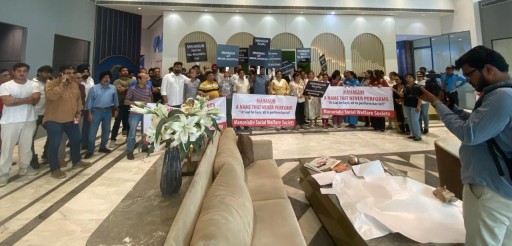
Protest of home buyers at the office of Mahagun Builder in Noida (Image credit Homebuyers of Mahagun Monorialle project)
In a landmark real estate reset, the Supreme Court signals that insolvency is resolved only when homes are delivered—not when balance sheets are rearranged
By P. SESH KUMAR
New Delhi, February 6, 2026 — For years, India’s Insolvency and Bankruptcy Code (IBC) has promised resolution but delivered paperwork—especially in real estate. Towers stood frozen, cranes rusted, and families aged while “resolution plans” travelled between committees and courts.
The October 2025 Mint article ‘A House for Mr. Vishwas’ by Dr Praveen Tiwari and Mr G.N. Bajpai called out this legal fiction bluntly: a housing project is not resolved when balance sheets are rearranged—it is resolved only when keys are handed over. The recent observations of the Supreme Court of India in the Supertech homebuyers matter appear to finally bring judicial muscle to this simple truth.
By placing delivery of homes before settlement of financial and operational creditors, the Court has punctured the core illusion of IBC-driven real estate resolution. This note attempts to critically examine why the old approach failed homebuyers, how insolvency law drifted away from social reality, and whether the Court’s intervention can finally realign law with lived justice.
For nearly a decade, our insolvency framework treated stalled housing projects like failed steel plants or bankrupt airlines. Numbers mattered. Possession didn’t. Resolution professionals obsessed over haircut percentages, creditor hierarchies, and balance-sheet triage while lakhs of families remained trapped in half-built dreams-paying EMIs for homes that existed only in glossy brochures.
The Mint article of 7 October 2025 cut through this technocratic fog with devastating simplicity: in real estate, liquidation is not failure—it is cruelty. When a factory shuts, machines can be sold. When a housing project collapses, human lives collapse with it. Children grow up in rented homes their parents never planned for, savings evaporate, marriages are postponed, and retirements shrink.
Yet the IBC’s operating logic quietly normalised liquidation as an acceptable outcome if no “viable resolution applicant” emerged.
In other words: if no investor found profit in finishing your home, tough luck.
The law behaved as though homebuyers were merely another creditor class-statistically important but emotionally invisible.
This is where the article made its most powerful intervention. It argued that housing insolvency is not about recovering money; it is about completing shelter. The moment IBC treats a half-built flat like a defaulted loan asset, justice loses its soul. Real estate resolution must be measured in bricks laid, not crores recovered.
What makes the recent Supreme Court observation so momentous is not just its legal impact—it is its moral clarity.
By stating that financial and operational creditors’ claims can be addressed only after fully furnished homes are delivered, the Court appears to have inverted the entire insolvency pyramid in real estate cases. For the first time, possession is not a side effect of resolution. It is the resolution.
This quietly demolishes three destructive assumptions that haunted IBC implementation in housing.
First, it exposes the fiction that liquidation is neutral. In reality, liquidation in real estate doesn’t redistribute value-it destroys it. Half-built towers fetch scrap prices while wiping out middle-class life savings.
Second, it ends the moral absurdity where banks could recover loans before families received roofs, even though those loans were often secured precisely against the same unfinished projects.
Third, it recognises that homebuyers are not speculative investors-they are end-users of a constitutional necessity: shelter.
The IBC was born to rescue businesses, not abandon citizens.
Yet for years, real estate insolvency became a playground for distressed asset funds, where stalled projects were seen as land banks rather than human habitats. Resolution plans focused on monetisation, not completion. Developers with better lawyers survived; buyers with weaker voices waited.
The Mint article foresaw this drift and warned that unless possession became the central legal objective, insolvency would simply formalise injustice.
The Court has now echoed that warning. But celebration must be cautious. Because the deeper problem is not only legal—it is structural.
IBC was designed around cash-flow businesses, not asset-heavy housing projects involving thousands of retail consumers. Its committee-of-creditors model privileges institutional lenders by voting power. Homebuyers were later added as financial creditors, but without practical influence or organisational capacity. In theory they had votes. In practice they had chaos.
Resolution professionals focused on creditor recoveries because that is how success is measured under insolvency law. No metric exists for social harm avoided, family stability preserved, or homes delivered.
So the system naturally optimised for money, not justice. The Supreme Court’s intervention tries to bend this financial machinery toward human outcomes—but it will face resistance.
Banks will argue cash flow constraints. Investors will worry about delayed recoveries. Resolution applicants will demand stronger guarantees. And some will quietly push cases back toward liquidation under technical pretexts.
This is why judicial sentiment alone is not enough. Real estate insolvency requires a specialised framework within IBC—or even outside it—that recognises housing as a social contract, not just a commercial asset.
Globally, consumer-centric insolvency models in housing prioritise project completion through escrow protections, ring-fenced funds, step-in developers, and state-backed completion mechanisms. India experimented partially through RERA escrow norms, but insolvency often bypassed these safeguards.
Can we deny that IBC overrode real estate regulation instead of complementing it?
The result was legal schizophrenia-consumer law promised possession, insolvency law delivered spreadsheets.
The Mint article’s brilliance lay in pointing out that trust in housing markets cannot be restored through faster tribunals alone. It can only be rebuilt when the legal system makes delivery non-negotiable.
The Court appears to have, now, taken a step in that direction. But the battle ahead is operational. Who funds completion when developers collapse? How are partially diverted funds recovered? Who supervises construction quality? How are timelines enforced?
Without institutional answers, even well-meaning intentions and even orders, risk becoming symbolic.
Course Correction Prescription
Government must formally recognise real estate insolvency as a distinct category where completion overrides monetisation. Resolution plans should be statutorily required to prioritise construction funding before creditor settlements. Escrow accounts must survive insolvency, not dissolve into the general asset pool. Government-backed completion funds—recoverable later from asset sales or promoter clawbacks—can bridge funding gaps. Homebuyer representation must be professionally organised rather than fragmented across thousands of individuals. Most importantly, liquidation in housing projects should become the rarest exception, not the default escape.
IBC ‘saved’ many corporations. Though in another context, SC appears to have recently remarked that “Unfortunately, the IBC platform is now being misused like anything, you get the company’s all assets undervalued, then you indulge in a kind of an auction, which is also a completely pre-planned game, somebody from the family or the close friends comes and buys it.”
In the present context of real estate, it may not be incorrect to say that it nearly buried millions of homeowners.
The Supreme Court has reminded the system of a forgotten truth: A house is not a financial instrument. It is a life.
If insolvency law finally internalises this, our real estate sector may recover not just capital-but credibility. And perhaps, after years of legal jargon and delayed dreams, “resolution” will finally mean what ordinary people always thought it meant: getting home.
(This is an opinion piece. Views expressed are author’s own.)
Follow The Raisina Hills on WhatsApp, Instagram, YouTube, Facebook, and LinkedIn




About The Author