How the RSS Model Is Fueling Jamaat’s Rise in Bangladesh
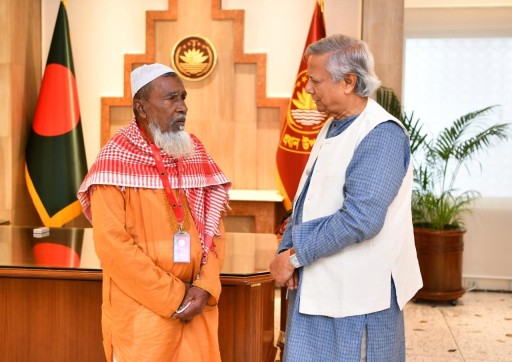
Chief Advisor of Interim Govt in Bangladesh Muhammed Yunus. Image credit @ChiefAdviserGoB
From welfare politics to organisational discipline, why Jamaat is being seen as Bangladesh’s ‘party with a difference’
By NIRENDRA DEV
Guwahati, FEBRUARY 10, 2026 — As electioneering intensifies in Bangladesh ahead of the February 12 polls, anxiety within the political establishment is becoming increasingly visible. BNP acting chairman Tarique Rahman’s recent warnings about “covert forces” allegedly preparing fake ballot seals underline a deeper concern: the electoral ground beneath traditional parties is shifting.
“You must stay alert… so that these covert forces cannot confuse the people,” Tarique Rahman told party workers at an election meeting in Dhaka.
Behind such cautionary rhetoric lies an unmistakable reality—the unprecedented political surge of Jamaat-e-Islami since August 2024. While most surveys still project the Bangladesh Nationalist Party (BNP) as the frontrunner, the scale and momentum of Jamaat’s rise has sparked serious debate: could a Jamaat-led alliance still upset the race?
The Jamaat Surge: An Unexpected Political Moment
Few developments in recent Bangladeshi politics have been as striking as Jamaat’s rapid resurgence. Marginalised for years under the Awami League, the Islamist party has managed to convert political vacuum into “significant political goodwill.” The reason, many analysts argue, lies not in ideology alone—but in method.
Increasingly, observers are drawing parallels with India’s RSS–BJP organisational model.
Welfare Politics, Not Street Power
Since 2024, Jamaat has aggressively pivoted to welfare-centric politics—charitable outreach, financial assistance, and grassroots engagement across multiple sectors. The party has consciously projected itself as an organised, disciplined force, in sharp contrast to Bangladesh’s long-standing culture of violent street politics.
This has resonated particularly with the urban and semi-urban middle class, long disillusioned with what they see as the hooliganism of mainstream parties. The comparison with the BJP’s early “party with a difference” image is hard to miss.
Probity as Political Capital
Another cornerstone of Jamaat’s rise is its carefully cultivated reputation for probity and corruption-free politics. Both the Awami League and BNP carry heavy baggage of corruption allegations. When Sheikh Hasina’s government fell, many Bangladeshis hoped the collapse would end syndicate-driven extortion and rent-seeking politics.
That hope was quickly dented.
Sources suggest that since 2024, extortion networks once controlled by Awami League cadres were swiftly taken over by BNP-aligned groups. Jamaat, however, has largely escaped such accusations—further reinforcing its image as an outsider to entrenched patronage systems.
Learning from Crisis: The Welfare Push After Awami League’s Fall
Following the fall of the Awami League, hundreds of families mourned lost relatives, while thousands nursed serious injuries. Jamaat moved with institutional precision—identifying affected families and offering direct support.
Reports suggest bereaved households received at least Tk 100,000 each, along with financial and logistical assistance to the injured through hospital visits. While individual BNP leaders offered help, their efforts lacked scale and coordination.
In political optics, Jamaat clearly won that moment.
1971: A Fading Political Weapon?
Jamaat’s historical baggage—its alleged collaboration with Pakistani forces in 1971—remains real. Yet for a younger, economically anxious electorate, the Liberation War is increasingly distant and abstract.
Several factors explain this shift. Senior Jamaat leaders accused of 1971-era crimes were convicted and executed during Awami League rule. With the party’s collapse, its long-used narrative of repeatedly invoking Jamaat’s war legacy has lost potency.
This mirrors another parallel often drawn in India: the way the BJP and RSS are repeatedly forced to defend historical positions, even as younger voters prioritise present-day governance and opportunity.
Organisational Discipline: The RSS Parallel
Perhaps the strongest similarity lies in organisational discipline. Almost immediately after the fall of the Awami League, Jamaat began preparing for elections with methodical seriousness.
The party invested heavily in door-to-door outreach, especially in rural areas—an approach strikingly reminiscent of the RSS’s long-standing grassroots mobilisation model. Face-to-face engagement, cadre-based campaigning, and message discipline have given Jamaat a structural edge over rivals relying largely on money and muscle.
Jamaat as the Party of ‘Change’
Post-Hasina Bangladesh is marked by a powerful public craving for change—from autocracy, corruption, and what many describe as the country’s “tired old politics.”
In a straight contest between BNP and Jamaat, it is Jamaat that, for many voters, more convincingly embodies renewal. Its outsider status, distance from entrenched syndicates, and emphasis on welfare over patronage have positioned it as a credible alternative.
Whether this momentum translates into electoral victory remains uncertain. But one thing is clear: Jamaat’s rise is not accidental. It is the product of disciplined organisation, welfare politics, and reputation-building—an approach uncannily similar to the RSS-inspired model that transformed the BJP in India.
(This is an opinion piece. Views expressed are author’s own.)
Follow The Raisina Hills on WhatsApp, Instagram, YouTube, Facebook, and LinkedIn




About The Author