‘Hindu Suffering Won’t End by Silence’: Mohan Bhagwat in Kolkata
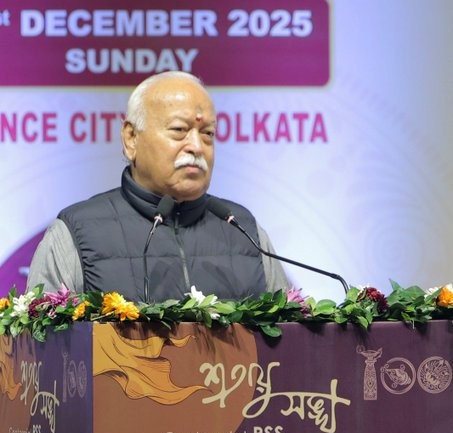
RSS chief Mohan Bhagwat in Kolkata on Sunday (Image RSS on X)
RSS chief avoids electoral talk, stresses social organisation, empathy, and India’s responsibility toward vulnerable Hindus
By TRH Political Desk
New Delhi, December 21, 2025 — Rashtriya Swayamsewak Sangh chief Mohan Bhagwat on Sunday urged upon Hindus in Bangladesh to unite to face the ongoing violence. He also said that “India being the only country for Hindus has a moral responsibility for the protection of the minorities in neighbouring nations.”
Bhagwat’s remarks were pointed to situations prevailing in Bangladesh. A Hindu man was lynched to death and burnt by a mob in Neymensingh in Bangladesh. The RSS chief expressed concerns at the situations in Bangladesh.
His message was pointed, restrained, and deliberately non-electoral. Asked when the “plight of Hindus” would end, the RSS chief did not offer slogans or timelines. Instead, he offered something rarer in contemporary discourse: a social diagnosis.
Bhagwat’s central argument was simple. Suffering does not end automatically. It ends when society develops samvedana—empathy—and the collective will to correct unjust circumstances. Where Hindus face adversity, he argued, the first line of defence must be social unity. Organisation, not outrage, is what creates protection. “If Hindu society stands together,” he said, “conditions can change—and quickly.”
Importantly, Bhagwat widened the responsibility beyond borders. Hindus living under pressure outside India, he noted, deserve support—but within limits of dignity and law. Yet he was unequivocal on one point: India is the only Hindu homeland. Therefore, the Government of India cannot escape responsibility, he suggested. “It must take cognisance, act where possible, and accept that some actions cannot be publicly disclosed,” added Bhagwat while speaking in Kolkata as part of his centenary speeches. Results, he admitted, are not always immediate—but effort is non-negotiable.
What stood out was what Bhagwat refused to do. When pressed on political change in West Bengal, he drew a clear line. Political transformation, he said, is not his mandate. The RSS works for social change. Decisions about power belong to society—and ultimately to voters, he added. A transformed society, he argued, will know what choices to make.
In an era where religious identity is routinely weaponised for electoral gain, Bhagwat’s insistence on separating social mobilisation from party politics seems strategic. It places accountability squarely on citizens rather than saviours. It also shifts the debate from “who should rule” to “what kind of society are we building.”
Whether one agrees with his worldview or not, Bhagwat’s Kolkata speech underscores a hard truth: without social cohesion, neither law nor politics can guarantee security. And without state responsibility, social unity alone is never enough.
Bangladesh’s Counterrevolution: Toppling Hasina Delivered Chaos
Follow The Raisina Hills on WhatsApp, Instagram, YouTube, Facebook, and LinkedIn




About The Author




That the Raisina Hill has chosen to give publicity to Bhagvat is understandable, though doesn’t deserve appreciation
Why this bloke, Bhagvat, had to make such a speech in Kolkata is easy to understand as elections to Bengal assembly are forthcoming despite all protestations of the RSS about being a “cultural” front
When the RSS says culture it is actually an affront to culture