


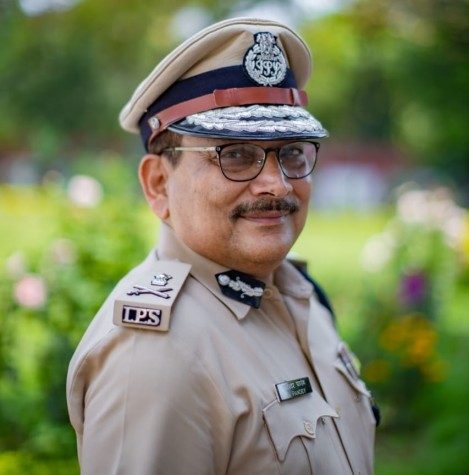
In a striking on-camera statement, the former Director General of Police names a one-time SP of Betia — an Andhra Pradesh cadre IPS officer on deputation — as the man who allegedly struck a deal with dacoit gangs that quietly transformed Bihar’s crime landscape for decades.
By AMIT KUMAR
Patna, April 2, 2026 — Gupteshwar Pandey, former Director General of Police of Bihar, has made one of the most specific and consequential accusations about the origins of organised kidnapping in the state — naming a serving IPS officer of the Andhra Pradesh cadre as the man whose alleged arrangement with criminal gangs gave birth to Bihar’s kidnapping-for-ransom culture.
“I am saying this on record,” Pandey said in the video statement now circulating widely. “Kidnapping in Bihar started from here. And every old police officer knows this.”
According to Pandey, the officer in question — identified as an IPS officer surnamed Yadav, from the Andhra Pradesh cadre, posted on deputation as Superintendent of Police in Bettiah in the West Champaran district — faced intense pressure from police headquarters over a surge in dacoity in the region.
Unable to control the large and well-organised dacoit gangs operating across the Bagaha-Bettiah belt, the officer allegedly reached out to gang leaders directly and brokered an informal understanding: stop the dacoities, and in exchange, the police would look the other way on a new, quieter crime.
“He told the criminals — there is too much pressure on me because of the dacoities. If you stop dacoity, how will you live, how will you eat?” Pandey said. “So he told them — quietly pick up wealthy people, take money, and release them. And that is where kidnapping began in Bihar.”
Pandey’s account, if accurate, describes how a localised police-criminal accommodation metastasised into the defining organised crime of an era. The “catch the rich, take money, release” model required no weapons heists, produced no bodies that demanded immediate police response, and generated reliable income for criminal networks.
From Bettiah, Pandey said, the model spread slowly and steadily across Bihar — eventually becoming the state’s signature criminal economy through the 1980s and 1990s, when Bihar was synonymous nationally with kidnapping-for-ransom at an industrial scale.
“This is history,” Pandey said. “It spread gradually across all of Bihar.”
Pandey credited Chief Minister Nitish Kumar with dismantling what he called the “culture” that had taken root — suggesting the problem had become so entrenched it was no longer simply a law enforcement failure but a systemic norm that required political will to reverse.
“When Nitish Kumar came, he ended this culture,” Pandey said.
Pandey is not a marginal voice. He served as Bihar’s DGP — the state’s top police officer — and subsequently entered politics, contesting the 2020 Bihar assembly elections as a BJP-aligned candidate before withdrawing. His willingness to name a specific officer, a specific posting, a specific cadre, and to assert that serving and retired officers are aware of the facts, gives the allegation an institutional weight that distinguishes it from political rhetoric.
The officer named has not responded publicly. The Bihar government has not commented. The Andhra Pradesh cadre has not issued a statement.
Pandey’s repeated emphasis — “I am saying this on record, I am saying this again and again, it was started by one SP” — reads as a deliberate attempt to prevent the claim from being dismissed or quietly absorbed. He appears to be inviting scrutiny, not avoiding it.
The claim is, at this stage, an accusation made by a single former official in a video statement. The named officer’s version of events is not known. Whether the arrangement Pandey describes was explicit or tacit, ordered or emergent, remains unestablished. Bihar’s kidnapping epidemic of the late 20th century had multiple drivers — land conflict, caste violence, political patronage of criminal networks — and attributing its origins to one officer’s decision is a simplification that historians and criminologists would likely qualify.
What is not in doubt is that Pandey has made a specific, named, on-record allegation about the institutional origins of a crime that shaped a generation’s perception of Bihar — and has called on others who were present to confirm it.
End of an Era: Nitish Kumar Quits Bihar Council, What Comes Next
Follow The Raisina Hills on WhatsApp, Instagram, YouTube, Facebook, and LinkedIn




