Geopolitics Is Repeating History: AI Feels More 1906 Than Sci-Fi
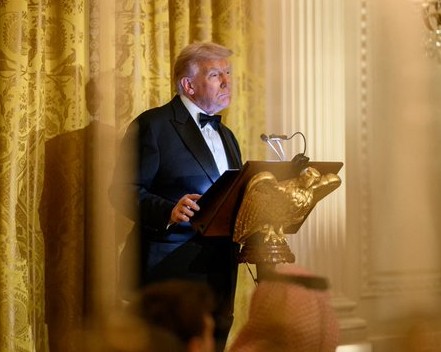
US Presdent Donald trump at a welcome ceremony for Saudi Arabia Crown Prince Mohammed bin Salman. (Image The White House on X)
Niall Ferguson warns the world is turning the political clock back 120 years, as Amitav Acharya asks whether a Western-dominated, racist, imperial order is being quietly resurrected.
By TRH World Desk
New Delhi, January 5, 2026 — Is the world marching forward—or sleepwalking backward?
In a widely discussed X thread amplifying his article in The Free Press, historian Niall Ferguson delivers a chilling diagnosis of our moment: the ejection of Nicolás Maduro from Caracas—real or imagined—symbolises something far bigger than regime change. It marks a collective return to the early 20th century worldview, when empire, tariffs, arms races, and moral absolutism defined global politics.
“The issues of our time,” Ferguson argues, “are the issues our great-grandfathers debated 120 years ago.”
From tariffs and food prices to immigration restriction, antisemitism, socialism, corruption, vaccines, and arms races, Ferguson sees a world replaying old arguments with new tools—but unchanged instincts. Even the age of artificial intelligence, he provocatively claims, is less futuristic than Victorian.
Technology has not transformed politics. It has merely amplified inequality, recreating what Neal Stephenson foresaw in The Diamond Age: a neo-Victorian elite culture, where cutting-edge tools coexist with feudal power structures.
AI, But With Imperial DNA
Ferguson’s most unsettling insight is that AI does not herald a sci-fi future. Instead, it mirrors the late 19th century—when innovation served empire, hierarchy, and control rather than emancipation. In that sense, the digital revolution is not disruptive enough. It is obedient to old power.
But this is where Amitav Acharya, one of the world’s most influential geopolitics observers, issues a sharp counter-warning.
History Repeating—or History Being Chosen?
Acharya reminds us that the early 1900s were not neutral times. They were defined by a Western-dominated global order, racial hierarchy, and resource imperialism.
The United States, then rising as a global power, ruled or controlled the Philippines, Hawaii, Puerto Rico, and Cuba, while President Theodore Roosevelt strengthened the Monroe Doctrine and openly justified the expulsion of native populations. Filipinos, Roosevelt told Congress, were “pirates and head-hunters” undeserving of independence.
Acharya’s question is not merely historical. It is normative—and urgent: Do we really want this history to repeat itself?
If today’s geopolitical reset mirrors 1906, then the return of great-power arrogance, racialised moral claims, and resource-driven intervention is not an accident. It is a choice.
The Fork in the Road
Ferguson sees inevitability: politics reverting to type.
Acharya sees agency: the possibility of alternative pathways drawn from “other histories”—ones that reject racism, imperial domination, and moral hypocrisy.
The real danger is not that the world resembles the past. The real danger is that we recognise the pattern—and still accept it.
As AI accelerates power concentration, as wars multiply, and as old empires rediscover their appetite, the question is no longer whether history is repeating—but whose history is being revived, and who pays the price.
US in Latin America: Why Venezuela Is Just the Latest Target
Follow The Raisina Hills on WhatsApp, Instagram, YouTube, Facebook, and LinkedIn




About The Author