G20 CSAR: India Calls for Equity-Based Global STI Framework
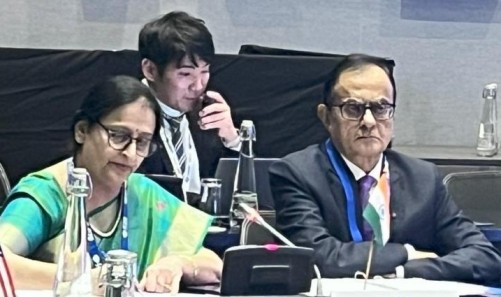
India at G20 CSAR (Image PIB)
At the G20-CSAR 2025 in South Africa, India’s Principal Scientific Adviser Prof. Ajay Sood urged global collaboration to bridge AI and digital divides, promote inclusive energy transition, and strengthen STI capacity in developing nations.
By TRH News Desk
NEW DELHI, September 22, 2025 —The 2025 edition of the G20 Chief Science Advisers’ Roundtable (CSAR) convened in Pretoria, South Africa, under the theme “Equity-based Science, Technology and Innovation (STI) for Inclusive Human Development and Global Sustainability.” The roundtable, hosted by South Africa’s Department of Science, Technology and Innovation (DSTI) and the National Advisory Council on Innovation (NACI), was a continuation of the initiative launched during India’s G20 Presidency in 2023.
India was represented by Principal Scientific Adviser (PSA) Prof. Ajay Kumar Sood, Scientific Secretary Dr. Parvinder Maini, and Chief Policy Adviser Dr. B. Chagun Basha. Delegates from all G20 members, guest countries, and UNESCO as knowledge partner, participated.
The discussions focused on three priority areas:
- Advancing a global STI agenda to support SDGs and enable a just energy transition.
- Building an equitable and open global knowledge system.
- Strengthening STI capacity in Africa and developing countries.
Prof. Sood highlighted the disparities in AI development, stressing that concentration of computational power and data in a few regions perpetuates systemic biases. He called for collaborative frameworks to democratize AI access, citing India’s initiatives like One Nation One Subscription (ONOS), I-STEM, and RuTAG Smart Villages as scalable models for inclusive STI.
Dr. Maini emphasized the need for equitable knowledge access and continuity of CSAR beyond rotating presidencies, urging member states to treat the outcome statement as a living document driving real-world impact.
The Outcome Statement, adopted unanimously, recommended leveraging global STI partnerships to address planetary crises such as climate change, biodiversity loss, pollution, and energy access gaps, while promoting open, collaborative research ecosystems.
Following CSAR, Prof. Sood participated in the UNESCO MOST Forum 2025, where he underscored India’s approach to AI for inclusive social transformation. He outlined the upcoming India AI Impact Summit (Feb 2026) as a platform for global cooperation on AI governance.
On the sidelines, the Indian delegation engaged in bilateral meetings with the UK, Italy, and the EU to deepen partnerships in areas such as quantum technologies, big data, AI collaboration, and supercomputing.
With equity and sustainability at its core, G20-CSAR 2025 reinforced the role of science advice in shaping inclusive global policies and bridging the digital divide.
Follow The Raisina Hills on WhatsApp, Instagram, YouTube, Facebook, and LinkedIn




About The Author