Frontier Nagaland Territorial Authority: A Lesson from Kohima
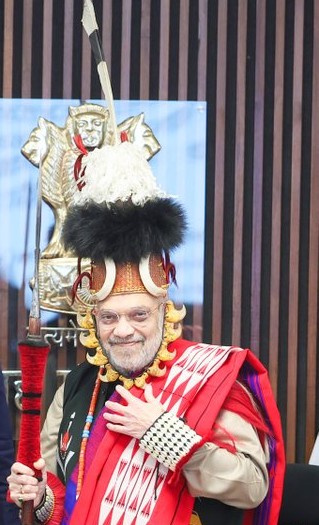
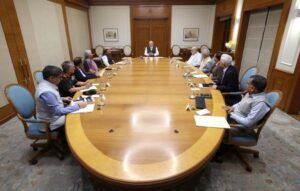
Union Minister for Home Affairs Amit Shah at the signing of tripartite Naga agreement in New Delhi (Image PIB)
Tripartite FNTA agreement marks a governance breakthrough in Nagaland even as Manipur’s ethnic wounds deepen
By NIRENDRA DEV
Kohima, February 6, 2026 — A new chapter has been written for the Nagas.
On February 5, a tripartite Memorandum of Agreement was signed in New Delhi between the Government of India, the Government of Nagaland, and representatives of the Eastern Nagaland Peoples’ Organisation (ENPO), paving the way for the creation of the Frontier Nagaland Territorial Authority (FNTA).
The agreement—inked in the presence of Union Home Minister Amit Shah and Nagaland Chief Minister Neiphiu Rio—covers six eastern districts: Tuensang, Mon, Kiphire, Longleng, Noklak and Shamator, with the FNTA receiving devolution of powers over 46 subjects. Describing the moment as a step towards a “dispute-free Northeast”, Shah framed it as both political closure and administrative foresight.
The timing is politically loaded. This breakthrough, after years of negotiations that began during the UPA era (2011–12), comes when neighbouring Manipur continues to reel under unresolved ethnic conflict. The contrast is stark—and impossible to ignore.
A Governance Signal from Nagaland
Among Northeast watchers, the FNTA deal is already being cited as an example of governance-driven conflict management. The Modi government, it is argued, demonstrated the political will to address long-standing grievances of far-flung, development-deficit regions without letting negotiations drift endlessly.
One refrain is unavoidable: Nagaland has offered Manipur a lesson—that dialogue, flexibility, and administrative imagination can succeed where street politics and hardened postures fail.
Since 2023, Manipur has suffered what many describe as a lost period, with ethnic polarisation deepening and the Kuki demand for a separate administrative arrangement remaining unresolved. Yet officials in New Delhi maintain that the Centre remains open to a mutually acceptable solution for all communities there.
A retired military officer puts it bluntly: “Glorifying the turmoil of 2023 as a political foundation is an invitation to chaos. The Government of India will now have to work harder in Manipur.”
Eastern Nagas Choose Pragmatism
In Nagaland, however, optimism is palpable. “For the first time, Nagas are celebrating a solution,” says one observer. “Eastern Nagas may be backward in development, but they have shown the courage to think forward. This could be a catalyst for the larger Naga political solution.”
That optimism, however, comes with caution. Saboteurs remain active, and the broader Naga political negotiations—stalled since 2015—still hang fire. Perhaps the old adage applies: if the results are unsatisfactory, change the approach.
The ENPO’s journey is instructive. Having demanded a separate ‘Frontier Nagaland’ state in 2010 due to perceived neglect, it has now accepted territorial autonomy as a “temporary” compromise—a narrowing of stance to ensure immediate developmental gains.
The Architecture of FNTA
Under the agreement: Geology, mining and tourism will be jointly handled by the FNTA and the State Government.
Central funds will be routed through the State under a separate FNTA head and disbursed to the Authority within seven days.
Financial oversight will rest with an Additional Chief Secretary, nominated by the Governor in consultation with FNTA leadership.
In strategic terms, the Government of India scores both a moral and administrative victory.
Integration vs Division: The Nagalim Question
Yet, an uncomfortable question lingers: does FNTA dilute the long-articulated vision of Nagalim or greater Naga integration?
History complicates the answer. In the 1960s, Nagas from the Tuensang area—then part of NEFA (now Arunachal Pradesh)—joined hands with others to form Nagaland in 1963. Today, eastern districts argue that the state apparatus failed them.
Critics of the Modi government are already sharpening their knives, ready with interpretations—and misinterpretations. Some will cry divide and rule. Others will see strategic realism.
The paradox is undeniable: even as Nagas speak of integration, they are celebrating autonomy.
For the future, perhaps James Baldwin offers the most fitting warning: “Children have never been very good at listening to their elders. But they have never failed to imitate them.”
Congratulations, Eastern Nagaland—provided the larger Naga political solution follows sooner rather than later.
(This is an opinion piece. Views expressed are author’s own.)
Follow The Raisina Hills on WhatsApp, Instagram, YouTube, Facebook, and LinkedIn




About The Author