From Stuck Rupees to a New Trade Play: Sberbank’s Nifty50 Bet
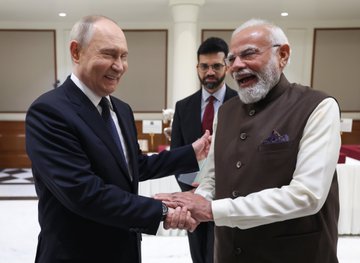
Prime Minister Narendra Modi with Russian President Vladimir Putin in New Delhi on Thursday. (Image Modi on X)
From ‘Stuck Rupees’ to ‘First-India’: How Sberbank’s Nifty50 Fund Rewires the India–Russia Trade Imbalance
By P. SESH KUMAR
New Delhi, December 6, 2025 — For three years, India–Russia trade has looked like a lopsided marriage: India imported shiploads of discounted Russian oil and coal, paid largely in rupees, and Russia sat on a mountain of local-currency balances that it could neither freely convert nor easily spend. The phrase “stuck rupees” captured both the frustration in Moscow and the policy headache in New Delhi.
With the launch of Sberbank’s Nifty50-linked “First-India” mutual fund for Russian retail investors, and plans to channel rupee surpluses into Indian government securities, that stalemate may be giving way to a new model of “petro-rupee recycling.”
The long story of “stuck rupees”
The backdrop is simple, and brutal in its arithmetic. Since 2022, Indian refiners have gorged on discounted Russian crude, fertilizers and coal, while Indian exports to Russia have crawled. In 2024-25, India exported under five billion dollars’ worth of goods to Russia but imported nearly sixty-four billion dollars, leaving a trade deficit of roughly fifty-nine billion dollars in Russia’s favour.
Because a growing share of this commerce has been settled in rupees through special vostro accounts in Indian banks, Russia has accumulated tens of billions of rupees that are effectively trapped inside India’s financial system and unusable in the wider world.
For New Delhi, this imbalance threatened to turn a diplomatic success-cheap oil during a global energy shock—into a structural vulnerability. For Moscow, it was worse: a sanctions-hit economy holding a claim on Indian output that it could not easily convert into euros, dollars or even yuan.
Russian commentators openly grumbled that they were shipping real barrels and getting “funny money” in return. Indian policymakers, for their part, pushed repeatedly for Russia to ramp up imports of Indian machinery, pharma, textiles and IT services, and for a more sophisticated rupee–rouble settlement system.
Into this stalemate walks Sberbank, Russia’s largest lender and the principal financial gateway for India–Russia trade settlements. Over the last two years it has rapidly expanded in India, handling the majority of rupee–rouble trade flows and planning a bigger on-the-ground footprint, including data centres and a network presence in multiple cities. The “First-India” Nifty50 fund is the sharpest expression yet of this strategy.
What exactly has Sberbank done?
At its simplest, Sberbank has created a rupee-linked bridge between Russian savers and India’s stock and bond markets. It has received regulatory permission to launch a Nifty-benchmarked mutual fund or ETF that allows Russian retail investors to buy units in roubles, while the underlying portfolio is invested in rupee-denominated Indian assets, starting with a passive basket of Nifty50 stocks and, as reported, extending to Indian government securities.
This does three things at once.
First, it transforms at least part of the stranded rupee surplus in Russian-owned nostro and vostro accounts into equity and debt claims on India Inc and the Government of India. Instead of parking idle balances in low-yield accounts, Sberbank can buy Nifty50 exposure or long-dated G-Secs, converting “stuck rupees” into productive financial assets.
Second, it gives Russian households, who have been increasingly cut off from Western capital markets since 2022, a clean, regulated product to participate in the India growth story. Russian investors do not need to open Indian accounts or chase individual Indian stocks; they can simply buy units in a domestic fund that tracks India’s flagship index. Sberbank’s “First-India” fund is marketed precisely as this kind of convenient diversification tool.
Third, it deepens India’s investor base with a new pool of long-term foreign capital that is less “hot money” and more structural, tied to energy flows and trade settlements rather than fleeting carry trades. The National Stock Exchange has hailed the move as a vote of confidence in India’s market architecture and regulatory framework.
The meme-like claim you cited-oil money turning into Nifty units, Bharat getting long-term capital and Russia getting growth exposure-is not entirely hyperbole. It captures, in 280 characters, what policy wonks would call a bespoke local-currency recycling mechanism.
World Order Collapsing, Global South Will Decide Future: Stubb
Why this is genuinely novel
Countries have been recycling trade surpluses for decades. In the 1970s and 1980s, OPEC’s “petrodollars” were poured into U.S. Treasuries, Eurodollar bank deposits and syndicated loans that financed both rich-country deficits and developing-country imports. China’s rise in the 2000s was accompanied by a flood of surplus dollars into U.S. government bonds, mortgage-backed securities and global infrastructure via sovereign wealth funds.
What is different here is the currency, the legal architecture and the political context.
The surpluses in question are not in hard currency but in Indian rupees, created because sanctions pushed India–Russia trade away from dollars and euros into local currencies. These rupees are trapped in India by design: they cannot be freely moved into Western capital markets without triggering sanctions and settlement risks.
Instead of routing surpluses into the usual safe-asset destinations-U.S. Treasuries, German Bunds, London property or New York private equity-Russia is now being nudged, almost forced, into taking local-currency exposure to a single emerging market. The instrument of choice is not a sovereign wealth fund or a central-bank reserve portfolio but a retail mutual fund marketed to ordinary Russian savers.
Put differently, this is “petro-rupee recycling,” not petrodollar recycling. The oil exporter’s surplus is being reinvested directly in the importing country’s capital markets, in the same currency in which the original trade took place.
That greatly reduces cross-border FX risk for India, shifts market risk to Russian investors, and ties both sides together in a deeper web of financial interdependence. It is also very much a child of sanctions and dedollarisation: absent Western restrictions on Sberbank and Russian oil, no one would have bothered to engineer such a complex workaround.
In global terms, one can find partial analogies-Gulf oil exporters taking equity in Western utilities and banks in the 2000s, or Chinese state funds buying stakes in African infrastructure-but the scale, the retail orientation and the local-currency constraint make the Sberbank–Nifty experiment quite distinctive.
What it holds for India: boon, with barbed wire
For India, the upside is obvious and politically seductive. A chronic trade deficit with Russia can be partly offset by steady portfolio inflows into equities and government bonds, easing pressure on external accounts and supporting domestic capital formation.
The presence of a large, sticky buyer of Nifty-linked instruments and G-Secs can lower yields at the margin, deepen liquidity and provide a modest buffer against global risk-off episodes.
It also dovetails neatly with New Delhi’s narrative of India as a “Vishwaguru” marketplace-an alternative growth engine where sanctioned capital from Russia, Gulf petrodollars or even Chinese savings can find a productive home. As bilateral leaders talk of lifting trade to one hundred billion dollars by 2030, converting stuck rupees into productive investments offers a tangible answer to critics who complain that India is free-riding on Russian discounts without offering anything in return.
But the opportunity comes wrapped in barbed wire.
First, there is sanctions risk. Sberbank and several of its affiliates are on the U.S. Specially Designated Nationals list and subject to full blocking measures; U.S. financial institutions must close correspondent accounts and reject transactions involving them or their majority-owned subsidiaries.
India has so far navigated this minefield by ensuring that rupee-denominated trade settlements and investments are cleared entirely outside the U.S. financial system. As long as the Nifty50 fund structure, custody chain and settlement pipes avoid any U.S. nexus, it may not breach primary sanctions—but the political optics are delicate.
Second, there is the spectre of secondary sanctions. Washington has already used tariffs and regulatory pressure to signal displeasure at India’s Russian energy imports, and is increasingly deploying secondary sanctions to threaten non-U.S. entities that facilitate Russian oil and finance.
A high-profile fund explicitly marketed as a way to monetise Russian oil surpluses via India may be seen in some U.S. circles as a sanctions-evasion device, even if it is technically legal. That could invite targeted pressure on Indian banks, exchanges or officials involved, complicating India’s broader strategic balancing between Washington and Moscow.
Third, India takes on reputational and concentration risk. If Russia, under a future leadership or under pressure of a fiscal crunch, decides to dump its Indian holdings en masse, Indian markets could face a sharp, geopolitically triggered sell-off. Conversely, if India tightens capital controls or tax rules in ways that hurt Russian investors, bilateral tensions could spike. Either way, what begins as a clever financial hack can morph into a political weapon.
Finally, there is the question of whether portfolio flows really solve the trade imbalance. Even if tens of billions of rupees are recycled into Nifty50 and G-Secs, the underlying structural problem-that India sells too little to Russia-remains. Without a serious push on services exports, pharma, machinery and IT to Russia, Sberbank’s fund risks becoming a glossy band-aid on a chronic ailment.
India and Russia Ink 20 MoUs to for Broader Strategic Roadmap
What it holds for Russia: from trapped cash to growth bets
For Moscow and Russian savers, the initiative is both a necessity and an opportunity.
Necessity, because the existing pile of rupee balances earns little and cannot be easily swapped into reserve currencies without tripping sanctions or suffering punitive spreads. Russian officials have publicly acknowledged the dilemma of having billions of unusable rupees sitting in Indian banks.
Opportunity, because India is one of the few large economies still willing to do business with Russia at scale, and it offers both growth and political predictability compared with many other emerging markets.
Giving Russian households regulated exposure to Nifty50 via a domestic fund allows them to diversify out of an increasingly constrained Russian market and dollar-centric instruments that are vulnerable to seizure.
Over time, if Sberbank also channels rupee surpluses into long-dated Indian government bonds, Russian institutions will, in effect, hold a portfolio of Indian sovereign risk instead of cash claims on Indian banks. That is not risk-free, but India’s macro-fundamentals and debt record compare favourably with many peers, and certainly with the zero-yield alternative of idle balances.
Yet Russia, too, is taking a gamble. It is swapping liquidity for market volatility, political risk in India and potential FX-conversion constraints down the line. If India experiences a market correction, or if rupee assets underperform Russian energy exports over time, Russian savers could end up bearing a meaningful opportunity cost. The Kremlin will then have to explain why “patriotic” oil sales were effectively converted into foreign equity bets rather than domestic investment or social spending.
There is also a subtle sovereignty trade-off. The more Russia’s surpluses are embedded in Indian financial assets, the more it becomes, in part, a stakeholder in India’s macro-stability and regulatory regime. That is not necessarily a bad thing—but it does mark a shift from classic reserve accumulation into a more entangled, politically exposed form of partnership.
How the United States will read this move
Washington will see the Sberbank–Nifty50 bridge through three overlapping lenses: sanctions enforcement, dedollarisation and regional geopolitics.
On sanctions, Sberbank is one of the poster-children of U.S. Russia policy. It has been hit with correspondent-account bans, full blocking sanctions and repeated warnings to foreign financial institutions about dealing with it. Any move that visibly strengthens Sberbank’s hand and gives it a new channel to monetise export earnings will be scrutinised in Washington and Brussels. U.S. regulators have already begun issuing alerts about sanctions risks to foreign financial institutions that facilitate Russian transactions, particularly in energy and finance.
On dedollarisation, the symbolism is hard to miss. The U.S. has long benefited from petrodollar recycling-oil exports priced and settled in dollars, with surpluses parked in U.S. assets. The Sberbank–rupee–Nifty triangle is a small but noisy example of a counter-trend: an oil exporter and a large emerging importer building a parallel ecosystem in local currencies that bypasses the dollar and U.S. capital markets altogether.
In geopolitical terms, the move reinforces a discomforting pattern for Washington. India is deepening energy and financial ties with Russia at the very moment when a Trump-led administration is ramping up sanctions and tariffs-already slapping a twenty-five percent tariff on a wide basket of Indian exports in retaliation for its continued purchases of Russian crude.
Taken together, U.S. strategists are likely to view this as one more brick in a wall of alternative financial plumbing that chips away, however modestly, at the centrality of the dollar and the leverage of U.S. sanctions.
They may not rush to directly target the Nifty50 fund-especially if it remains a purely rupee-denominated, India-cleared product-but they will keep their powder dry, watching whether other sanctioned jurisdictions copy the model and whether Indian entities stray into any U.S. nexus in the process.
India Secures Arctic Access as Modi–Putin Summit Unveils Pact
Is it really a win-win?
In the short run, yes. Oil flows continue, rupees no longer sit idle, Indian markets gain a new class of long-term investors, and Russian savers get a slice of India’s growth. It is hard to deny the elegance of converting a politically awkward trade imbalance into a portfolio-investment bridge.
But genuine win-wins in international finance are rare without careful design. Three tests will determine whether this innovation endures or unravels.
The first is whether India can actually rebalance trade by selling more to Russia, rather than simply absorbing its surpluses in its capital markets. Without a sustained export push-pharma, engineering goods, IT, agri-products and services-the structural imbalance will persist, and the pressure to find ever more exotic recycling mechanisms will grow.
The second is whether both countries can ring-fence this arrangement from sanctions spillovers. If an over-zealous compliance team in New York or London decides that clearing rupee trades linked, however indirectly, to Sberbank is too risky, Indian counterparties may find doors quietly closing on them elsewhere. Conversely, if India is seen as offering a free pass to sanctioned Russian entities, it could face not only tariffs but targeted financial restrictions.
The third is whether the politics of the relationship can handle market volatility. Equity markets go down as well as up; currencies move; governments change. A sharp drawdown in Nifty50, a ratings shock to India, or a policy misstep on either side could turn today’s “Gujju brain” masterstroke into tomorrow’s blame game.
Way forward: how to make this experiment work
For India and Russia, the task now is to turn a clever workaround into a robust, transparent and balanced architecture. That means, first, embedding the Sberbank–Nifty50 mechanism within a broader strategy to diversify and deepen India–Russia trade: using rupee surpluses not only for portfolio flows but for direct investments in manufacturing, logistics, critical minerals, shipbuilding and services where India has real comparative advantage.
Second, regulators in New Delhi and Moscow need to hard-wire safeguards: clear disclosures on the size and composition of Russia-linked holdings in Indian markets; stress-tests for sudden withdrawals; strict KYC/AML norms; and legal firewalls to ensure that Indian intermediaries do not inadvertently breach U.S. or EU sanctions. This is not to meekly accept Western diktats, but to ensure that India’s own financial system is not collateral damage in a sanctions crossfire.
Third, India should use this moment to sharpen its broader financial-diplomacy toolkit. If it can successfully manage a rupee-based recycling arrangement with a heavily sanctioned Russia, it strengthens the case for similar local-currency trade and investment frameworks with less controversial partners in the Global South. Done right, this could over time nudge India from being merely a taker of global capital flows to a shaper of alternative circuits beyond the dollar.
Finally, both sides must resist the temptation to oversell the innovation. Sberbank’s Nifty50 fund and the associated rupee-G-Sec channel are not the end of the dollar era, nor a magic solution to the sixty-billion-dollar trade gap. They are, at best, an imaginative way of using financial plumbing to buy time and create options.
Whether this becomes a durable win-win or an elegant footnote in the story of sanctions and dedollarisation will depend less on memes and more on the hard grind of trade policy, regulatory prudence and diplomatic balance.
(This is an opinion piece, and views expressed are those of the author only)
India–Russia Summit Seals Big Push on Energy and Defence Ties
Follow The Raisina Hills on WhatsApp, Instagram, YouTube, Facebook, and LinkedIn




About The Author