From Red to Saffron: Bengal’s Left Mind Is Not Immune to BJP
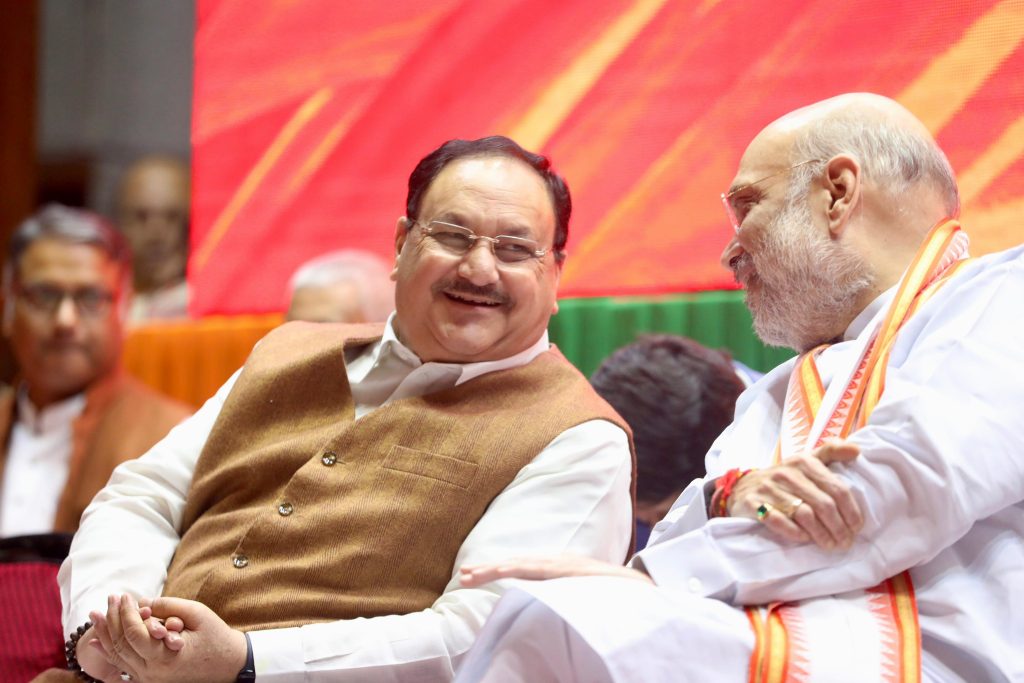
Amit Shah and JP Nadda attend IT cell meeting of BJP in Kolkata
Intense political churns are underway in West Bengal ahead of Assembly elections.
By NIRENDRA DEV
New Delhi, January 12, 2026 — “Do you come from a family where no one has ever done anything wrong?” That piercing line from Satyajit Ray’s Jana Aranya (1975) still echoes through Bengal’s moral and political psyche. Ray’s film—set against joblessness, compromise, and ethical decay—captured not just an era, but a mindset: one where corruption was condemned in theory yet tolerated as reality.
To understand why Bengali voters—long stereotyped as pro-Communist—are now warming to the BJP, one must first understand this layered Bengali mind: culturally Left, intellectually sceptical, morally conflicted, and politically pragmatic.
The Left Was Never Just a Party—It Was a Culture
For decades, Bengal’s political identity was inseparable from Marxist ideology, especially among the bhadrolok—the educated, urban upper-caste middle class. Communism in Bengal was not merely electoral; it was cultural. Literature, cinema, theatre, academia, and trade unions reinforced it.
Even when the Congress shared power, Kolkata symbolised a Left-dominated intellectual ecosystem. This made Bengal uniquely resistant to the BJP’s early Hindutva pitch. As late as 2016, the BJP was virtually absent from the state’s power corridors.
Mamata Banerjee: The Anti-Left Who Never Sounded Anti-Left
Mamata Banerjee cracked the Marxist fortress not by opposing Left ideology, but by appropriating it. Singur and Nandigram were not just land movements—they were ideological turning points. By positioning herself as the protector of farmers against forced industrialisation, Mamata appeared more Marxist than the Marxists themselves. CPI(M) leaders were mocked as “pseudo followers of Karl Marx.”
Her imagery—rubber chappals, cotton sari, street protests—challenged the Left’s proletarian monopoly. Disillusioned Left cadres migrated en masse to the Trinamool Congress after 2011, especially in Maoist-affected regions where Mamata restored faith in electoral democracy.
But the Myth of Moral Superiority Has Collapsed
Fast forward to 2026, and the image has cracked. While Mamata Banerjee still wears chappals, few believe the Trinamool Congress is pro-poor anymore. ED raids, cash seizures, and corruption allegations involving senior TMC leaders have shattered the moral halo that once differentiated her from the Left.
The old dadagiri of CPI(M) cadres has been replaced by TMC syndicates—and voters are visibly fatigued. This erosion of moral authority is critical. Bengal’s electorate can tolerate ideological rigidity, even inefficiency—but not naked hypocrisy.
Why the BJP’s Moment Has Arrived
The BJP’s rise in Bengal is not ideological conversion—it is ideological exhaustion. The Left and Congress are electorally irrelevant, reduced to vote-splitters.
The BJP won 18 Lok Sabha seats in 2019, proving scale. Even after slipping to 10 seats in 2024, the BJP remains the only credible challenger.
More importantly, BJP strategists argue that the “ideological wall” that existed in 2016 no longer exists. The cultural Left monopoly has broken.
Tripura’s 2018 political shift—another Bengali-majority state—acted as psychological validation. If Marxists could fall there, they could fall in Bengal.
The BJP’s Limits—and Its Opportunity
Yet, the challenge remains formidable. The BJP lacks: Deep grassroots organisation compared to TMC; Any meaningful Muslim support base; and Organic leadership rooted in Bengal’s cultural idiom.
Reports suggest the deployment of over 500 BJP–RSS karyakartas from other states across Bengal’s Assembly segments—an admission that the local organisational muscle is still insufficient.
Unlike Assam—where caste alignments, tribal coalitions, and Hindutva found natural resonance—Bengal’s bhadrolok historically aligned with Marxism, not Brahminical politics. But that allegiance is no longer emotional—it is transactional.
From Ideology to Accountability
Bengal’s shift is not from Communism to Hindutva. It is from ideology to accountability. Voters who once excused moral compromises in the name of class struggle are now asking Ray’s old question again: Is corruption inevitable—or just convenient?
If the BJP can frame itself not merely as a Hindutva force but as an anti-corruption, post-Left alternative, 2026 may mark the most serious challenge Mamata Banerjee has faced since 2011.
The kaleidoscope has turned. The colours are no longer just red.
(This is an opinion piece. Views expressed are author’s own)
Follow The Raisina Hills on WhatsApp, Instagram, YouTube, Facebook, and LinkedIn




About The Author