From Nehru to Now: India’s Strategic Silence Faces Dharmic Test
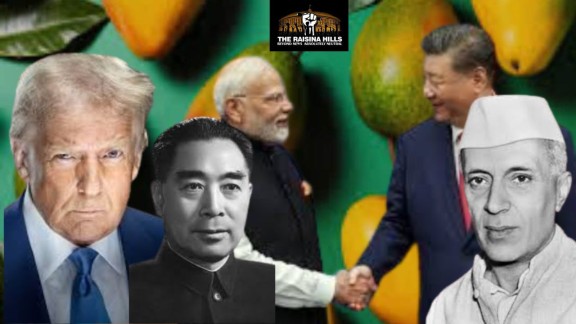
Donald Trump, Narendra Modi, Xi Jinping, JL Nehru, Zou Enlai (Image credit X.com)
As India rises economically and militarily, its refusal to exercise judgement abroad turns strategic autonomy into moral drift
By SAHASRANSHU DASH
Sheffield (UK), January 11, 2026 — When Jawaharlal Nehru wrote A Foreign Policy for India in 1927, two full decades before Independence, he was addressing a country without sovereignty, without control over its military or diplomacy, and without the capacity to shape the international system that nonetheless shaped it.
His insistence on independence of judgment, resistance to imperial wars, and refusal of premature alignment were not evasions of responsibility. They were acts of moral self-preservation. Neutrality, in that context, was emancipatory. It preserved dignity in the absence of power and prevented India’s future voice from being foreclosed before it could speak.
By January 2026, however, India inhabits a fundamentally different condition. Its rise is no longer speculative. It is on track to become the world’s third-largest economy, one of the top three or four military powers, a central node in global supply chains, and an unavoidable presence in every major multilateral forum.
Yet this ascent has coincided with a destabilising paradox. India is more visible than ever, yet less persuasive; more present, yet less defended; structurally indispensable, yet narratively weak. This contradiction reflects not diplomatic miscalculation but inertia—the failure to recalibrate restraint once power arrived.
India has elevated non-commitment from a tactical instrument into a governing ideology long after the conditions that justified it have disappeared.
Across crises as varied as Ukraine, Gaza, Myanmar, Bangladesh, Sri Lanka, Venezuela, and the Rohingya catastrophe, India’s conduct follows a familiar pattern. Moral language collapses into procedural platitude, legalism substitutes for judgement, and “all sides” rhetoric persists even where asymmetry is unmistakable. There is near-zero willingness to absorb diplomatic cost in defence of principle. This is not situational caution but doctrine. Silence is treated as prudence; judgement as risk.
The result resembles a paralysis the Mahabharata recognised long ago. Arjuna’s crisis on the battlefield was not cowardice but moral confusion—an inability to distinguish restraint from abdication. Krishna’s intervention was not a call to blind action, but a refusal to dignify indecision as virtue. To refuse judgement, he insisted, is itself a choice, and often the most consequential one. India today increasingly resembles Arjuna before instruction: aware of its power, conscious of consequence, yet mistaking hesitation for wisdom.
What this posture fails to grasp—something Nehru understood even in 1927—is that norms are not merely constraints. They are also currency. States that never spend moral capital never accumulate it. By refusing to invest in normative positions, India has forfeited the authority that allows states to shape agendas rather than merely attend forums. Omnipresence has come to substitute for influence.
Moral Fungibility and the Political Economy of Silence
This erosion of judgement is reinforced by a political economy increasingly at ease with moral fungibility. India’s post-2022 energy diplomacy, often justified in the language of strategic autonomy or Global South solidarity, has in practice been driven by commercial expediency operating with state acquiescence. The turn to discounted Russian crude, and more recently participation in arrangements that treat sanctioned Venezuelan resources as effectively transferable assets, reflects a willingness to bracket sovereignty and human cost wherever profit can be secured through compliant mechanisms.
What emerges is not strategic flexibility but moral fungibility: war, repression, and dispossession reduced to inputs for private gain. When foreign policy begins to translate violence abroad into balance sheets at home, national interest itself collapses into accounting. A state that refuses judgement publicly while enabling it quietly through capital forfeits not only credibility abroad but coherence at home.
This represents a betrayal not merely of Nehruvian rhetoric but of Nehruvian political economy. For Nehru, idealism and economic sovereignty were inseparable. His suspicion of concentrated private power was never doctrinaire socialism—it was anti-colonial self-preservation. He understood that a state unable to resist domestic oligarchy would inevitably become its instrument, and that capital unconstrained by public purpose would subordinate national interest to private profit, rendering independence nominal.
The mixed economy, for all its inefficiencies, was designed to prevent precisely this capture: the return of a comprador class that would treat sovereignty as a resource to be monetised rather than a responsibility to be exercised.
What distinguishes the current moment is not that India has abandoned idealism for realism, but that it has abandoned sovereign judgement for what can only be called oligarchic instrumentalism. When foreign policy is shaped to facilitate corporate access to sanctioned energy markets, when diplomatic positioning aligns with the balance-sheet needs of a handful of conglomerates, and when the state’s primary role becomes the provision of geopolitical cover for private accumulation, India has not become more pragmatic. It has become less sovereign. This is not realism. It is regression—a return to the colonial-era logic in which the state exists to smooth the passage of capital, and in which national interest is whatever serves concentrated private power. The difference is only that the conglomerates are now domestic.
Terrorism, Evidence, and a Collapsing Moral Grammar
Nowhere is this clearer than in India’s eroding authority on terrorism. India remains rhetorically anchored to the Global War on Terror framework of the early 2000s, treating Islamist militancy and state sponsorship as the organising moral principle of international security. The empirical reality of Pakistan-based terrorism has not changed. What has changed is how violence is morally processed. In a post-Gaza environment, terrorism is treated as chronic background noise, while civilian harm, occupation, and power asymmetry dominate judgement. Counterterror rhetoric increasingly sounds not like moral clarity but like securitisation by default.
India continues to submit dossiers in a world that no longer responds to them. It still dispatches carefully curated intelligence files, sponsors all-party parliamentary delegations, and stages explanatory outreach designed for a diplomatic culture that has largely vanished. These gestures assume a shared moral grammar in which evidence compels judgement. That grammar no longer governs global politics. Information now circulates less as proof than as narrative, and India has failed to adapt.
The consequences are visible in how even restrained Indian responses to terror attacks—whether along the Line of Control or after incidents such as Pahalgam—are rapidly reframed as escalation or aggression. Actions intended as deterrence are absorbed into a global discourse that privileges asymmetry and civilian vulnerability over antecedent violence. India’s insistence on factual correctness collides with an environment in which facts untethered from moral framing are easily inverted.
Pakistan, by contrast, has adapted with ruthless pragmatism. It presents itself not as a perpetrator but as a manager of instability: a victim of Taliban violence, a bulwark against narcotics flows, and a firewall against regional chaos. This framing maps neatly onto contemporary Western and Gulf anxieties. That Islamabad can arrest a former prime minister, endure major terror attacks, and still retain Saudi confidence and Washington access speaks not to moral rehabilitation but to perceived utility. India, meanwhile, is often factually correct and strategically sidelined. Terrorism, once its strongest narrative asset, barely registers.
Silence as Institutional Habit
This narrowing of voice extends well beyond security. Despite sustained nationwide protests in Iran against state violence and gender repression, India has had virtually nothing to say. Despite intensifying debate over threatened annexationist claims involving Greenland, India—while negotiating an India–EU trade agreement and repeatedly invoking sovereignty and territorial integrity—has remained silent. These silences are not compelled by circumstance. They are reflexive. India no longer articulates why some injustices merit speech and others do not. Selectivity can be legitimate. Unexplained selectivity corrodes credibility.
The institutional roots of this silence are deep. Indian diplomacy rewards procedural competence, ambiguity management, and relationship maintenance rather than judgement or agenda-setting. Strategic autonomy, once conceived as freedom of manoeuvre and independence of thought, increasingly functions as an alibi for non-position. Autonomy has curdled into invisibility.
Here the Mahabharata offers a darker warning than Arjuna’s hesitation: Bhishma’s silence. Possessing immense moral authority yet bound by loyalty and oath, Bhishma watched injustice unfold while believing neutrality preserved order. Instead, his silence legitimised catastrophe. The epic is unambiguous: authority that refuses to judge becomes complicit, even if it never strikes a blow. Power does not absolve silence; it magnifies its consequences.
Narrative Power and Reputational Drift
The effects of India’s posture are increasingly visible. Turkey has emerged as an active anti-India narrative operator, amplifying Kashmir claims and aligning rhetorically with Pakistan. It succeeds not because its arguments are stronger but because it speaks. Where Turkey polarises, India proceduralises. Where others assert, India hedges. The information battlefield rewards voice, not reticence.
Beyond elite diplomacy, the damage is reputational. Anti-Indian hostility has surged across global platforms, depicting Indians as scammers, polluters, demographic threats, or religious extremists. These narratives circulate not only in adversarial ecosystems but increasingly within Western and Global South societies alike. Other states treat narrative warfare as a core domain of national security. India absorbs abuse in silence. Silence is mistaken for wisdom. It is read instead as weakness.
In the United States, this vulnerability has produced a rare convergence. Liberals increasingly frame India through democratic backsliding and minority rights; terrorism arguments no longer persuade. Conservatives view India transactionally, as a trade irritant rather than a strategic equal. India is morally distrusted by one side and economically pressured by the other, with little narrative capital to offset either.
Domestic Politics and External Credibility
This vulnerability is compounded by India’s domestic trajectory. The steady narrowing of civic space, rising pressure on religious minorities, and the instrumentalisation of majoritarian identity have not merely altered India’s internal politics; they have eroded the external credibility of its voice.
A country that once spoke of pluralism as civilisational confidence now finds its claims filtered through suspicion of democratic backsliding and ideological rigidity. The foreign policy costs of domestic de-Nehruisation are real and cumulative: it becomes harder to invoke democracy without qualification, sovereignty without scepticism, or moral restraint without appearing selective. When the values that once anchored India’s global standing are diluted internally, its diplomacy loses not only persuasion but presumption—the benefit of being heard on its own terms.
Economic growth prevents exclusion. It does not guarantee respect. China paired scale with clarity and risk tolerance. India pairs scale with hesitation. The danger is not isolation but a more corrosive outcome: becoming a reluctant hinge—necessary, consulted, but rarely followed, defended, or deferred to.
Drift, Dharma, and the Cost of Arrival
At the core of this failure is a misreading of idealism. India has come to treat idealism and realism as opposites, when the real opposition is between realism and evasion. Nehru never imagined independence as withdrawal from the world. From the moment of freedom, India pledged itself to the service of its people and to the still larger cause of humanity, recognising that peace is indivisible, as are freedom and prosperity, and that disaster too could no longer be contained in a world incapable of living in isolated fragments. Idealism, in this tradition, was not self-righteousness: it was responsibility scaled to interdependence.
Measured against that inheritance, India’s foreign policy in 2026 reveals not excessive idealism but its near-total evacuation. India invokes autonomy while declining independent judgement. It affirms sovereignty abstractly while avoiding speech when sovereignty is violated. It cultivates relationships with power while refusing to differentiate morally amongst them. Silence is justified as realism even as India’s capacity to absorb disagreement has grown dramatically.
The supreme irony is that this posture has been perfected by a political dispensation that holds Nehru in open contempt. The current government blames him for Kashmir, for economic stagnation, for civilisational humiliation, for every perceived weakness in India’s post-Independence trajectory. Yet it has deepened precisely the pathology it claims to have overcome. What has changed is not the evasion but its alibi.
Where Nehru’s caution preserved India’s future voice, today’s caution avoids using the voice India already possesses. Where Nehruvian restraint served idealism, contemporary restraint serves oligarchy. What was once a strategy of emergence has become a habit of evasion—now practiced by those who ritually denounce the man who designed it, yet lack either his clarity of purpose or his willingness to accept cost in defence of principle.
A foreign policy adequate to India’s arrival—whether or not it honours Nehru’s name—would recover what his best instincts understood: that dharma, in its classical sense, means judgement under conditions of conflict, ambiguity, and cost. Dharma is not rule-following. It demands choice. It accepts tragedy but rejects abdication. It understands that refusal to choose is itself a moral act—and often the most damaging one.
India does not need to intervene everywhere. It does not need to moralise indiscriminately. But a power of India’s scale no longer has the luxury of refusing to explain why some injustices matter more than others. Silence is not neutrality. It is a choice, and the world has begun to interpret it.
The most damning feature of India’s current posture is the absence of an articulated end state. If invisibility is a tactic, to what end and until when? At what level of power does hedging stop? No answer has been offered because no decision has been made. That is not strategy. It is drift.
Nehru wrote for a nation struggling to be born. His restraint preserved the possibility of voice. India today risks forfeiting it not through weakness, but through a narrowing of judgement under conditions of power, compounded by a domestic climate that steadily thins the pluralism and institutional confidence on which its moral authority once rested. Economic rise may prevent India from being crushed. It will not prevent India from being ignored, misrepresented, or morally sidelined—especially if foreign policy comes to be read as the quiet translation of violence abroad into comfort at home, and democracy at home into inconvenience to be explained away.
To avoid that fate, India must recover an idealism adequate to its power: one that accepts judgement as obligation, speech as participation, responsibility as the price of arrival, and national interest as something larger than profit, narrower than ambition, and inseparable from the still larger cause of humanity.
(This is an opinion piece. Views expressed are author’s own)
Asim Munir’s Nine Lives: Pakistan’s Army Chief Escapes Trump
Follow The Raisina Hills on WhatsApp, Instagram, YouTube, Facebook, and LinkedIn




About The Author







Post Nehru & post Rajaji Indian political landscape has produced only midgets of whom Indira Gandhi was the “tallest”, though Rajiv Gandhi had the potential to be another Nehru, but his political impetuousness cost him his life
Dr Manmohan Singh could have restored international standing because of his intellectual heft, but he never tried tried to cultivate political heft . The less said about others the better
Hope Indian citizens understand that event managements & organized welcomes in foreign lands are no substitutes for genuine statesmanship & international acclaim
With one head of a state going berserk is there any room for meaningful diplomacy particularly when he repeatedly says in a bullying tone that he doesn’t want to finish off someone’s political career!