From Lions to Global South: Modi Warms India–Ethiopia Ties
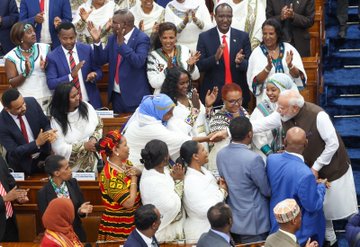
Prime Minister Narendra Modi addressed joint session of Ethiopian parliament. (Image Modi on X)
In Ethiopia’s Parliament, PM Modi blends civilisation, commerce and geopolitics—elevating ties into a Strategic Partnership and pitching a new Global South compact.
By TRH Foreign Affairs Desk
New Delhi, December 17, 2025 — Prime Minister Narendra Modi’s address to the joint session of Ethiopia’s Parliament was not merely ceremonial; it was a carefully layered statement of India’s diplomatic intent in Africa and the wider Global South. Speaking in Addis Ababa—the symbolic heart of African unity—Modi framed India–Ethiopia ties as a relationship rooted in ancient civilisations but urgently relevant to modern geopolitics.
Drawing parallels between lions of Ethiopia and Gujarat, between Lalibela’s rock churches and India’s temple traditions, Modi positioned both nations as old cultures confidently walking into the future. But beneath the cultural warmth lay strategic substance. The elevation of India–Ethiopia relations to a Strategic Partnership signals New Delhi’s intent to anchor itself deeper in Africa’s political economy at a time of global realignment.
Modi highlighted India’s $5 billion investments and 75,000 jobs in Ethiopia as proof that India’s engagement is economic, not extractive. He pitched cooperation in mining, clean energy, food and health security, defence, and digital public infrastructure—exporting India’s DPI success story as Ethiopia rolls out its Digital Ethiopia 2025 strategy. The subtext was clear: India offers an alternative development model—technology-driven, scalable, and sovereignty-respecting.
Security was another quiet but firm pillar. With a defence cooperation agreement already in place, Modi spoke of cyber security, joint research, and zero tolerance towards terrorism—placing Ethiopia as a key partner at the Horn of Africa, a region of rising strategic competition.
The speech also doubled as a manifesto for the Global South. From climate justice and green energy to reforming global governance frozen in 1945, Modi’s message was assertive: emerging nations will no longer wait for permission to shape the world order. Ethiopia’s inclusion in BRICS and the African Union’s permanent seat in the G20 were presented as milestones of this shift.
By invoking coffee ceremonies and tea conversations, Modi ended on symbolism—but the address had already done its work. India is no longer just reaching out to Africa; it is staking a long-term strategic claim, with Ethiopia as a pivotal partner.
Follow The Raisina Hills on WhatsApp, Instagram, YouTube, Facebook, and LinkedIn




About The Author