From Handshakes to Hard Outcomes: Who Tracks Mega MoUs?
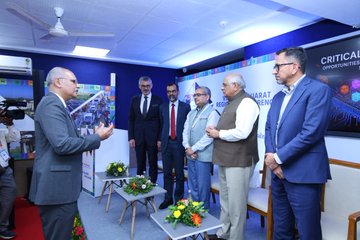
Vibrant Gujarat Summit! (Image X.com)
States announce investments worth lakhs of crores at flashy summits—but once the applause fades, no authority tracks what actually gets built, funded, or abandoned. Where is the accountability?
By P. SESH KUMAR
New Delhi, December 18, 2025 — Almost all major States in India today sign MoUs with industrialists, foreign investors and multilateral agencies at a pace that would make even the most optimistic investment banker blush. Global Investors’ Summits, Vibrant Gujarat or Telangana or Rajasthan—style conclaves, sectoral roadshows, defence expos and startup carnivals routinely announce commitments running into lakhs of crores. Yet, once the banners are rolled up, the hashtags fade and the CEOs fly back, a troubling silence descends. No single authority is demonstrably and clearly responsible for tracking whether these MoUs ever graduate from ceremonial paper to operational reality.
Most MoUs are non-binding expressions of intent. Governments know this. Corporates know this. Yet public communication deliberately blurs the distinction between commitments, intentions, letters of comfort and actual investments.
The political economy incentive is obvious: MoUs deliver instant optics-confidence, momentum, headlines-without the inconvenience of accountability. What they do not deliver, at least not systematically, is jobs, factories, exports or tax revenues in any proportion commensurate with the claims made at the time of signing.
It is nobody’s case that results and visible impact should flow at once- given the ‘gestation reality’ embedded in the approach.
A Quiet Court Order Just Shook India’s Audit and NFRA Regime
The Missing Chain: From Announcement to Asset Creation
The real failure is not that MoUs fall through-investment decisions are inherently uncertain—but that no publicly demonstrated institutional mechanism exists to track their life cycle. Once an MoU is signed, there is usually no mandatory reporting on whether land was acquired, statutory clearances obtained, financial closure achieved, or production actually commenced.
In many states, investment promotion agencies may maintain internal dashboards, but these are rarely subjected to independent scrutiny and almost never placed in the public domain in a verifiable form.
Equally opaque is the public expenditure incurred on these events. Government spending on summits-venue hire, infrastructure sprucing, security, branding, consultants, roadshows abroad, hospitality, and logistics-often runs into hundreds of crores over a few years.
These costs are justified as “investment promotion”, but there is rarely any ex post assessment of return on public money. Did the event materially accelerate projects that would not otherwise have happened? Did it crowd in private capital, or merely re-label pre-existing investment plans? These questions are conspicuously absent from official narratives.
Why This Is Squarely a Performance Audit Question
This is precisely where an institution like the Comptroller and Auditor General of India (CAG) should step in-not as a spoiler of ambition, but as a custodian of credibility. A performance audit of investment summits and MoU-driven commitments is not only feasible; it is overdue.
Such an audit would not question policy intent. Instead, it would ask cold, measurable questions. How many MoUs signed during a given summit translated into projects that reached financial closure within three years? How many actually commenced production or service delivery? What was the time lag between MoU signing and ground-level activity? How many jobs were created, and of what quality? What tax revenues accrued to the state or Centre as a consequence? And crucially, what proportion of announced investments merely reflected re-packaged or relocated projects that were already in the pipeline?
Equally important would be the audit of public expenditure efficiency. For every rupee spent by government on such events, what was the demonstrable economic return? If a state spends ₹300 crore over five years on investor summits, does it have evidence of incremental investment attributable to those events, net of counterfactuals? Without such analysis, claims of success remain little more than well-produced theatre.
Have There Been Any Genuine Success Stories?
To be fair, not all MoUs are empty promises. There could be demonstrable successes-typically where follow-up was institutionalised rather than left to ad hoc enthusiasm. Certain electronics manufacturing clusters, renewable energy parks and port-led industrial corridors show that MoUs can work when backed by land availability, time-bound clearances, escrow-linked incentives and single-window systems that actually function.
But these successes share a common trait: they matured despite the summit, not because of it. The real drivers were sustained administrative follow-through and policy stability, not the optics of the signing ceremony.
The problem is that such successes are selectively showcased, while the far larger universe of stalled, abandoned or indefinitely delayed MoUs quietly disappears from public memory. No government brochure ever lists projects that never took off.
North Block’s Sunset Push Exposes a Deeper Governance Crisis
What States Should Be Doing-but Mostly Aren’t
States serious about credibility must move beyond celebratory dashboards to verifiable outcome registers. Every MoU should be assigned a unique public identifier and tracked across stages-land, approvals, financing, construction and operations.
Periodic status reports should be placed in the legislature, not merely on promotional websites. Sunset clauses should automatically flag MoUs that fail to progress beyond defined milestones within a reasonable timeframe.
Most importantly, independent audit-whether by the CAG or reputed independent third-party, be built into the architecture. Not to embarrass governments, but to protect them from their own temptation to oversell. Transparent audit findings, even if uncomfortable, ultimately strengthen investor confidence far more than inflated claims that collapse under scrutiny.
Beyond Glitz: Reclaiming Trust in Public Economic Storytelling
India does not suffer from a shortage of ambition. It suffers from a shortage of disciplined follow-through. Investment summits and MoUs can be useful tools, but only if stripped of their myth-making and subjected to the same accountability standards we expect of welfare schemes or infrastructure projects.
Until then, the gap between announced intent and lived reality will continue to widen-stoking cynicism rather than confidence.
If public money is being spent, public outcomes must be demonstrated. And if commitments are being announced in the name of the people, someone must be accountable for ensuring they do not dissolve into silence once the applause dies down.
The deeper danger of the current model is reputational. When exaggerated claims are repeated year after year without visible outcomes on the ground, credibility erodes. Investors discount official numbers, citizens grow cynical, and the very instrument designed to inspire confidence begins to breed distrust.
No government brochure would ever list the MoUs that may have quietly died, projects that stalled indefinitely, or commitments that vanished with a change in political leadership or market sentiment.
What is missing is not ambition but architecture. States serious about long-term credibility must replace celebratory dashboards with verifiable outcome registers.
Every MoU should carry a unique public identifier and be tracked across milestones—land acquisition, statutory approvals, financial closure, construction and operations. Periodic status reports should be placed before legislatures, not buried in promotional websites. Sunset clauses should automatically flag commitments that fail to progress beyond defined stages within reasonable timeframes.
Independent audit must be embedded into this ecosystem. Institutions like the CAG are uniquely positioned to assess whether public expenditure on such events delivers commensurate public value, and whether announced commitments bear any relationship to realised outcomes.
This is not (as stated earlier) about embarrassing governments or dampening investor sentiment. On the contrary, transparent audit strengthens trust by separating genuine achievement from inflated rhetoric.
Showing Outcomes, Not Decibels
Our government does not need fewer investment summits; it needs fewer illusions. MoUs can be useful signalling devices, but only when followed by disciplined monitoring, transparent reporting and independent evaluation. Public money spent on promotion must be justified by demonstrable public outcomes, not by decibel levels or social media reach.
A formalised framework for tracking MoUs, combined with periodic performance audits, would transform summits from headline factories into instruments of accountable growth. In the long run, credibility-not choreography-will determine whether India’s investment story is believed, sustained and rewarded.
(This is an opinion piece, and views are of author’s)
Follow The Raisina Hills on WhatsApp, Instagram, YouTube, Facebook, and LinkedIn




About The Author