Europe at a Crossroads: Kaja Kallas on Shifting Transatlantic Order
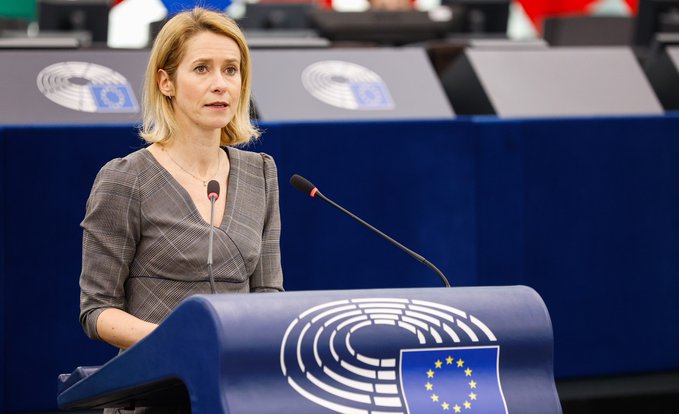
Kaja Kallas, EU High Representative for Foreign Affairs and Security Policy, speaks in EU Parliament (Image Kallas on X)
As Washington’s priorities change, the EU’s top diplomat warns that Europe must step up—or risk a return to a world where might makes right
By TRH World Dek
New Delhi, January 28, 2026 — A quiet but profound reorientation is underway across the Atlantic—and it is shaking the transatlantic relationship to its foundations.
That was the unmistakable warning delivered by Kaja Kallas, the European Union’s High Representative for Foreign Affairs and Security Policy, in remarks that mark one of the clearest strategic assessments from Brussels in years. Her message was neither anti-American nor alarmist. It was, instead, brutally realistic.
“Let me be very clear,” Kallas said. “We want strong transatlantic ties. The United States will remain Europe’s partner and ally.”
But she added the sentence that defines the moment: Europe is no longer Washington’s primary centre of gravity.
This shift, she stressed, is not episodic or personality-driven. It is structural, not temporary—the result of changing global power balances, domestic priorities in the US, and an international system under strain.
For Europe, the implications are stark. No great power in history, Kallas reminded her audience, has ever outsourced its own survival and endured. The age when Europe could rely on the United States as the default guarantor of security, stability, and global norms is drawing to a close. What replaces it depends on whether Europe adapts—or hesitates.
The strain is already visible. The international rules-based order, painstakingly constructed over the past 80 years, is under severe pressure. Institutions meant to enforce norms are weakening. Coercive power politics is returning. Spheres of influence are re-emerging. The idea that might makes right is no longer theoretical—it is operational.
Kallas warned that this “virus has started to spread.”
Her assessment echoes remarks by Canadian Prime Minister Mark Carney at Davos, who bluntly acknowledged that the old assumptions underpinning Western leadership no longer hold. Together, these voices signal a broader recognition among US allies: the tectonic shift is real, and denial is no longer a strategy.
Europe’s challenge, therefore, is not to decouple from Washington—but to rebalance the relationship. Strategic autonomy, defence readiness, industrial resilience, and diplomatic coherence are no longer optional debates. They are urgent requirements.
This moment demands political courage. Taking down the old sign—one that assumed permanent American centrality—does not mean abandoning partnership. It means recognising reality and acting accordingly.
The transatlantic bond will endure, but on different terms. A stronger Europe is not a threat to that alliance; it is its precondition.
History suggests that periods of transition punish complacency. Kaja Kallas’ remarks are a warning shot—not against the United States, but against European inertia.
Pakistani Analyst Reads Germany Signaling India Pivot for Europe
Follow The Raisina Hills on WhatsApp, Instagram, YouTube, Facebook, and LinkedIn




About The Author