Eight Filters vs Reality: Can India’s Reforms Ever Be Perfect?
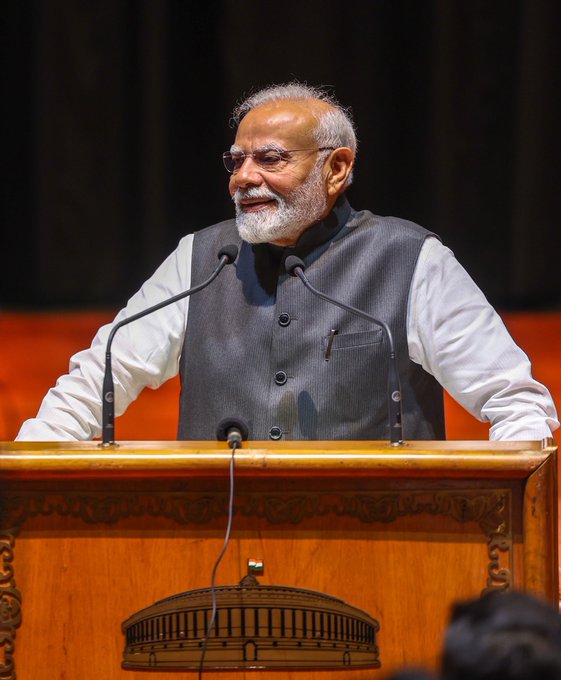
Prime Minister Narendra Modi at an NDA parliamentary party meeting on Tuesday! (Image X.com)
India governance reform debate reignites as ‘perfect policy checklist’ clashes with political economy reality
By P. SESH KUMAR
New Delhi, February 23, 2026 — The viral checklist that says every idea must be politically acceptable, socially desirable, technologically feasible, financially viable, administratively doable, judicially tenable, emotionally relatable and environmentally sustainable sounds like a governance dream manual. On paper, it is flawless. In India’s real political economy, however, it reads less like a roadmap and more like a wish list written in an air-conditioned policy lab far away from district collectors’ offices, courtrooms bursting with pendency, coalition compulsions, vote-bank anxieties and implementation fatigue.
This assessment attempts to strip the poetry from the principle and examine whether such perfection is even remotely achievable in India’s lived governance environment.
There is something irresistibly elegant about that list. It promises a world where every reform glides smoothly through Parliament, is loved by society, paid for without fiscal pain, implemented without leakage, upheld by courts without delay, embraced by citizens with warmth and delivered without harming nature. If governance were a PowerPoint presentation, this would be slide one.
But India is not a slide deck. It is a noisy democracy of 1.4 billion people, fractured interests, institutional overload and permanent political negotiation.
Let us start with political acceptability. In India, political consensus is not built around what works but around what wins elections. Power tariffs are not rational because of farmers’ vote. Freebies multiply not because budgets allow but because opponents promise more. Structural reforms that hurt in the short term- land markets, municipal taxation, rational subsidies, civil service accountability — routinely die because no politician survives the first wave of anger. If every idea had to be politically comfortable, GST itself would never have happened. Farm laws would not even have been drafted. Disinvestment would remain a speech, not a policy.
Then comes social desirability — a dangerously vague phrase in a society as unequal as ours. What is socially desirable for urban taxpayers is often intolerable for rural households. What benefits informal workers terrifies small traders. What helps honest businesses unsettles those thriving in regulatory grey zones. In India, every reform creates winners and losers instantly- and the losers scream louder. Social harmony is not the natural outcome of reform; it is something governments must actively manage, often with compensation and narrative warfare.
Technological feasibility is the easiest box to tick today — India can build world-class digital platforms in record time — but it is also where illusions begin. Aadhaar, GSTN, PFMS, e-courts, land digitisation all looked perfect in design and still collapsed repeatedly in execution phases. Technology works beautifully in Delhi conference halls (Global AI Summit is the latest example) and struggles heroically in tehsils with power cuts, poor connectivity and overworked clerks. Feasible does not mean functional at scale.
Financial viability is where reform idealism meets fiscal gravity. Every good idea in India is announced with brave intent and funded with hope. Municipal reforms without property tax reform. Health insurance without hospital capacity. Infrastructure missions without maintenance budgets. Welfare schemes without long-term revenue backing. The Indian state (Union as well as State Governments) has mastered the art of launching without sustainably paying.
Administratively doable is perhaps the most underestimated fantasy. Our country runs on an overstretched bureaucracy managing hundreds of schemes simultaneously, burdened with compliance reporting, audits, court cases and political pressure. Every new reform adds layers of portals, committees, dashboards and monitoring — but rarely adds manpower, training or institutional reform. Policy ambition keeps rising; administrative capacity barely moves. Can we say that we design Ferrari policies and drive them on bullock-cart institutions.
Judicially tenable sounds noble until one meets India’s legal reality. Laws are routinely stayed, challenged, delayed and reinterpreted for years. Projects worth thousands of crores freeze in litigation. Environmental clearances, land acquisition, regulatory penalties and tax demands remain sub judice longer than many careers last. Retrospective taxation has resurfaced. Insolvency and Bankruptcy law is undergoing upheaval even after a decade of introduction. A reform that requires swift judicial certainty is practically asking for divine intervention.
Emotionally relatable is where populism quietly enters policy. If every reform must feel good immediately, tough decisions become impossible. Cutting wasteful subsidies, pricing water and electricity realistically, enforcing tax compliance, disciplining public sector inefficiency- none of these are emotionally popular. Yet every successful economy has gone through exactly these painful corrections. Feel-good governance is often feel-poor economics.
And finally, environmental sustainability- morally essential but politically complicated in a developing country where millions still seek basic prosperity. India must grow fast while growing green, but the transition imposes costs that voters, industries and states resist. Every coal phase-down clashes with employment. Every pollution control norm meets industry lobbying. Sustainability is not a switch; it is a negotiated journey.
Put together, the checklist assumes a frictionless state, rational politics, infinite administrative capacity, fast courts, patient citizens and painless trade-offs.
That is not India. That is not any democracy. In reality, most transformative reforms succeed precisely because they violate some of these conditions at the start. They are politically risky, socially contested, administratively messy, financially tight and emotionally unpopular-and only later do their benefits become obvious.
Economic liberalisation in 1991 was not socially comfortable. GST was not technologically smooth. Direct Benefit Transfer was not administratively easy.
Bankruptcy Code was not judicially instant. Yet each shifted India structurally.
Governance is not about waiting for perfect alignment of eight stars in the sky. It is about navigating conflict, absorbing backlash, fixing failures mid-course and building legitimacy over time. When policy waits for universal acceptability, nothing moves.
From Utopian Checklists to Reform Realism
We do not need reforms that satisfy every ideal condition before launch. We need reforms that are politically courageous, administratively supported, financially honest and continuously corrected in real time. The real governance test is not whether an idea looks perfect on LinkedIn-it is whether institutions are strengthened to implement imperfect reforms, whether citizens are protected during transitions, whether transparency reduces misuse, and whether feedback loops fix failures quickly.
Instead of chasing utopia, we must master managed disruption. Bold policy backed by capacity building. Tough reforms cushioned by targeted support.
Technology backed by ground-level systems. Sustainability phased with economic realism. Progress in a democracy is never clean. It is noisy, contested and incremental. Waiting for perfection is the surest way to preserve dysfunction.
Would one be wrong to say ‘If Chanakya were advising modern India, he wouldn’t ask for eight boxes to be ticked first -he would ask which battles are worth fighting now, and how power, institutions and incentives can be aligned to win them over time’.
Reform is not about comfort. It is about courage with course correction. And that, in India’s governance reality, is the only path that has ever worked.
(This is an opinion piece. Views expressed are author’s own.)
Budget 2026 Retrospective Tax: Is India Rewriting the Rules?
Follow The Raisina Hills on WhatsApp, Instagram, YouTube, Facebook, and LinkedIn




About The Author