Economic Survey 2025–26 Makes a Direct Pitch to Global Capital
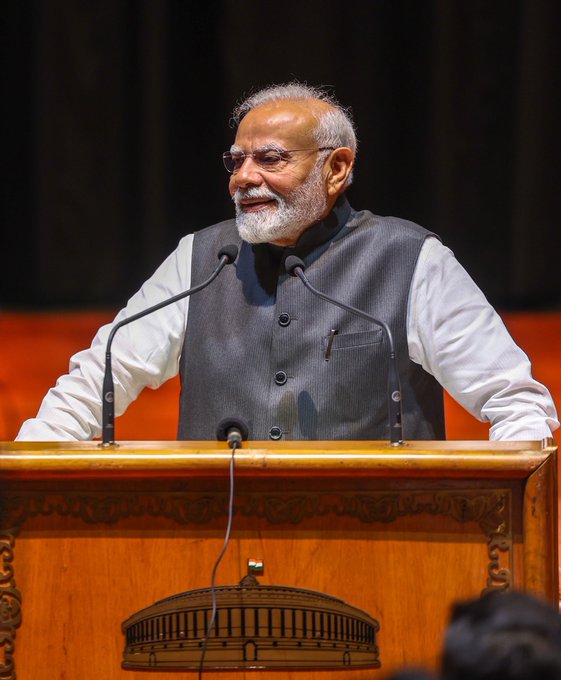
Prime Minister Narendra Modi at an NDA parliamentary party meeting on Tuesday! (Image X.com)
Low inflation, strong balance sheets, and policy credibility position India as the rare large economy where growth and stability now coexist
By PRADEEP KUMAR PANDA
Bhubaneshwar, January 31, 2026 — For global investors navigating a world of elevated rates, geopolitical risk, and slowing growth, India’s Economic Survey 2025–26 reads less like a government report and more like an investment thesis.
The message is unambiguous: India is no longer merely resilient—it is allocatable at scale.
In a global economy distorted by energy weaponisation and strategic trade fragmentation, India stands out as the fastest-growing major economy, with real GDP projected at 6.8–7.2% in FY27. What differentiates this cycle from earlier ones is not speed, but quality of growth.
Private consumption now contributes over 61% of GDP, while investment has climbed to nearly 30%—a composition that reduces volatility and improves earnings visibility. Structural reforms in capital formation, digital public infrastructure, and financial intermediation have lifted India’s potential growth rate to 7%, offering long-duration returns rare among large economies.
Macroeconomic discipline is doing the heavy lifting. The government remains committed to fiscal consolidation, targeting a 4.4% fiscal deficit in FY26, even as effective capital expenditure reaches 4% of GDP. Rising tax buoyancy—especially the expansion of the direct tax base to 48% of gross revenues—signals durable formalisation rather than cyclical revenue spikes.
For investors, inflation control is the most underappreciated signal. Headline CPI averaged just 1.7% between April and December 2025, while core inflation remained anchored. Monetary transmission is working, liquidity is orderly, and India has quietly achieved something many emerging markets struggle with: price stability without growth sacrifice.
The banking system reinforces this credibility. Gross NPAs have fallen to 2.2%, net NPAs to 0.5%, and credit growth to MSMEs remains robust. This creates the precondition for a private capex revival—without balance sheet stress or credit mispricing.
Externally, India is reducing tail risks. Foreign exchange reserves at $701 billion, a narrowing current account deficit, and leadership in greenfield digital FDI ($114 billion between 2020–24) provide insulation against global shocks. Trade agreements with major partners—and negotiations with the EU and UK—signal integration, not retreat.
Sectorally, the opportunity set is broadening. High-tech manufacturing now accounts for 46% of value added, electronics production has surged 30-fold in a decade, and India ranks among the world’s top jurisdictions for patents and trademarks. Services remain the earnings anchor, with India emerging as a global hub for GCCs and deep-tech startups.
Labour market dynamics strengthen the medium-term case. Unemployment has declined to 4.8%, female labour force participation has risen sharply, and labour code reforms are expected to unlock 77 lakh new formal jobs. For investors, this translates into demand durability and social stability—often overlooked but critical variables.
Looking ahead, India’s policy stance on AI, energy transition, and nuclear power reflects pragmatic ambition. A focus on data as a strategic asset, combined with a renewed push for nuclear capacity—backed by a ₹20,000 crore allocation—signals seriousness about long-term energy security and productivity growth.
The Economic Survey 2025–26 does not argue that India is risk-free. It argues something more credible: that India now offers one of the best risk-adjusted growth stories in global markets.
In a world where capital is increasingly selective, that may be India’s strongest pitch yet.
(This is an opinion piece. Views expressed are author’s own.)
Bibek Debroy Memorial Lecture: Shaktikanta Das Weighs Economy
Follow The Raisina Hills on WhatsApp, Instagram, YouTube, Facebook, and LinkedIn




About The Author