Digvijaya Singh’s ‘Full Circle’ Moment Puts Rahul Gandhi in Focus
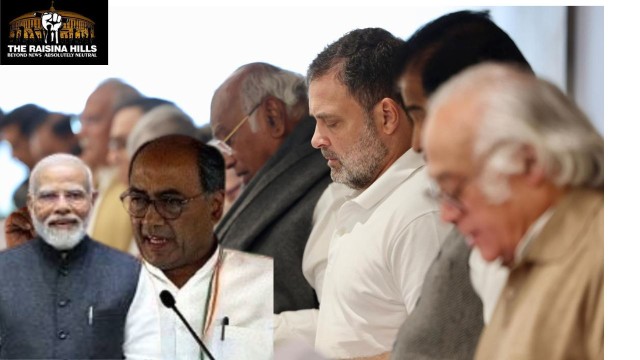
Congress Working Committee meeting in New Delhi took place on Saturday (Image INC India)
As Congress leadership crisis sharpens after repeated electoral defeats, Digvijaya Singh’s unexpected praise of the RSS exposes simmering dissent within the party.
By TRH Political Desk
New Delhi, December 27, 2025 — The Congress Working Committee meeting in Delhi over the weekend was meant to signal introspection. Instead, it opened the lid on a deeper Congress leadership crisis that the party can no longer manage with denials or damage control.
Senior Congress leader and former Madhya Pradesh Chief Minister Digvijaya Singh triggered a political storm by sharing an image of former Prime Minister Atal Bihari Vajpayee and L.K. Advani, praising the organisational strength that allowed an RSS worker to rise from the floor to the office of Prime Minister. Coming from a leader who once popularised the phrase “saffron terror” after the 26/11 attacks, the remark appeared nothing short of a political U-turn.
Singh has since clarified that he was praising the organisation, not the ideology or individuals. “Yet, in politics, context matters more than clarification. His statement arrived at the end of a bruising 2025—a year that has steadily eroded Congress morale and credibility,” said Manish Anand in a monologue for the YouTube channel of The Raisina Hills.
He said thar Singh’s statement “also landed at a time when Rahul Gandhi’s leadership is facing its sternest internal test since the 2024 general elections.”
“After briefly touching the psychological mark of 99 Lok Sabha seats in 2024, Congress’s graph nosedived. Defeats in Haryana and Maharashtra shattered the comeback narrative,” Anand added.
Maharashtra, in particular, exposed the party’s weakness, with the BJP-led NDA registering strike rates above 80 percent, while Congress was virtually wiped out. “Haryana, despite strong local leadership, succumbed to internal factionalism that the central leadership failed to manage,” noted the political journalist in his analysis.
He stressed that “Jharkhand stood out as an exception, driven by sympathy for Hemant Soren and tribal consolidation—factors external to Congress’s organisational strength.” “In Jammu and Kashmir, while the INDIA bloc won, Congress was marginalised, especially in Jammu, prompting it to stay out of government,” added Anand.
He also spotlighted that “Delhi was a zero. Bihar reduced Congress to single digits, raising doubts over the very relevance of the INDIA alliance on the ground.”
Against this backdrop, Digvijaya Singh’s remarks read less like ideological admiration and more like a coded indictment of Congress’s stagnant leadership structure, added Anand.
“Mallikarjun Kharge, at 83, is widely seen as a nominated president, not an empowered one. The contrast with the BJP’s younger organisational leadership has become impossible to ignore,” stressed Anand.
With crucial elections in Tamil Nadu, Kerala, Assam, and West Bengal in 2026, Rahul Gandhi faces an unmistakable reality: this is no longer about optics or yatras. The Congress leadership crisis has entered an agnipariksha phase. “Either the party democratises its leadership and rebuilds organisationally—or the dissent Singh has ignited will only grow louder,” warned Anand.
Amit Shah Vs Rahul Gandhi: History Answers Opposition Questions
Follow The Raisina Hills on WhatsApp, Instagram, YouTube, Facebook, and LinkedIn




About The Author