


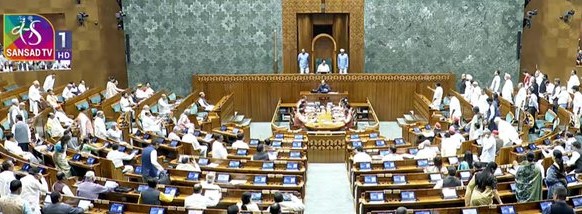
Govt’s three-day legislative push seen as groundwork for women’s reservation; critics warn of “gerrymandering” and loss of federal balance
By KUMAR VIKRAM
New Delhi, April 14, 2026 — The Centre is set to introduce three key Bills during the Parliament session from April 16 to April 18, in what is being seen as a decisive push towards electoral restructuring and governance reform — while also triggering sharp political debate.
As per the agenda, the government will table:
- Union Territory Law Amendment Bill, 2026
- Delimitation Bill, 2026
- Constitution Amendment Bill, 2026
The sequencing reflects a structured legislative strategy—beginning with administrative changes, followed by electoral boundary redrawing, and culminating in constitutional amendments.
On April 16, the Union Territory Law Amendment Bill is expected to focus on updating governance frameworks in select Union Territories, including administrative and local governance reforms. The Delimitation Bill, 2026, slated for April 17, is likely to be the most politically sensitive. It proposes redrawing electoral constituencies based on updated population data, directly impacting representation in the Lok Sabha and state assemblies.
The rationale for this exercise is rooted in demographic changes. While seat allocation has remained frozen based on the 1971 Census — extended through subsequent amendments — the country’s population distribution has undergone major shifts due to urbanisation, migration, and uneven regional growth. The proposed delimitation aims to address disparities between population size and political representation.
On April 18, the government will introduce the Constitution (One Hundred and Thirty-First Amendment) Bill, 2026, which seeks to amend provisions of the Constitution of India, including Articles 55 and 81. The Bill proposes expanding the Lok Sabha’s strength to a maximum of 850 (815 from states and 35 from UTs) members.
The amendment is closely tied to the implementation of the women’s reservation framework under the Constitution (106th Amendment) Act, 2023, which mandates nearly one-third reservation for women but requires fresh delimitation to take effect.
However, the proposed changes have drawn criticism from opposition voices and political analysts. Political scientist Yogendra Yadav in a post on X has alleged that the Bill could “open the floodgates for complete reallocation of seats” and enable potential gerrymandering.
Yadav argued that while the Bill is framed as a step towards enhancing women’s representation, it effectively facilitates early delimitation and expansion of the Lok Sabha. He raised concerns that the legislation removes the existing freeze on seat allocation — based on the 1971 Census — without safeguards to maintain the current proportion of seats among states.
Yadav also flagged that the Bill shifts the decision on which census to use for seat allocation from the Constitution to ordinary law, meaning it could be determined by a simple parliamentary majority. Further, he pointed out that the actual process of redrawing constituencies would be carried out by a Delimitation Commission, with limited scope for judicial review.
The government has yet to formally respond to these specific concerns, but has consistently maintained that the reforms are necessary to ensure fair and updated representation.
The Constitution Amendment Bill will require a special majority for passage, making consensus-building critical. As Parliament takes up the three Bills, the debate is expected to centre on representation, federal balance, and the political implications of redrawing India’s electoral map.
FAQs:
Q1. What are the key Bills being introduced in the Parliament session?
The government will introduce three Bills: the Union Territory Law Amendment Bill, 2026; the Delimitation Bill, 2026; and the Constitution (131st Amendment) Bill, 2026.
Q2. What is the main objective of the Delimitation Bill, 2026?
The Bill aims to redraw electoral constituencies based on updated population data, impacting representation in the Lok Sabha and state assemblies.
Q3. Why is delimitation being proposed now?
Seat allocation has been frozen based on the 1971 Census for decades. Due to demographic shifts, urbanisation, and migration, the government argues that a fresh delimitation is needed for fair representation.
Q4. What changes are proposed in the Constitution Amendment Bill, 2026?
The Bill seeks to amend provisions of the Constitution of India, including expanding the Lok Sabha to a maximum of 815 seats and enabling seat allocation based on a future census.
Q5. How is this linked to women’s reservation?
The implementation of the women’s reservation law (33% quota) requires fresh delimitation of constituencies, making these Bills crucial for its rollout.
Q6. What concerns have critics raised?
Analysts like Yogendra Yadav have warned that the Bill could allow large-scale seat reallocation, weaken safeguards for states, and open the door to potential gerrymandering.
Q7. Will the changes affect the balance of power between states?
Potentially, yes. If seat allocation is recalculated based on new population data without safeguards, states with higher population growth could gain more seats.
Q8. What is required for the Constitution Amendment Bill to pass?
It requires a special majority in Parliament, meaning broad political consensus will be necessary.
Delimitation in India: Past to Future, A Parliament Reset Ahead
Follow The Raisina Hills on WhatsApp, Instagram, YouTube, Facebook, and LinkedIn




