Degrees of Pain: Gender and Mental Health in Higher Education
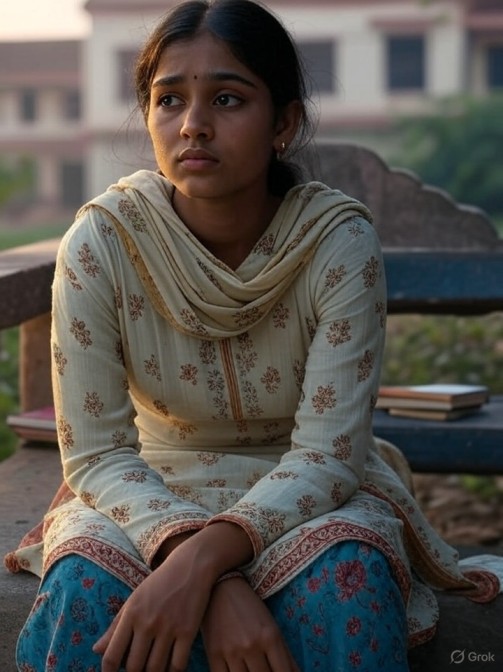
A representative image of stressed scholar (Image TRH)
Death by suicide of a Fakir Mohan College scholar in Odisha highlights a wider, underreported mental health crisis among young women in India’s higher education system.
By PALLAVI DAS
BHUBANESWAR, September 15, 2025 — A young woman at Fakir Mohan (FM) College in Odisha died by suicide recently. Her death, barely reported in national media, speaks to something deeper than a personal tragedy. It is a mirror to the silent crisis facing thousands of female students and scholars across the country—an emotional burden that builds quietly until it becomes unbearable.
In most cases, there’s no harassment to report. No villain to blame. Just the slow, steady pressure of expectations and deadlines—wrapped in institutional rigidity and social roles—that becomes too much for one person to hold.
Not Just a Degree, But a Daily Battle
A woman pursuing a PhD is often balancing more than academic work. She may be married, managing a home, fulfilling cultural and familial duties, and navigating life transitions that don’t show up on her CV. She may be caring for in-laws, dealing with health issues, or caught in emotional stress she can’t name.
It’s not that her supervisor is unsupportive. In many cases, guides are kind and encouraging. But even then, the university’s rules loom large. Notices warn of de-registration. Internal circulars threaten cancellation of admission if scholars do not submit within time. Phone calls from departments remind students that “your time is running out.”
For male or female scholars alike, these policies are stressful. But for women, the stakes are often different. They’re not just fighting a deadline—they’re fighting time, fatigue, and a hundred other invisible responsibilities.
And when they ask for more time—because life got in the way, because they just couldn’t hold it all together that month—the answer is rarely empathetic. Even though the UGC clearly allows six years (and extensions under special circumstances), the tone from many institutions is punitive: “You’ve had enough time,” “Why are you delaying?” “We can’t keep extending forever.”
What no one sees is that sometimes, the delay has no clear reason. It’s not laziness. It’s not irresponsibility. It’s just life—complex, gendered, overwhelming.
And that complexity has no form to fill. No letter to submit. No deadline extension clause for unnameable emotional weight.
The Mental Pressure No One Talks About
Let’s say it clearly: the mental pressure in academia is intense for everyone. But for many female scholars, it takes on a particularly silent, sharp form.
There is the pressure to complete. The fear of failure. The anxiety of disappointing one’s supervisor, one’s family, oneself. The constant internal voice whispering: “You’ve come this far—don’t mess it up.”
And it’s not always a crisis. Sometimes it’s just a slow erosion of joy, motivation, and energy. The deadlines feel heavier. The chapters take longer. And there’s nowhere to say: “I’m trying. I’m tired. I need time.”
Mental health doesn’t always break down with a scream. Often, it collapses in silence.
A Journey Few Understand
For many women, even reaching the PhD level is a journey filled with quiet sacrifices. She may have negotiated with her family to continue studying after marriage. She may be writing her thesis between household responsibilities. She may be the first in her village or family to pursue higher education.
But once she’s in the system, that context disappears. She’s measured by deadlines and forms. Her journey, her internal battles, her resilience—none of that counts when it comes to submission dates.
And if she breaks down or falls behind, she’s told: “You should have planned better.”
What should be a space for learning becomes a countdown clock.
It’s Not Weakness. It’s the Weight of Carrying Too Much
This is not about making excuses. It’s about recognising that real lives don’t always run on academic calendars. That pressure doesn’t always come from cruelty. Sometimes, it comes from silence. From the fear of not being “good enough” to finish. From the loneliness of having no one to say, “It’s okay. You’ll get there.”
These scholars are not weak. They are just tired. Tired of being strong, composed, and responsible every single day. Tired of pretending everything is okay, when inside, it often isn’t.
What Must Change
If we want to prevent future tragedies, we must stop treating these cases as exceptions. They are symptoms of a larger pattern: a university system that talks of academic rigour but offers little emotional scaffolding—especially for women.
- Respect Time as a Right, Not a Favour: UGC’s six-year submission period (and eligible extensions) must be honoured. Extensions should not be treated like indulgences—but as part of a realistic academic life.
- Acknowledge Emotional Labor: Universities must realise that not all delays are due to poor planning. Sometimes, they stem from mental and emotional burdens that women can’t even articulate. And they shouldn’t have to justify their pain to be granted patience.
- Shift from Compliance to Compassion: Administrative communication should not trigger anxiety. Academic systems must move away from threatening de-registration in bulk emails and instead ask: “What support do you need?”
- Create a Culture of Listening: Students need safe, stigma-free spaces to talk—about fear, about doubt, about everything that doesn’t fit into a seminar or progress review.
We Must Learn to See the Unseen
When a female scholar falters, falls behind, or simply disappears from the system, it’s rarely because she lacked ambition. More often, it’s because she was carrying too much—and no one paused to ask how heavy the load was.
In higher education, we celebrate intellectual merit, but we fail to recognise emotional labour. We demand research outputs but ignore the realities that shape a woman’s ability to produce them. We have created a system where silence is mistaken for strength, and vulnerability is punished with bureaucratic indifference.
But resilience should not be the price of survival.
If a university cannot offer empathy, flexibility, and understanding—especially to those who are already navigating a gendered world of invisible responsibilities—it fails in its larger mission of education.
It is time we stopped measuring scholars only by submission dates and started seeing the full human being behind the thesis.
Because the cost of ignoring this quiet crisis is not just delayed dissertations. It is lives lost in silence—and that is too high a price to pay for any degree.
(This is an opinion piece, and views expressed are those of the author only)
Follow The Raisina Hills on WhatsApp, Instagram, YouTube, Facebook, and LinkedIn




About The Author