


By NIRENDRA DEV
The Congress may have sought to corner the Modi government over Vande Mataram and Jantar Mantar, but the two controversies could instead give the BJP potent political ammunition.
New Delhi, August 24, 2026 — “Jeet ke haarne wale ko Congress party kehte hain.”
“The Congress party is very adept at cutting their nose to spite their face,” Biju Janata Dal MP Pinaki Mishra had remarked in August 2023.
The observation seems relevant once again.
At a time when the political atmosphere was not particularly favourable for the BJP or the Narendra Modi government, the Congress appears to have handed its principal rival two political escape routes — and perhaps two major campaign issues.
The two self-goals are the Congress’ handling of Vande Mataram and its political response to the controversy surrounding the “pellet gun FIR” linked to the Jantar Mantar protests.
Of the two, the Vande Mataram controversy could prove to be the bigger political blunder. Its electoral consequences may become clearer once the issue travels beyond the immediate media cycle and reaches the ground.
Congress does not seem to have understood that Vande Mataram, whatever the historical debate around some of its verses, is not simply a Hindu prayer or a song about glorifying Durga. It became a powerful anti-British patriotic song and a rallying cry during the freedom struggle.
The political circumstances that influenced the Congress’ position on the song in the 1930s were also very different. In 2026, there is no Muslim League of the pre-Independence era whose political objections Congress needs to accommodate in the same manner.
Indeed, even among Muslim voters today, there may be many who consider the controversy a non-issue.
That is what makes the Congress’ handling of the matter politically puzzling.
Vande Mataram: A Political Self-Goal
In 1937, the decision to use selected stanzas of Vande Mataram can be understood in the political context of the time. Congress was attempting to accommodate competing political constituencies while the question of Partition had not yet assumed the shape it eventually did.
But in 2026, as India marks 80 years of Independence and the song completes 150 years, reviving the controversy without a clear political objective appears difficult to explain.
The Congress has consequently allowed the BJP to reclaim the issue as one of cultural nationalism.
That could be particularly significant ahead of next year’s Assembly elections in several states, including Uttar Pradesh and Gujarat, where questions of nationalism, identity and cultural symbolism can carry considerable political weight.
The Congress may have intended to make a nuanced political point. Instead, it has allowed the BJP to frame the debate in much simpler terms: who respects Vande Mataram and who does not?
That is rarely a good position for the Congress.
The party’s attempts to explain its position have also invited ridicule. Jairam Ramesh, one of the Congress’ principal communicators, has been unable to prevent the controversy from acquiring a life of its own.
The damage, therefore, may already have been done.
And there is another important political calculation. If a significant section of Muslim voters does not consider Vande Mataram an electoral priority, the Congress could end up paying a political price without necessarily gaining the electoral benefit it appears to have sought.
The ‘Pellet Gun FIR’ Controversy
The second issue is the FIR controversy surrounding the use of pellet guns during the Jantar Mantar protests.
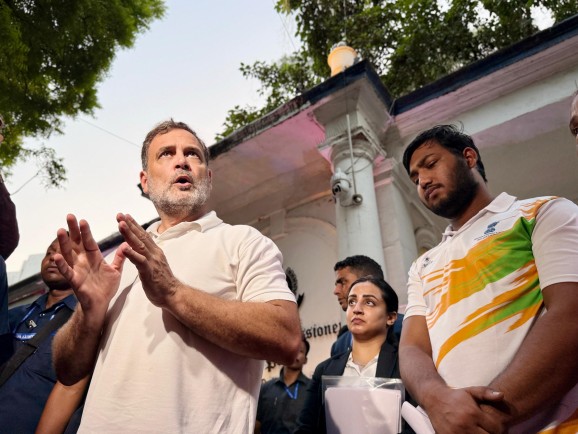
Rahul Gandhi’s August 21 intervention gave the Congress a short-term opportunity to attack the government and the Delhi Police. The Congress could portray the issue as evidence of excessive police action and demand accountability.
But the political problem is that the broader events surrounding the July 20-21 protests and police action are already subject to scrutiny by a Supreme Court-appointed panel.
An FIR, by itself, does not establish criminal culpability. Nor does it automatically translate into political accountability for the Union Home Minister, whom Rahul Gandhi has repeatedly targeted.
The Congress therefore risks turning a legitimate question about police conduct into another partisan confrontation before the facts of the matter have been fully established.
The party’s larger challenge is its longstanding perception among sections of the electorate as being unsympathetic to the security establishment.
That perception has been reinforced over the years by controversies involving Congress leaders’ comments on the armed forces, as well as the party’s political attacks over issues such as the 2016 surgical strikes and Operation Sindoor.
Whether those criticisms were justified or not is a separate debate. Politically, however, the Congress has not succeeded in convincing large sections of voters that it is instinctively on the side of the security forces.
That is why the pellet-gun controversy requires considerably more political caution than the Congress appears to be displaying.
Ram Madhav’s BJP Return: RSS Concession or a Bigger Political Script?
The Jantar Mantar Hangover
The irony is that the Congress’ latest moves come after the party’s high-profile intervention at Jantar Mantar.
Rahul Gandhi’s presence generated substantial media attention. But the Congress has struggled to convert that attention into a sustained political narrative.
Instead, the party now finds itself debating Vande Mataram and police action — precisely the sort of issues on which the BJP has historically enjoyed greater political traction.
This is where political strategy matters.
A successful opposition does not merely attack the government. It chooses the terrain on which the government is most vulnerable.
The Congress, in both these cases, appears to have chosen terrain on which the BJP is far more comfortable.
A Gift for the BJP?
The BJP could now turn the Vande Mataram controversy into a larger cultural-nationalism campaign.
Its organisational machinery, social-media network and political base are well suited to such an exercise.
The issue could therefore become a vote-garnering tool in the coming Assembly elections, particularly in states where nationalism and cultural identity already carry significant political resonance.
The Congress, meanwhile, may discover that a controversy intended to consolidate a section of its support base has instead helped consolidate the BJP’s.
This is the classic problem of a political self-goal: the immediate tactical objective may look attractive, but the strategic consequences can be very different.
As Pinaki Mishra’s 2023 remark suggested, the Congress has often displayed an unfortunate ability to hurt itself while attempting to hurt its opponent.
The BJP could not have asked for a better political opportunity at a time when it was still dealing with the fallout from the Jantar Mantar episode.
If the Congress’ objective was to put the Modi government on the defensive, it has so far achieved almost the opposite.
Rahul Gandhi and Sonia Gandhi may have intended to create political pressure on the government. Instead, they may have handed Narendra Modi and the BJP two ready-made narratives: Vande Mataram and national security.
For the Lotus party, the political takeaway is obvious.
The Congress has done the hard work.
All the BJP may need to do now is pick up the issues and run with them.
And yes, metaphorically speaking, Team Modi could perhaps send a few pizzas and pastries to Congress headquarters — as a thank-you for the political gifts.
(This is an opinion piece. Views expressed are the author’s own.)
CJP Announces September 5 Delhi March, Accuses Govt of Backtracking on July 25 Assurances
Follow The Raisina Hills on WhatsApp, Instagram, YouTube, Facebook, and LinkedIn




