Civil Services Day: When Good Governance Becomes a Photo-Op
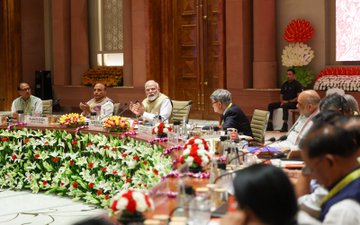
Tenth Governing Council meeting of Niti Aayog in New Delhi (Image Niti Aayog)
As Civil Services Day celebrates delivery optics, India’s good governance narrative sidelines audit and enforcement services whose success depends on exposing uncomfortable truths.
By P. SESH KUMAR
New Delhi, December 28, 2025 — The good work showcased in Annual Civil Services Day (21 April) narratives is often genuine—and sometimes genuinely transformative. But the selection optics are rarely neutral. The Prime Minister’s Awards for Excellence in Public Administration are fundamentally application-driven, filtered through government screening and empowered committees, and finally ratified at the apex.
That makes the awards valuable—but also structurally inclined toward what is safe to celebrate: visible delivery wins, scheme saturation, “innovation” that photographs well, and outcomes that do not openly embarrass the administrative mainstream. This is where a quiet distortion enters: services whose excellence is measured through ‘uncomfortable truths’—like IA&AS (audit exposures) and IRS (enforcement, penalties, evasion detection)—find themselves perennially under-credited in popular governance storytelling.
It is a rare exception that an odd initiative from these and other Civil Services here and there may find a ‘consolation mention’ under say, the ‘innovation’ category. Not because they lack impact, but because their impact is often inseparable from the revelation of failure elsewhere. Consequently, these services devise their own award functions which do not generate the same amount of publicity and recognition that the Annual Civil Service Day awards do.
The “good work” in such public narratives deserves applause—full stop. When a district administration pushes last-mile delivery, de-bottlenecks service timelines, or uses data to prevent leakages, citizens feel the difference first. But here is the inconvenient footnote that India’s governance storytelling rarely prints in bold: what gets celebrated is not the universe of good governance-it is the subset that survives a politically comfortable selection funnel.
The awards are not “the best governance”—they are “the best governance that got nominated”
The Prime Minister’s Awards framework is explicitly built on nominations/applications and then multi-layer evaluation (screening committee, expert committee, empowered committee chaired by the Cabinet Secretary, and final approval).
That architecture is rigorous—but it is also bounded by what is submitted, how it is framed, and what a system is willing to own publicly.
So yes-awards can signal excellence. But they also inevitably signal what governments prefer to project as excellence: outcomes with a neat narrative arc, stakeholder-friendly language, and minimal institutional embarrassment.
853 IRS Officers Quit in a Decade: Tax Service Losing Its Soul?
Civil Services Day 2025: what and how many awards?
For Civil Services Day 2025, the awards conferred were the Prime Minister’s Awards for Excellence in Public Administration, 2024, awarded on 21 April 2025. The Government’s own outline states three buckets: 5 awards for Holistic Development of Districts; 5 awards for Aspirational Blocks Programme; and 6 awards for Innovations (Central Ministries/Departments, States, Districts). That is 16 awards in total.
A question may arise in some quarters. How many non-IAS officers were awarded in Civil Services Day 2025 or earlier years?
Here’s the crucial nuance: the PM Awards (as structured for 2024 and conferred on Civil Services Day 2025) are awards to districts/blocks/organisations, not to named officers by service cadre. The public-facing Civil Services Day 2025 page lists the citation booklet and citation films largely by district/block/initiative name, not by the recipient officer’s service (IAS/IAAS/IRS etc.).
Districts, blocks, and organisations are the entities that are officially awarded based on their submitted applications and evaluation. Officers are often acknowledged informally in media reports because district leadership (often IAS) receives the award on behalf of the nominated entity at the ceremony-but the official citations are tied to project/district/agency outcomes, not to officers’ names or service cadres in the citation booklet itself. This format is consistent with other years’ awards, where institutional entities win and not individual officers by service (unless a specific officer-led innovation is submitted as a Central/State/Agency initiative).
So, if the question is framed strictly as “How many non-IAS officers were awarded?” the most accurate answer-based on the published official material-is: the official published awardee listings do not consistently identify individual officers and their service cadres for 2025; they identify award-winning districts/blocks/organisations/initiatives.
In other words, the design itself blurs the cadre question: a district’s trophy is typically received by the district leadership (often IAS, sometimes otherwise depending on posting structures), but the award is formally attributed to the administrative unit/organisation and initiative-making a “non-IAS count” impossible to compute reliably from the published list alone.
Why IA&AS and IRS or other services’ excellence gets ‘neglected’: the “success” that requires a “failure” to exist
Now to the heart of a sharper point-one that polite governance literature tiptoes around.
IA&AS excellence often means: finding systemic weakness, quantifying loss, documenting irregularity, exposing procurement manipulation, proving avoidable expenditure, or showing how controls failed. In plain terms: the more impactful the audit, the more it implies that someone else’s governance was not as excellent as advertised. It is “good governance” of the immune system-but it begins by diagnosing disease.
IRS excellence often means: widening the tax base, detecting evasion, prosecuting fraud, imposing penalties, dismantling networks, or raising demand through scrutiny. Again: high-impact enforcement is frequently read-politically and socially-as an indictment of the “normal” administration’s deterrence and compliance culture.
And therefore, when the stage is designed to project the State as an unbroken success story, audit and enforcement become the guests who arrive carrying X-rays. Not welcomed, not invited often, and certainly not photographed at the centre.
This is not a moral criticism of the awards; it is a structural truth about incentives. Awards prefer victories that flatter the system. Audit and enforcement victories prove the system needed correction.
The missing piece: objective evaluation that doesn’t confuse “pleasant” with “important”
If we want governance awards to mature, they need a parallel evaluation vocabulary that can reward:
- prevention (controls that stopped a scam, not merely cleaned it up),
- integrity (systems that reduced discretion),
- deterrence (enforcement that changed behaviour),
- and institutional accountability (audit impact that forced reform).
The present award grammar is heavy on delivery outputs and lighter on integrity outcomes-because integrity outcomes are harder to narrate without naming what went wrong.
A practical fix is not to abolish awards. It is to add an independent verification spine:
- citizen feedback and service-level metrics (already used in some form in award evaluation design in earlier years),
- third-party audits/impact evaluations where feasible,
- and a structured role for credible civil society/academia/media as evidence partners (not as judges in a TV debate).
What CAG, CBDT and CBIC should do differently: stop whispering, start publishing
It is true that the organizations like CAG, CBDT and CBIC have instituted their own very internal awards or rewards system where achievements are typically relevant to their respective domains. These do motivate their officers but are not publicized adequately for public or media appreciation.
As an illustration, the observation about CAG Day being internal and media-indifferent is painfully accurate-because the communication product is built for insiders.
If CAG/CBDT/CBIC want their services’ governance contributions to stop being treated as “background radiation,” they need a modern public narrative stack: CAG should publish a yearly “Audit Impact Report” – not just an activity report that is dull but one that tracks accepted recommendations, recoveries, systemic reforms triggered, and time-to-correction-and write it in citizen language, not only parliamentary prose. It should build a searchable public dashboard of thematic audit outcomes (procurement, health, highways, PSUs), showing what changed after audit-because impact is the only antidote to “CAG only points fingers.”
Similarly, CBDT / CBIC could publish enforcement impact in a way that does not look like triumphalism: behavioural compliance outcomes, reduction in fraud vectors, faster dispute resolution, analytics-led targeting, and taxpayer service improvements alongside collections. They should institutionalise “Tax Administration Excellence Notes” where one sees not just revenue numbers, but cost of collection, litigation outcomes, time-to-refund, time-to-assessment closure, grievance disposal-so excellence is not reduced to “more tax extracted.”
And across all three: nominate, nominate, nominate. The awards are application-driven. Silence guarantees invisibility.
Make room for the governance that corrects governance
If Civil Services Day wants to be more than an annual victory parade, it must learn to honour two kinds of excellence in the same breath: the excellence that delivers and the excellence that detects and deters.
India does not need fewer success stories. It needs success stories that can tolerate the adult truth that strong governance is not only the ability to build; it is also the courage to inspect, to penalise, and to admit where the scaffolding was weak.
Because the Republic’s most valuable civil servant is not merely the one who cuts a ribbon-but also the one who quietly prevents the ribbon from covering a crack.
(This is an opinion piece. Views are personal)
How a ‘Digital’ Tax System Let Fraud Thrive Until CAG Intervened
Follow The Raisina Hills on WhatsApp, Instagram, YouTube, Facebook, and LinkedIn




About The Author