‘Chor-der Energy’: Mamata’s ED Clash and Political Freefall
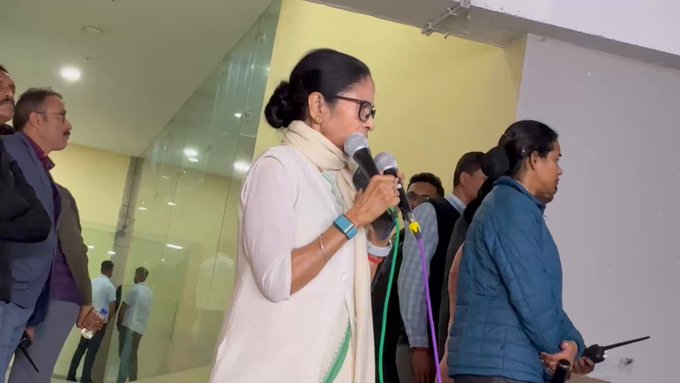
West Bengal CM Mamata Banerjee speaks to supporters during ED raid at I-PAC office (Image AITMC on X)
From shielding a private firm to attacking federal probes, Mamata Banerjee’s latest confrontations may mark the fastest fall of a powerful chief minister
By NIRENDRA DEV
New Delhi, January 10, 2026 — There is an old saying in politics—and in nature—everything that rises unchecked eventually falls. Often, the fall is steep, sudden, and unforgiving. West Bengal Chief Minister Mamata Banerjee now appears to be hurtling towards such a moment.
BJP leader Suvendu Adhikari has coined a slogan that captures the current political mood with brutal simplicity: “Chor-der Energy—Mamata Banerjee.” The implication is direct—that corruption draws its power and protection from the very top.
This slogan may prove to be the most politically damaging phrase Mamata Banerjee has faced in her long and combative career.
The immediate trigger is her recent attempt to confront and obstruct an Enforcement Directorate (ED) operation linked to alleged wrongdoing involving a private political consultancy firm. Instead of allowing the probe to proceed, the Chief Minister chose public confrontation—effectively positioning herself as a shield between investigators and the accused.
That decision has raised an unavoidable question: what exactly is she afraid of?
In trying to justify the obstruction, Mamata Banerjee claimed the ED raid was aimed at “stealing election strategy and data” from the I-PAC office. For a leader of her experience, the explanation bordered on the implausible.
Election strategies are not nuclear secrets. They are not rocket science. They are built on ground-level mobilisation, narrative framing, candidate selection, and social coalitions—most of which are visible to political observers and accessible through open sources. The idea that a federal agency would raid an office merely to “steal data” defies both logic and credibility.
Worse, the claim insults institutional intelligence. Neither the Union government nor the BJP leadership needs investigative agencies to collect electoral data—nor would January be the time to do so for an election months away.
Suvendu Adhikari, once Mamata Banerjee’s trusted lieutenant and now her fiercest critic, escalated the attack by alleging that ₹16 crore had already been paid to the private firm in question, even sharing cheque details publicly. His rhetoric grew harsher when he declared, “If Sheikh Shahjahan is a goonda, she is a goondi.”
Such language is extreme—but it reflects how rapidly the political discourse around the Chief Minister is deteriorating.
Mamata Banerjee has never been known for restraint. She has clashed with Prime Ministers, insulted constitutional authorities, and publicly humiliated senior leaders—including former Lok Sabha Speaker Somnath Chatterjee. Yet this time, her actions go beyond discourtesy. By preventing a central agency from performing its legal duty, she may have triggered the beginning of a serious loss of legitimacy.
The deterioration of law and order was visible even inside the Calcutta High Court, where proceedings had to be disrupted due to chaos involving Trinamool Congress supporters. Despite repeated warnings, decorum was not restored—forcing the judge to threaten leaving the courtroom.
This is not defiance; it is institutional breakdown.
Mamata Banerjee has long survived on political gimmickry and a “street-fighter” image. But that formula is wearing thin. Her 2021 victory depended heavily on strategic voting, particularly in South Bengal, where Congress and Left votes collapsed entirely in her favour. Sympathy did not save her in Nandigram. Arithmetic did.
Today, frustration appears to have replaced calculation. Arrogance has overtaken instinct. And insecurity now defines her politics.
In January 2026, Mamata Banerjee increasingly resembles leaders she once mocked—authoritarian in tone, dismissive of institutions, and surrounded by loyalists willing to push the system to the brink.
Every powerful leader faces a moment when gravity asserts itself. For Mamata Banerjee, that moment may have arrived.
(This is an opinion piece. Views expressed are author’s own)
Follow The Raisina Hills on WhatsApp, Instagram, YouTube, Facebook, and LinkedIn




About The Author