China’s $1 Trillion Trade Surplus: Trump–Xi Showdown Inevitable

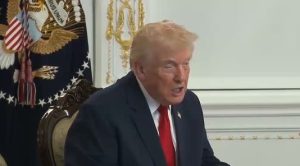
US President Donald Trump with Chinese President Xi Jinping. (Image video grab)
From record-breaking export dominance to geopolitical shockwaves, economists and policy voices warn that China’s unprecedented $1T+ trade surplus will reshape U.S.–China ties, fuel tariff politics, and test Washington’s economic resolve.
By TRH Foreign Affairs Desk
New Delhi, December 8, 2025 — China has crossed a psychological and political milestone — a trade surplus exceeding $1 trillion in just the first 11 months of the year. It is a figure that has stunned economists, rattled Washington and revived debates on whether the global trading system can absorb China’s relentless export juggernaut without deeper political blowback.
Indian market analyst Ajay Bagga noted the sheer scale of Beijing’s export advantage, pointing out that this year’s surplus has already surpassed 2024’s full-year figure of just under $1 trillion. “This comes even after a de-escalation in trade tensions,” Bagga wrote, referencing the one-year truce negotiated last October between Washington and Beijing.
But the more striking takeaway for analysts is not the size of the surplus — it is the speed and resilience of China’s export machine. Finnish economist Jari-Pekka Raitama captured the sentiment succinctly: “China’s $1T+ trade surplus shows how quickly its export sector adapts… Even with weaker US demand, Chinese suppliers shifted to other markets.”
That adaptability is precisely what alarms policymakers in Washington and Brussels. If tariffs cannot dent China’s export ambition, what tools remain?
Former IMF First Deputy Managing Director Gita Gopinath echoed this concern, noting that China offset falling U.S. demand by expanding aggressively into Europe and East Asia. “China’s growth at 5% this year seems unaffected by tariffs. Hard to see this last though,” she warned.
In U.S. political circles, the milestone has injected new urgency into trade rhetoric. Conservative economist Stephen Moore, speaking on Fox News, said the record surplus strengthens the case for a tougher line: “Trump will have to force China to buy more American products and stop discrimination… They discriminate against our dairy, farm and manufacturing goods.”
Yet Moore also made a counterintuitive point — that cheap Chinese imports ease U.S. consumer inflation. “Low-priced Chinese goods make things more affordable in the United States,” he said, calling himself a “free trader” even as he backed Trump’s push to shrink the deficit.
The geopolitical weight of the numbers is unmistakable. April’s planned Trump–Xi meeting in Beijing is now viewed as a decisive chapter in the remaking of the global trade order.
China’s surplus has always been an economic story. Now it has become a political one — and a test of whether the world is ready for the next phase of U.S.–China rivalry.
Follow The Raisina Hills on WhatsApp, Instagram, YouTube, Facebook, and LinkedIn




About The Author