Can Prashant Kishor Build a New Political Center in Bihar?
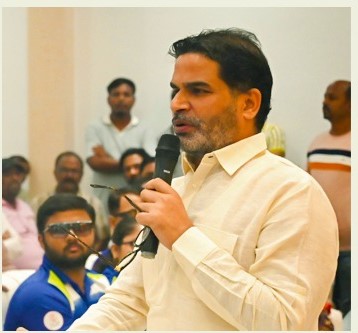
Image credit X.com @JanSuraaj
After shaping electoral narratives for others, Kishor now faces India’s hardest political test — turning ideas into votes in a state where caste, charisma, and continuity still rule.
By AMIT KUMAR
Patna, November 13, 2025 — Prashant Kishor’s career has always been about helping others win. Now, as Bihar’s assembly elections wind down, the master of the political narrative faces his most elusive experiment yet — winning for himself.
For a decade, Kishor has been the unseen architect behind India’s most successful campaigns. From Narendra Modi’s 2014 blitz to Mamata Banerjee’s defiance in Bengal, he redefined the language of persuasion — data-driven, disciplined, and cinematic. Yet politics, unlike campaigns, is not a project. It is permanence. And permanence in Bihar demands something Kishor has long helped others manufacture: credibility.
In the cluttered landscape of Bihar’s politics, Kishor’s Jan Suraaj movement is an audacious bet. He speaks of breaking the twin monopolies of caste and communal politics. He disowns the language of identity — “I belong to no caste,” he says — and refuses to adopt the religious vocabulary that fuels the BJP’s Hindutva. But in India’s electoral grammar, neutrality rarely wins elections.
The precedents, however, are not discouraging. Indian democracy has repeatedly birthed successful new parties — Mamata Banerjee’s Trinamool Congress in West Bengal, Naveen Patnaik’s Biju Janata Dal in Odisha, Mayawati’s Bahujan Samaj Party in Uttar Pradesh, and Arvind Kejriwal’s Aam Aadmi Party in Delhi and Punjab. Each began as a reaction — to centralization, corruption, or exhaustion. Each also forged an alternative moral claim to power. Kishor seems to believe Bihar is due for its own revolt.
There is, perhaps, logic to that belief. By 2029, Nitish Kumar will be 79 — a political survivor nearing the end of his arc. The BJP in Bihar suffers from what analysts call “the post-Modi vacuum”: a lack of a recognizable state leader. Tejashwi Yadav remains the opposition’s most visible face, but he carries the burden of dynasty and a nostalgia for his father’s era that few younger voters share.
This leaves a gap — the kind of gap that modern India’s restless electorate sometimes fills with new experiments. Kishor has already built the scaffolding for one: a state-wide grassroots network that claims presence in nearly every block and panchayat, and a campaign style that blends digital precision with street-level mobilization.
Yet the central question remains: can Prashant Kishor the strategist become Prashant Kishor the politician? His critics doubt his appetite for electoral combat. Bihar, unlike Delhi, is not kind to half-measures. “You can’t do politics in Bihar like Bal Thackeray — by remote control,” says a local observer. “You have to contest. You have to bleed.”
Kishor’s insistence on remaining equidistant from both BJP and RJD may appeal to Bihar’s politically fatigued middle, but neutrality also risks invisibility in a polarized ecosystem. The measure of his seriousness, as voters will see it, is whether he commits fully — fielding candidates, contesting personally, and enduring defeat, if only to build credibility.
Still, in the quiet hum of post-election Bihar, one truth resonates: a political vacuum is forming. Nitish Kumar’s twilight, BJP’s leadership deficit, and Tejashwi’s untested promise have together opened a rare corridor in Bihar’s rigid political geometry. Kishor’s challenge is to walk through it before it closes.
The man who once built India’s most effective narratives may now have to live one.
Follow The Raisina Hills on WhatsApp, Instagram, YouTube, Facebook, and LinkedIn




About The Author