CAG Must Audit Beyond Numbers: Ex-DG Warns of Diluted Onus
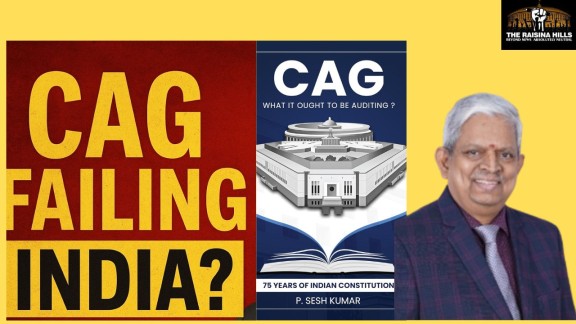
CAG: What It Ought to be Auditing by P Sesh Kumar (Image TRH)
In his new book CAG: What It Ought to Be Auditing, ex-Director General of the CAG of India, P. Sesh Kumar, calls for timely, independent, and performance-driven audits.
By MANISH ANAND
NEW DELHI, August 24, 2025 —As India reflects on its 79th Independence Day, former Director General of the Comptroller and Auditor General (CAG) of India, P. Sesh Kumar, has released a timely sequel to his earlier work on the institution. His latest book, CAG: What It Ought to Be Auditing, examines whether the CAG — India’s constitutional financial watchdog — is fulfilling its mandate in safeguarding public accountability.
In an interview with The Raisina Hills, Kumar said the book was born from concerns over the independence, timeliness, and efficacy of the CAG’s reports, which in recent years have been criticized as delayed, diluted, or politically skewed. “The CAG has the constitutional power to be independent. But independence ultimately depends on the individual who occupies the chair,” Kumar remarked.
The 600-page volume highlights missed opportunities, such as the absence of a comprehensive audit of the 2016 demonetisation exercise, which Kumar calls a “significant failure of scrutiny.” Similarly, he flagged delays in high-profile audits like the Antrix-Devas deal and the Noida Toll Bridge case, warning that “delays dilute the impact of CAG reports.”
Kumar stresses the difference between “performance audits” and “outcome audits”, arguing that the shift to the latter has narrowed the scope of oversight. “The CAG should examine not just outcomes but also the design, assumptions, and execution of flagship schemes worth trillions of rupees,” he said, citing welfare programs like MGNREGA and key sectors such as renewable energy, MSMEs, and judicial efficiency.
He also pointed to success stories, including a CAG report that contributed to reducing rhino poaching in Assam’s Kaziranga National Park by working closely with forest rangers and villagers. “That report became a template for conservation,” Kumar noted, contrasting it with the missed audits on critical economic policies.
On the question of independence, Kumar acknowledged the controversy around the CAG’s appointment process, which is controlled by the executive. While the Supreme Court has upheld the current system, PILs continue to challenge it. “The CAG is the financial conscience keeper of India. If the head chooses gratitude to the appointing authority over independence, democracy suffers,” Kumar warned.
With Prime Minister Narendra Modi promising a “next generation GST” reform from the Red Fort, Kumar argued that a proactive and root-cause-driven CAG audit of GST architecture could have provided valuable insights. However, he noted that lack of access to taxpayer records remains a handicap.
Ultimately, Kumar frames his book as not a technical treatise but a call to strengthen India’s democracy at 75. “The CAG is not a mere accountant. He is the most important officer of the Constitution, ensuring accountability of the executive to Parliament,” he emphasized.
Follow The Raisina Hills on WhatsApp, Instagram, YouTube, Facebook, and LinkedIn




About The Author