Bullet Train: Why Palghar Tunnel Marks a Turning Point
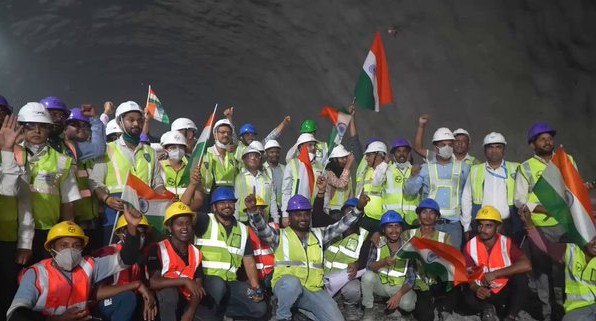
India’s Bullet Train Breaks Through the Mountains (Image Ashwani Vaishnaw on X)
With the first mountain tunnel breakthrough in Maharashtra, the Mumbai–Ahmedabad Bullet Train moves from scepticism to inevitability—reshaping travel time, jobs and India’s infrastructure ambition
By AMIT KUMAR
New Delhi, January 2, 2026 — For years, India’s Bullet Train has been mocked as elitist, delayed, or over-ambitious. On Friday, deep inside the mountains of Palghar, Maharashtra, that narrative cracked—quite literally.
With the successful breakthrough of the first mountain tunnel of the Mumbai–Ahmedabad High Speed Rail (MAHSR) project, Union Railway Minister Ashwini Vaishnaw sought to suggest that India’s most ambitious transport project has crossed a point of no return.
This was not just another engineering update. It was a psychological breakthrough.
Why the Palghar Tunnel Matters
The tunnel—MT-5, nearly 1.5 km long—is among the longest mountain tunnels in Palghar district, located between Virar and Boisar. Excavated from both ends within 18 months, it used advanced drill-and-blast technology, allowing real-time monitoring of geological behaviour and adaptive safety measures.
In infrastructure terms, mountain tunnelling is where projects either stall—or succeed. The Palghar breakthrough demonstrates that India’s high-speed rail ecosystem has matured enough to execute complex, high-risk engineering in difficult terrain.
This is Maharashtra’s first mountain tunnel success in the Bullet Train project—and a critical confidence boost after years of political and land-acquisition turbulence.
From Prestige Project to Middle-Class Utility
Ashwini Vaishnaw’s framing is deliberate: the Bullet Train, he insists, is not a luxury toy but middle-class infrastructure.
Once operational, the train will slash Mumbai–Ahmedabad travel time to just 1 hour 58 minutes—integrating two of India’s most powerful commercial regions into a near single economic zone. For professionals, students, entrepreneurs and small businesses, this is not speed—it is time sovereignty.
The corridor is expected to generate significant employment during construction and long-term jobs during operations, while catalysing industrial clusters, logistics hubs, and IT corridors along its 508-km stretch.
A Green Argument Often Ignored
One of the least-discussed aspects of the project is environmental impact. According to official estimates, the Bullet Train could lead to a nearly 95 percent reduction in carbon dioxide emissions compared to road transport.
At a time when infrastructure projects are routinely attacked as environmentally reckless, the MAHSR offers a counter-model: speed with sustainability.
The Scale of the Challenge—and the Progress
The MAHSR project spans 508 km, with: 352 km in Gujarat and Dadra & Nagar Haveli; 156 km in Maharashtra; and 27.4 km of tunnels, including eight mountain tunnels.
In Maharashtra alone, seven mountain tunnels are under construction, totalling about 6 km. The Palghar breakthrough puts real momentum behind a project that critics long dismissed as perpetually delayed.
Earlier, in September 2025, the project completed its first underground tunnel between Thane and BKC, reinforcing the sense that execution—not announcement—is now driving the project.
Beyond Trains: A Statement of Intent
The Bullet Train is no longer just about faster travel. It is about India’s credibility as an infrastructure state—one that can absorb technology, execute at scale, and think long-term.
From knowledge transfer to engineering self-reliance, the MAHSR is quietly laying the foundation for future high-speed corridors across India.
The Palghar tunnel does not end the journey. But it decisively ends the doubt.
(This is an opinion piece. Views expressed are those of author’s own.)
36-Meter-Tall Bridge Rising Over Sabarmati for Bullet Train Project
Follow The Raisina Hills on WhatsApp, Instagram, YouTube, Facebook, and LinkedIn




About The Author