Budget 2026 Misses Reform Moment as Modi Govt Rides Caution
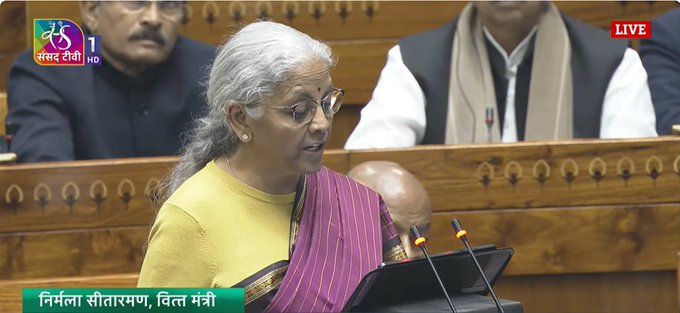
Union Minister for Finance Nirmala Sitharaman in the Lok Sabha on Sunday (Image Sansad TV)
No Key Reform Push as Budget 2026 Sticks to Business-as-Usual Economics
By NIRENDRA DEV
New Delhi, February 2, 2026 — When it comes to Budget-making, the Modi government faces two persistent dilemmas. First, it has a limited grasp of hard-core economics. Second—and more importantly—it understands the politics of the economy far better. This explains its chronic over-cautiousness.
In defence and national security, the government has shown aggression and clarity. Politically, the BJP has been near-supreme, inching towards a one nation–one party milestone. But when it comes to deep economic reform, caution has been the defining feature—whether in 2014 or even after 12 years in power in Budget 2026.
This year’s Budget took no meaningful steps to dismantle gatekeepers and rent-seekers who inflate India’s cost of production. Equally disappointing was the failure to unlock reform in the archaic agricultural distribution system—an omission that guarantees continued inefficiencies and losses in the farm sector.
Beyond a tax holiday for data centres set up by foreign investors, Finance Minister Nirmala Sitharaman offered little by way of transformative incentives or reforms. To her credit, she stayed committed to fiscal consolidation, lowering the fiscal deficit to 4.3 per cent in FY 2026–27 from 4.4 per cent the previous year. She resisted populism and avoided reckless spending.
Capital expenditure rose modestly—from ₹11.11 lakh crore to ₹12.2 lakh crore—despite heightened security pressures following Operation Sindoor. This restraint is exactly what global investors and credit rating agencies appreciate.
Yet, the Budget’s central flaw is its business-as-usual mindset.
At a time when protectionism is rising globally and great powers are forcing middle powers to choose sides, India cannot afford incrementalism. It must urgently make itself more competitive and attractive for investors.
The reality check is sobering. As China races toward becoming the world’s largest economy, India remains far from the promised $5 trillion milestone. Economists note the absence of big-ticket reforms—lower tax rates, simpler tax structures, labour and land reforms, or decisive privatisation of loss-making PSUs.
To be fair, the finance minister attempted longer-term structural nudges—renewed emphasis on manufacturing, semiconductors, rare-earth corridors, MSME support, customs rationalisation, and infrastructure spending.
Bottom line: Budget 2026 will not excite those seeking giveaways. It will reassure those who understand statecraft.
But patience, boredom, and discipline alone will not propel India into the top tier of global economies. At some point, reform must stop waiting for the perfect political moment.
(This is an opinion piece. Views expressed are author’s own.)
Follow The Raisina Hills on WhatsApp, Instagram, YouTube, Facebook, and LinkedIn




About The Author