Budget 2026–27: Is Odisha Finally Overcoming Historical Neglect?
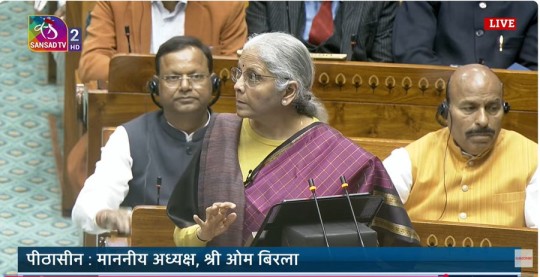
Finance Minister Nirmala Sitharaman presents Budget 2026 (Image Sansad TV)
Fiscal discipline, record capex and Purvodaya promises lift Odisha on paper, but welfare gaps and missed projects fuel political backlash
By PRADEEP KUMAR PANDA
Bhubaneswar, February 7, 2026 — The Union Budget 2026-27, presented by Union Finance Minister Nirmala Sitharaman on February 1, 2026, emphasizes fiscal consolidation, infrastructure-led growth, and strategic sectoral investments while maintaining policy continuity amid global uncertainties. Positive aspects include a reduced fiscal deficit to 4.3% of GDP, record capital expenditure of ₹12.2 lakh crore, and targeted reforms in manufacturing, MSMEs, and employment generation.
However, negatives encompass modest tax buoyancy, unchanged personal tax slabs, and perceived inadequacies in rural welfare spending. With a special lens on Odisha, the budget marks a potential shift by prioritizing the state through initiatives like National Waterway-5 and Rare Earth Corridors under the Purvodaya framework.
Historically, since 2014, Odisha has faced criticisms of neglect from opposition parties, yet data reveals a substantial increase in central allocations, devolution, and infrastructure investments under the NDA regime compared to the UPA era.
India’s Union Budget serves as a pivotal instrument for macroeconomic steering, resource allocation, and addressing regional disparities in a federal structure. The 2026-27 budget, themed around “Viksit Bharat (Developed India)” and “Yuva Shakti (Youth Power)”, reflects a mature policy stance prioritizing stability, structural reforms, and long-term competitiveness over populist measures. Presented against a backdrop of global trade tensions, it projects a real GDP growth of 6.8-7.2% for FY26 and nominal growth of 10%. Total expenditure is estimated at ₹53.47 lakh crore, a 7.7% increase from revised estimates of FY26.
Odisha, while rich in minerals and natural resources, has historically been plagued by perceptions of central neglect. Since 2014, under the NDA government, Odisha’s budgetary narrative has evolved from allegations of discrimination to evidence of enhanced allocations, though political critiques persist.
Positive Aspects of the Union Budget 2026-27
The budget embodies a “growth + discipline” paradigm, balancing fiscal prudence with investments in productivity and resilience. These elements collectively position the budget as a catalyst for inclusive, resilient development. Key positives include:
Fiscal Consolidation and Macroeconomic Stability: A cornerstone is the fiscal deficit target of 4.3% of GDP for FY27, down from 4.4% in FY26 revised estimates, aligning with a new debt-to-GDP framework aiming for 50±1% by 2030-31. This prudent path, reducing debt from 56.1% in FY26 to 55.6% in FY27, enhances credibility and shields against external shocks like U.S. tariff hikes. The approach avoids dramatic giveaways, focusing on sustained 7% growth through public investment.
Infrastructure and Capital Expenditure Push: Record capital expenditure (capex) of ₹12.2 lakh crore (3.1% of GDP) underscores infrastructure as a growth multiplier. This includes ₹1.85 lakh crore in capital loans to states and development of City Economic Regions (CERs) with ₹5,000 crore per region over five years via challenge-mode financing. Such investments are poised to boost employment, connectivity, and urban-rural linkages.
Sectoral Reforms and Employment Focus: The budget prioritizes seven strategic sectors (e.g., semiconductors, biopharma) and rejuvenates legacy industries like textiles. Initiatives like the SME Growth Fund, expanded TReDS, and risk capital access aim to empower MSMEs and create “Champion SMEs.” Agriculture and allied sectors see enhanced support, with health and education allocations rising by 12.6%. Tax simplifications, including unified safe harbors for IT services and decriminalization of minor offenses, enhance ease of doing business.
Energy Security and Regional Development: A ₹20,000 crore allocation for CCUS technologies and customs duty exemptions for clean energy components signal a green transition. The Purvodaya initiative for eastern states, including 20 new national waterways, fosters balanced growth.
Negative Aspects of the Union Budget 2026-27
Despite its strengths, the budget faces criticism for conservatism and inadequacies in addressing immediate vulnerabilities. These shortcomings highlight a budget that prioritizes stability over aggressive stimulus, potentially exacerbating inequalities.
Modest Revenue Projections and Tax Buoyancy: Gross tax revenue growth is budgeted at 8%, with indirect taxes at a mere 3% due to GST contraction. Tax buoyancy dips to 0.8, showing reliance on fiscal compression rather than robust revenue mobilization. Unchanged personal tax rates and slabs disappoint the middle class, potentially dampening consumption.
Rural and Welfare Spending Concerns: Revenue expenditure growth at 6.6% is critiqued as insufficient amid rural distress. Changes to MGNREGA, merging it with a new scheme (VBG–Ram Ji), raise fears of diluted guarantees, with critics labelling it an abandonment of rural India. Meagre increases in schemes like Mid-Day Meals and ICDS perpetuate historical underfunding.
Market Reactions and Sectoral Gaps: Equity markets dipped post-budget due to hikes in securities transaction tax (STT) and buyback tax shifts to capital gains. While capex is lauded, the absence of bold reforms in labour or land markets limits transformative potential. Inflation projections around 3% overlook persistent food price pressures.
Odisha in Union Budgets 2026-27
Odisha has long grappled with perceptions of central neglect, rooted in uneven federal resource distribution. Pre-2014, under the UPA, average annual rail investments were ₹838 crore, and total devolution stood at ₹1.14 lakh crore. Opposition figures like Srikant Jena (Congress) and BJD leaders have accused the NDA of “fiscal discrimination,” citing inadequate special assistance for disasters and mineral royalties. A 2017 CAG report on social assistance pensions noted the Centre covering only 24% of expenditures, forcing states like Odisha to subsidize gaps.
However, empirical analysis reveals a paradigm shift post-2014. Devolution surged to ₹4.57 lakh crore, a 4x increase. Rail allocations escalated to ₹10,586 crore in 2024-25, a 12.6x rise. Health, water, and connectivity funds expanded exponentially, with Odisha’s own fiscal reforms reducing debt from 45% to 15% of GSDP by 2014. Welfare spending as a GDP share dipped from 1.5% in 2014 to 1.1% in 2019-20, but absolute allocations grew, supplemented by state schemes like Madhu Babu Pension Yojana covering 58% of pensioners.
Criticisms often stem from political narratives rather than data, with Odisha’s agrarian economy and tribal disparities amplifying demands for equity. Studies like the 14th Finance Commission’s evaluation highlight revenue buoyancy issues but affirm improved fiscal health post-reforms. Overall, while neglect rhetoric persists, allocations indicate enhanced federal support since 2014.
The 2026-27 budget positions Odisha as a “standout gainer,” aligning with Purvodaya for eastern states. Key provisions include operationalizing NW-5, linking mineral hubs to ports, and establishing Rare Earth Corridors to harness Odisha’s reserves for EVs and defence. CM Mohan Majhi praised these as accelerating infrastructure and youth development.
Leader of Opposition termed the budget as disappointing one. The budget has offered no noteworthy benefits to Odisha and its people. The anticipation from the people of Odisha was that the double engine government would offer a growth momentum with focus on infrastructure, job creation and additional allocation which is due to the state. The state has received very little. He welcomed the proposal to establish Rare Earth Corridor in Odisha. Odisha is the leading producer of several key minerals and will always contribute to nation building through its rich resources.
It has again been announced to have National Waterways to connect mineral rich areas and industrial centres to the Ports. But this is a decade old proposal without any progress on the ground. It is a huge disappointment for the people of Odisha that the announcement to develop seven High-Speed Rail corridors between cities as ‘growth connectors’ does not feature Odisha.
Odisha BJP nipped the Bhubaneswar Metro project earlier and the neglect of people’s needs continues as usual. And it’s quite baffling that the Tourism centric Scheme for Development of Buddhist Circuits has completely skipped Odisha despite having several very important Buddhist sites including our Diamond Triangle.
As seen from the entirety of the Union Budget, Odisha is getting allocations only for taking its natural resources away and completely ignored when it comes to resource allocation for benefit of people of the State. It’s time the State BJP Govt takes responsibility for people of Odisha and ensure they get their rightful dues from centre. Odisha and its people deserve more and better from the Union Budget.
The Union Budget 2026-27 navigates global headwinds with disciplined optimism, excelling in capex and reforms while faltering on welfare and tax relief. For Odisha, it signals a redressal of historical neglect through targeted initiatives, building on post-2014 gains. Yet, sustained implementation and equitable devolution are imperative to translate fiscal promises into developmental realities. Future budgets must prioritize regional balance to fulfil Viksit Bharat’s inclusive ethos.
(This is an opinion piece. Views expressed are author’s own.)
Follow The Raisina Hills on WhatsApp, Instagram, YouTube, Facebook, and LinkedIn




About The Author