Booming Border Trade: Myanmar Commerce Reshapes Northeast
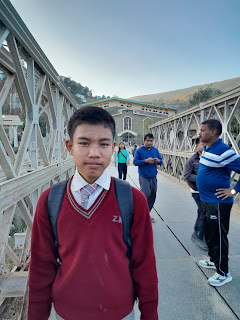
Myanmarese students cross bridge to come to Indian schools in Mizoram (Image Nirendra Dev)
Zokhawthar–Rihkhawdar trade hub shows commerce thriving even as borders harden and Myanmar burns
By NIRENDRA DEV
Aizawl, February 8, 2026 — When I landed at the Zokhawthar trade centre on the Indo–Myanmar border in Mizoram, it happened to be the same day the NCB Director was visiting the township. The symbolism was hard to miss: while New Delhi worries about borders and security, life here moves to the rhythm of commerce.
As the saying goes, seeing is believing. By afternoon, the marketplace was alive with brisk negotiations. On the Indian side, traders argued animatedly, offering competitive prices to familiar faces—many of them daily customers from across the border.
“Omlo mo…,” a woman trader protested, refusing to lower her price further. Her customer pushed back theatrically, prompting smiles from onlookers. An Assam Rifles personnel standing nearby remarked, almost amused, that it is often impossible to distinguish between Myanmarese traders and Indian Mizos—the language, culture, and business instincts are shared.
Booming business here is not an exception; it is routine.
Local Mizo traders spoke of logistics—how energy drinks imported in bulk could be transported onward to Champhai, Aizawl, Kolasib, and even Silchar in Assam. “Business is business,” said Bruce P. Hmar tersely, unwilling to be distracted during trading hours. Over dinner later, he was more candid.
“Fencing the border is a mistake,” he argued. “The British divided us whimsically, and Delhi has inherited that legacy.” He dismissed claims of insurgency in Mizoram, stressing instead the region’s commercial potential. “We have the business acumen of Gujaratis and Marwaris. We can transform Mizoram and the Northeast.”
Across this trading ecosystem sits a quieter, more poignant story—that of Myanmar’s children studying in Indian schools.
Jacob, a shy Class VI student from Myanmar, studies in Zokhawthar. “Hindi… theamlo,” he said softly. “I know English.” His dream, if God—Lal Pa—wills it, is to become a pilot. Asked about home, his voice dropped. “My country is burning every day. I am grateful to India and my Mizo brothers and sisters. A big kalawmein.”
Zokhawthar (India) and Rihkhawdar (Myanmar), formalised as a border trade point in 1994, remain a critical—if largely informal—economic lifeline. Agricultural goods such as beans, pulses, vegetables, fruits, spices, and tobacco dominate trade. For nearly six per cent of Mizoram’s population, livelihoods are tied directly or indirectly to this exchange.
Civil conflict in Myanmar has disrupted flows, triggered refugee movements, and forced intermittent closures. Yet commerce adapts, finding ways to survive.
The larger lesson is strategic. Business-to-business interests matter. Opening borders responsibly, investing in all-weather roads near international frontiers, and recognising the Northeast as a global partnership hub—not a peripheral security zone—are overdue policy shifts.
With over 250 ethnic communities, the Northeast has already demonstrated its potential. The 2023 G20-related business meet in Nagaland, attended by delegates from 27 countries, was proof.
At Zokhawthar, the border is not just a line—it is a marketplace, a classroom, and a reminder that integration, not isolation, is how regions truly prosper.
Northeast: Tracks of Change: Mizoram to Barak Valley by Rail
Follow The Raisina Hills on WhatsApp, Instagram, YouTube, Facebook, and LinkedIn




About The Author