BNP Far From Power? Bangladesh Election Enters Nervous Phase
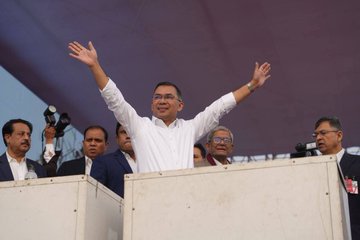
BNP acting chaierperson Tarique Rehman addressed a massive rally in Dhaka on Thursday. (Image BNP on X)
As Jamaat and NCP gain ground and election neutrality becomes contested, Bangladesh’s opposition BNP confronts shrinking momentum.
By NIRENDRA DEV
New Delhi, February 3, 2026 — Is the Bangladesh Nationalist Party (BNP) still far away from capturing power in Bangladesh? Until recently, the answer seemed obvious. Today, it is anything but.
As Bangladesh moves rapidly toward the February 12 national elections, the BNP—once widely perceived as riding a strong anti-incumbency wave—appears increasingly uneasy. What was earlier framed as a near “cakewalk” to power is now being recast as a fiercely competitive, even uncertain, contest.
The source of this anxiety is twofold: procedural mistrust and shifting political arithmetic.
Election Neutrality Under Question
In recent days, the BNP has formally objected to several decisions of the Election Commission, arguing that these measures risk compromising electoral neutrality. Most notably, the party has opposed the deployment of Bangladesh National Cadet Corps (BNCC) cadets for election duties.
BNP leader Mahdi Amin stated that the party has written to the Election Commission urging it not to deploy BNCC cadets, noting that they are college and university students who may be affiliated with political parties or ideological groups. Their involvement, the BNP argues, could undermine the perceived fairness of the polling process.
The party has also raised serious concerns over the appointment of election observers. According to Election Commission data, as of January 26, 55,454 observers from 81 local organisations had been approved—of whom 34,442 came from just 16 organisations. BNP leaders allege that some of these organisations are linked to particular political parties, creating the risk of bias or misuse on polling day.
To ensure what it calls a “level playing field,” the BNP has demanded:
- A comprehensive review of the approved observer list to remove politically affiliated individuals.
- A reduction in the number of observers from organisations with limited monitoring experience.
- Restrictions on allowing more than two local observers inside a polling centre at the same time.
Such disputes occur in many democracies. In Bangladesh’s context, however, they carry special political significance.
The Vanishing Wave
Following the demise of Khaleda Zia and the political re-emergence of her son Tarique Rahman, a strong perception had taken hold that the BNP was poised for a sweeping return. That narrative now appears overstated.
Political manoeuvring, fragmentation of opposition space, and the growing assertiveness of Jamaat-e-Islami and the National Citizens’ Party (NCP) have altered the electoral balance. Many Bangladesh watchers now believe Jamaat could emerge as a decisive force—possibly even outperforming expectations.
This explains the BNP’s visible nervousness. What lies ahead is not a one-sided verdict, but a high-stakes, multi-cornered contest.
Bangladesh’s Stability Question: Why Security of Hindus Matters
What This Means for India
A Jamaat resurgence inevitably raises questions in New Delhi.
Has India once again put all its eggs in one basket—this time betting on the BNP? And does this moment signal the end of the Awami League as a decisive political force?
The safest answer to both questions is: not quite. India’s strategic recalibration appears underway. If pragmatic diplomacy allows New Delhi to engage military rulers in Myanmar, why should it not explore calibrated engagement with diverse political forces in Bangladesh—even those with ideological discomforts?
This evolving approach—sometimes dubbed informally as the “new Moditva doctrine”—rests on one principle: India should have channels everywhere.
In that sense, even once-unthinkable political equations may be quietly reconsidered.
Politics Over Policy
Bangladesh’s elections, like many in South Asia, remain overwhelmingly leader-centric. Policies matter far less than personalities. Manifestos attract minimal public scrutiny and rarely shape voter behaviour.
In this election cycle, manifestos have taken a back seat altogether. Leaders announce policy promises selectively at rallies, tailoring messages to specific audiences rather than presenting coherent national programmes.
This fragmentation reflects a deeper truth: foreign policy itself has become a partisan storytelling tool.
India is cast as either friend or foe depending on political convenience. China is treated as a chequebook, not a strategy. The United States oscillates between saviour and conspirator. What Bangladesh lacks is a stable, election-proof foreign policy framework that survives domestic political churn.
Raging Firestorm of Fake Narratives
As misinformation spreads—BNP claims at least 29 fake or misleading narratives have circulated targeting Tarique Rahman—the battle is no longer just electoral, but informational.
Bangladesh’s February 12 election is shaping up as more than a routine transfer of power. It is a test of institutional credibility, opposition cohesion, and regional recalibration.
For India, the message is clear: the political map in Dhaka is shifting—and old assumptions may no longer hold.
(This is an opinion piece. Views expressed are author’s own.)
Follow The Raisina Hills on WhatsApp, Instagram, YouTube, Facebook, and LinkedIn




About The Author