Bihar Verdict and the Congress: Why Ground Politics Triumphs
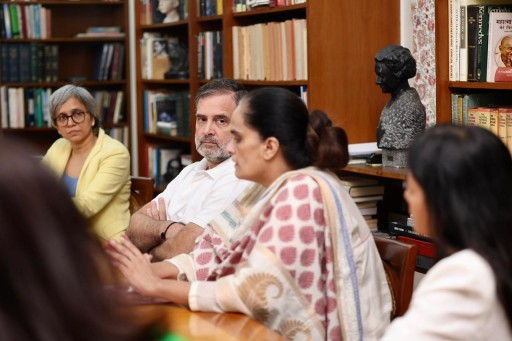
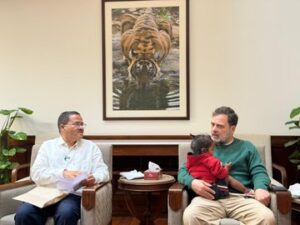
Former Congress president Rahul Gandhi with Delhi mothers who are protesting air pollution. (Image INC India)
The Bihar election outcome exposes how the Congress misread grassroots politics, alliance dynamics and welfare-driven mobilisation under Nitish Kumar.
By RAJESHWAR JAISWAL
Patna, November 29, 2025 — The Bihar Assembly election is over. The government is formed. Nitish Kumar is Chief Minister once again. And yet, instead of introspection, the Congress has chosen denial.
EVMs, SIR, the administration, the Election Commission—everything is under suspicion except the party’s own organisational collapse. That is the real political tragedy.
From the ground, the story looks very different from what is being told in air-conditioned studios and Delhi drawing rooms. I travelled extensively across panchayats during the campaign. I spoke to ordinary voters, booth workers, women beneficiaries and local leaders.
I did not come across mass deletion of names or large-scale voter suppression. Most deletions involved migrants or deceased voters. To blame the entire verdict on machine manipulation is not analysis—it is excuse-making.
The Congress leadership now says the mandate was “managed”. Senior leader K C Venugopal called the election engineered through misuse of EVMs and administrative machinery.
With due respect, Bihar cannot be understood from Delhi. You have to walk the lanes, sit with villagers, listen to women’s groups, and observe the booth-level machinery at work. Elections are not won on press conferences alone.
The Congress lost because it was not visible where it mattered most—on the ground.
‘What Face I will Show’: When Congress Agent Left Bihar Counting
How Nitish Kumar Actually Won
The victory of Nitish Kumar and the NDA was not accidental. It was constructed brick by brick through welfare delivery and micro-level mobilisation. Free electricity up to 125 units, increased old-age pensions, direct cash transfers of ₹10,000, and salary hikes for registered workers created a real economic impact in households. These were not abstract promises—these were benefits people had already received in their bank accounts.
Most crucially, the Jeevika self-help group network of women worked as a silent but powerful electoral force. These women did not intimidate voters. They spoke to families in their own local language about what they had gained—livelihoods, dignity and economic security. This sustained connect pushed women’s voting share. Welfare converted into votes because it was delivered, not merely advertised.
Congress’s Three Core Failures
- Organisational Weakness: Congress workers were missing from booths in many places. Campaign management was weak. There was no effective counter-narrative to the NDA’s welfare pitch. An election cannot be outsourced to television debates and social media trends.
- Alliance Confusion: Within the Mahagathbandhan, coordination was poor. The relationship with the Rashtriya Janata Dal remained uneasy. Some Congress leaders now blame the alliance itself. If that was the concern, why was it not addressed before the election? Post-defeat wisdom is the cheapest commodity in politics.
- Leadership Disconnect: Rahul Gandhi and Priyanka Gandhi did campaign, but only in short bursts. Bihar elections demand sustained physical presence—during Chhath, Diwali, at river ghats, in villages. Voters want to see their leaders, not just hear slogans. This emotional connect was missing.
The EVM Excuse and the AIMIM Alibi
Some within the Congress now blame the entry of AIMIM led by Asaduddin Owaisi for splitting minority votes. This argument only exposes deeper weakness. A strong organisation does not collapse because a smaller party contests. Votes are won by presence, credibility and daily engagement—not by theoretical vote arithmetic.
Caste Census: A Political Miscalculation
The Congress also misread the caste census issue. In Bihar, this is widely seen as Nitish Kumar’s political project, not the Congress’s. The party failed to convert the issue into a credible OBC–EBC mobilisation. As a result, votes did not transfer effectively within the alliance. The NDA, on the other hand, managed its social arithmetic with far greater discipline.
The Bigger Warning for the Congress
If the Congress continues to externalise its failures—blaming EVMs, allies, smaller parties and administrators—it is heading for similar outcomes in Uttar Pradesh and West Bengal. Elections in India today are won through:
- Booth-level organisation
- Welfare-backed credibility
- Constant local presence
- Cadre discipline
- Data-driven mobilisation
None of these can be replaced by press statements and national rhetoric.
Look Inward Before It’s Too Late
The Bihar verdict is not a conspiracy. It is a mirror. It shows what happens when a party loses touch with the voter on the street while remaining obsessed with narratives in newsrooms. Voters today are not confused. They calculate benefits, assess delivery and reward performance. Welfare works because it reaches homes. Organisation wins because it reaches booths.
Until the Congress accepts this uncomfortable truth, it will keep losing elections—and then blaming everything except itself.
The future of Indian politics now belongs not to those who shout the loudest, but to those who work the hardest on the ground.
(This is an opinion piece, and views expressed are those of the author only)
Follow The Raisina Hills on WhatsApp, Instagram, YouTube, Facebook, and LinkedIn




About The Author