Bibek Debroy Memorial Lecture: Shaktikanta Das Weighs Economy
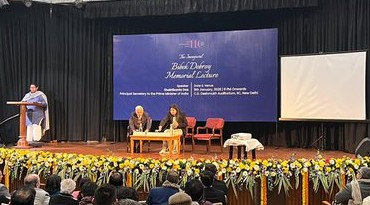
Shaktikant Das addressed the Bibek Debroy memorial lecture on Friday (Image Hindol Sengupta on X)
Inaugural Bibek Debroy Memorial Lecture Signals India’s Shift from ‘Incredible’ to ‘Credible’ Economy
By TRH Policy & Economy Desk
New Delhi, January 9, 2026—India’s economic journey over the past decade is no longer defined by survival amid crises, but by credibility earned through stability, reforms, and strategic self-reliance. That was the central message delivered by former RBI Governor Shaktikanta Das at the Inaugural Bibek Debroy Memorial Lecture at the India International Centre on Friday.
Titled “Indian Economy: A Story of Rising Credibility,” the lecture was both a tribute to the late economist Dr. Bibek Debroy and a sweeping account of how India has navigated a fractured global order to emerge as the world’s fastest-growing major economy.
A Global Order in Flux — And India’s Strategic Answer
Das began by situating India within a rapidly disintegrating global economic framework where multilateral institutions are weakened, supply chains are weaponised, and protectionism has replaced free trade.
Against this backdrop, India’s embrace of Atmanirbharta was presented not as isolationism but as strategic resilience—a policy choice made before the pandemic and geopolitical shocks forced the rest of the world to rethink over-dependence.
“India stands for a rules-based global order,” Das said, “but we will safeguard our national interests in a world where power is increasingly diffused.”
Macroeconomic Stability: The Bedrock of Credibility
At the heart of India’s credibility story lies macroeconomic discipline. “Despite overlapping shocks—from COVID-19 to global conflicts—India posted average growth of 8.2% between FY22 and FY25, with FY26 growth projected at 7.4%,” said Das. Inflation, once a persistent concern, fell to a historic low of 0.25% in October 2025, well below the RBI’s tolerance band, he added.
Fiscal consolidation has also been decisive. “The Centre’s fiscal deficit has fallen from 9.2% in FY21 to 4.8% in FY25, while public debt ratios are steadily declining,” added Das. India’s foreign exchange reserves, hovering near $700 billion, provide a powerful buffer against external volatility.
Equally striking has been the turnaround of the banking sector—once weighed down by NPAs, now among the most stable globally, even as banks in advanced economies faced crises.
A Decade of Structural Reforms
Das credited India’s credibility to policy continuity, highlighting reforms that have reshaped the economic architecture: GST unified India into a single market and boosted compliance; IBC transformed insolvency resolution and credit discipline; Flexible Inflation Targeting anchored expectations and policy trust; RERA cleaned up real estate governance; and Labour Codes balanced flexibility with worker protection.
These reforms, he argued, were not episodic but part of a coherent, long-term strategy.
Atmanirbharta in Action: From PLIs to Digital India
Strategic state intervention has focused on closing structural gaps rather than crowding out markets. The PLI schemes across 14 sectors have drawn global manufacturers to India, while infrastructure missions like Gati Shakti, Bharatmala, and Sagarmala have rewired logistics and connectivity.
India’s Digital Public Infrastructure (India Stack)—from Aadhaar to UPI—was highlighted as a new form of soft power, already being replicated by other nations.
The Multipliers: Demography, Digital Power, and AI
Looking ahead, Das identified four converging strengths powering India’s next growth phase:
- A youthful workforce in an ageing world
- World-class digital public infrastructure
- Deep financial inclusion
- Technological and AI leadership potential
With advances in space, biotech, AI, semiconductors, and clean energy, India is positioning itself not just as a participant—but as a global innovation hub.
From Incredible to Credible India
In his concluding remarks, Das captured the essence of the lecture: “India today is moving from being an incredible India to a credible India.”
Follow The Raisina Hills on WhatsApp, Instagram, YouTube, Facebook, and LinkedIn




About The Author