Beyond Hormuz: Can Iran Destroy the Gulf’s Oil Infrastructure?
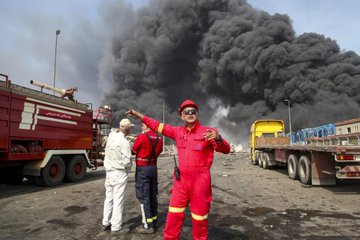
Shahid Rajaee Port Explosion in Iran (Image credit X.com)
Analysts warn that Iran shutting the Strait of Hormuz is not the gravest threat facing global energy markets. The real nightmare is Tehran — with nothing left to lose — turning its missiles and Shia militia networks on the oil fields, pipelines and processing plants of Saudi Arabia and the UAE themselves.
By TRH World Desk
New Delhi, March 1, 2026 — Everybody is focused on the Strait of Hormuz. But analysts tracking the Iran crisis say that closing the waterway — catastrophic as that would be — is not the worst outcome global energy markets should be pricing in right now.
Writing on X, analyst Adam Collingwood laid out the bleaker scenario in stark terms, drawing on an assessment by economics and geopolitics account @policytensor. “Everybody is concentrating on the Iranians shutting the Strait of Hormuz. But that’s not the worst-case scenario,” Collingwood wrote.
“The worst-case scenario is that Tehran starts destroying the Gulf’s entire oil and gas infrastructure,” he added.
The strategic rationale, Collingwood argues, is grimly coherent. A regime under existential military pressure — its Supreme Leader assassinated, its command structure fractured, its provinces under sustained bombardment — has rapidly diminishing incentives for restraint.
“The strategic need is there: only the threat of severe pain will make the US stop, and the closer the regime comes to collapse, the higher their risk tolerance will be,” he wrote.
The geography makes the threat credible. All the main Gulf oil fields and export terminals — in Saudi Arabia and the UAE — sit within short-range missile range of the Iranian coastline. Some are within artillery range. Iran would not need a sophisticated long-range strike campaign. It would need what it already has.
Collingwood raises a dimension that has received little attention in mainstream coverage: the demographic composition of the Gulf’s oil regions. The areas surrounding the main Saudi and Emirati oil infrastructure are majority Shia — populations that have, as Collingwood notes, faced decades of suppression by their Sunni-led governments.
“All those areas are majority Shia, a population that has been brutally oppressed for decades — much like the population in Iran, ironically enough,” he wrote.
The implication is that Iran would not need to rely solely on missile and drone strikes. A combination of missile attacks and activation of Shia militia networks inside Saudi Arabia and the UAE could threaten the infrastructure from both outside and within. Saudi Arabia and the UAE are, in Collingwood’s framing, already co-belligerents in the current conflict — along with most Gulf states, with the exception of Oman.
Collingwood invokes a historical parallel that concentrates the mind. When retreating Iraqi forces left Kuwait in 1991, they set the oil fields ablaze. It took a year — and one of the largest firefighting operations in history — to extinguish them all.
Iran, facing collapse, would not be retreating. It would be striking.
OIL MARKETS AND THE HUNDRED-DOLLAR THRESHOLD
The energy market consequences of such a scenario would be immediate and severe. If oil markets begin pricing in sustained destruction of Gulf infrastructure, Brent crude — and subsequently WTI — would move well above one hundred dollars a barrel, Collingwood argues. Brent crude has already hit the 80 dollars per barrel mark per reports.
The downstream political consequences in the United States could then reshape the conflict itself. With midterm elections in view, a sustained high oil price could lead US President Trump to impose export controls on American oil and gas to hold domestic prices down — a move with precedent in US energy policy history.
That is where the analysis arrives at its most alarming destination. Europe has already lost Russian oil and gas following the Ukraine war. If Gulf supply is simultaneously destroyed or blockaded — and if Trump moves to restrict American exports for domestic political reasons — Europe would have no viable fallback.
No Russian supply. No Gulf supply. American supply potentially locked behind export controls. The continent’s energy security, already strained to breaking point, would face a crisis without modern precedent.
A DISSENTING NOTE
Collingwood himself is not fully convinced the worst case will materialise. “The Iranians have threatened a big game before and not done it,” he writes. “This time does feel different, but I will believe it when I see it.”
The caveat matters. Iran has repeatedly signalled escalation and stepped back. The question now is whether a regime that has lost its Supreme Leader, its top commanders, and faces strikes across two-thirds of its territory retains the institutional discipline — or the incentive — to hold back once more.
“Iran Regime Tottering” — Implications Go Beyond the Middle East
Follow The Raisina Hills on WhatsApp, Instagram, YouTube, Facebook, and LinkedIn




About The Author