Bangladesh’s Forgotten Wounds: Fundamentalism Is Erasing 1971
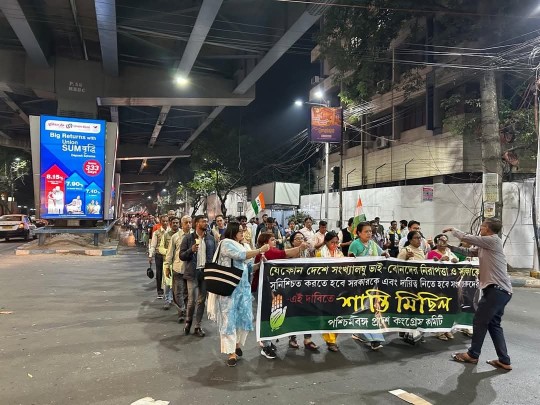
West Bengal Holds Candle march in Kolkata against arrest of Hindu priest in Bangladesh Image INC West Bengal
From the Birangana to today’s street radicalism, Bangladesh risks losing its moral compass—and its history.
By NIRENDRA DEV
New Delhi, December 20, 2025 — “Fundamentalism and radicalism are spreading like cancer in Bangladesh. All right-thinking people must unite to fight this menace,” warned Samik Bhattacharya, president of the West Bengal BJP, striking a chord that extends far beyond party politics. His concern points to a deeper tragedy: a nation born of one of the world’s most documented genocides now appears to be forgetting who it once fought—and why.
Since the 1980s, extremist forces have steadily expanded their influence in Bangladesh, often reshaping public memory. The cost of this amnesia is best understood through the haunting legacy of 1971. During the Liberation War, between 200,000 and 400,000 Bengali women and girls were subjected to systematic rape by the Pakistani military and Razakar collaborators—an atrocity recognised globally as genocidal violence.
The iconic photograph titled Shamed Woman—also known as Brave Woman—captured by Bangladeshi photographer Naib Uddin Ahmed, remains a visual indictment of that brutality. The image reflects both trauma and resilience. Sheikh Mujibur Rahman sought to protect survivors from social ostracism by naming them Birangana—war heroines—a rare act of moral clarity in the aftermath of mass violence.
Internationally, the crimes shocked consciences. The infamous “Blood Telegram,” sent by US Consul General Archer Blood, accused Washington of complicity in genocide. Indira Gandhi justified India’s intervention with a stark question: “Shall we sit and watch their women get raped?” Decades later, Bangladesh’s International Crimes Tribunal prosecuted several perpetrators, reaffirming the truth of history.
Yet memory alone does not safeguard a society. As radical ideologies gain ground, there is a disturbing tendency to relativise or bury these crimes—sometimes even rehabilitating the political heirs of those who sided with Pakistan in 1971. Literature and cinema—from Ami Birangana Bolchi to Rising from the Ashes and films like Children of War—have tried to keep these stories alive, often indicting post-war society for failing its survivors.
Bangladesh’s struggle today is not against faith, but against extremism that corrodes pluralism and historical truth. Forgetting 1971 is not reconciliation; it is surrender. A nation that erases the suffering of its mothers risks repeating the sins of its past.
(This is an opinion piece, and views expressed are those of the author only)
Birth of Bangladesh: Niazi’s ‘Kuj palley hai’ Set up Pakistan’s Surrender
Follow The Raisina Hills on WhatsApp, Instagram, YouTube, Facebook, and LinkedIn




About The Author