Bangladesh Rethinks India—and Itself—After the Media Meltdown
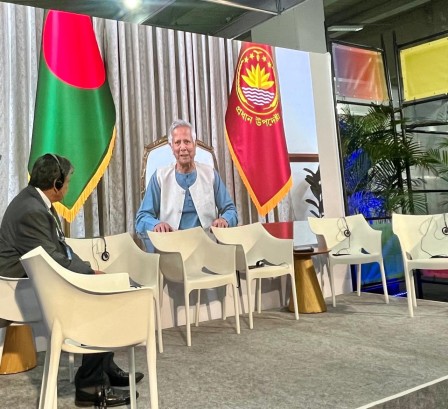
Chief Adviser of Bangladesh Professor Muhammad Yunus at the G20 Social Summit Image Credit X.com @ChiefAdviserGoB
As Bangladeshi television debates civilisation, media freedom and anti-India excesses with rare candour, New Delhi must read the signals beyond the noise.
By NIRENDRA DEV
New Delhi, December 29, 2025 — “Naya Bandobosto” has come full circle—perhaps not in New Delhi, but in Dhaka.
For months, Bangladesh appeared caught in a self-generated storm of performative radicalism, social media hysteria, and a carefully cultivated anti-India narrative. What is striking now is not the noise, but the sudden emergence of introspection. On Bangladeshi television screens, a new—almost forgotten—tone has surfaced: candid, uncomfortable, and sobering.
The trigger is not ideology alone, but chaos. It is a universal truth that social media today is polluted beyond repair. Narratives—often fake, sometimes malicious—travel faster than facts.
Yet the tragedy is that mainstream media, which should act as a corrective, has increasingly abdicated its responsibility. This is not a Bangladesh-only disease. In India too, editors are often editors only in designation, much like police chiefs who serve at the pleasure of political masters. Ambition—to Rajya Sabha seats or political relevance—has hollowed out editorial spine.
Bangladesh, however, is discovering the cost of this erosion in real time.
Over the last 16 months, the Yunus-led interim arrangement rode both social and mainstream media narratives to consolidate legitimacy. In the process, Talibanisation of discourse was normalised. Street power was romanticised as “revolution.” Attacks on media houses—ironically not pro-India ones—followed. On the nights journalists were assaulted and newspaper offices attacked, desperate calls to Dhaka’s power centres reportedly went unanswered.
That silence changed something.
Bangladeshi vernacular TV channels are now hosting discussions that would have been unthinkable months ago. One journalist’s remark stands out for its brutal honesty: “We made India our best friend for our selfish agenda. Now we are making India our enemy—again for our own benefit.”
Another observation cuts deeper: “India is not today’s nation. Mahabharat and Ramayan were not written yesterday. When was zero discovered?” The implication is civilisational humility—rare in contemporary political shouting matches.
The debate has also turned inward. Analysts are openly acknowledging that anarchy benefits a select few, that every crisis produces exploiters, and that mobs empowered by street violence soon mistake vandalism for revolution. Bangladesh is rediscovering an old truth: “ghar-dhore biplob” eventually eats its own.
Print media has joined the course correction. The Daily Star’s sharp reassessment of the National Citizen Party (NCP) and its warning against alliances with Jamaat-e-Islami signals something larger—the intelligentsia’s honeymoon with pro-Pakistan nostalgia is fading. Jamaat’s 1971 baggage, the paper reminds readers, is not a footnote but a political fault line.
What does this mean for India?
New Delhi must resist the temptation to gloat or overreact. This moment calls for patience, not propaganda. Bangladesh’s current self-examination—however fragile—suggests a society confronting the consequences of narrative excess. India did not manufacture this reckoning; Bangladesh did.
Sometimes, diplomacy works best when it waits.
(This is an opinion piece. Views are personal)
1971, Dharmyudh and Dhaka’s Drift: Bangladesh Faces Fire Test
Follow The Raisina Hills on WhatsApp, Instagram, YouTube, Facebook, and LinkedIn




About The Author