Bangladesh on the Brink: Can Tarique Rahman Walk the Blade?
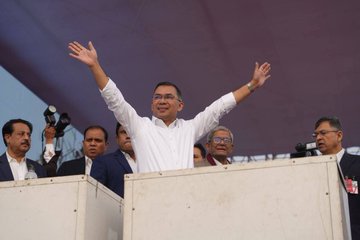
BNP acting chaierperson Tarique Rehman addressed a massive rally in Dhaka on Thursday. (Image BNP on X)
A destabilised Bangladesh faces rising radicalism as Tarique Rahman positions himself for power—testing India’s patience and regional stability
By NIRENDRA DEV
New Delhi, December 26, 2025 — Bangladesh today stands at a dangerous crossroads. A nation once celebrated for its secular promise is now showing clear signs of being radicalised, destabilised, and quietly weaponised. Against this volatile backdrop, BNP’s acting chairman Tarique Rahman, widely seen as a future prime minister, has struck a conciliatory tone—at least in words.
“This country belongs to people of the hills and plains, Muslims, Hindus, Buddhists and Christians,” Tarique declared at a massive Dhaka gathering on December 25. He urged restraint, warned of conspiracies by “dominant powers,” and invoked the shared memory of 1971 to underline national unity. Politically, this is a smart balancing act. He mentions minorities. He acknowledges Liberation War history. He signals calm amid provocation.
But in politics, saying the right thing is far easier than enforcing it.
The reality on the ground is grim. Since August 2024, hardliners and Jamaat-linked street power have increasingly dictated Bangladesh’s political rhythm, with mob culture, intimidation, and anti-Hindu violence becoming disturbingly frequent. Tarique Rahman’s biggest test is not rhetoric—it is control. Can he rein in forces that thrive on chaos while still relying on them for political mobilisation?
India, meanwhile, must resist over-enthusiasm. The BNP continues to carry a deeply entrenched anti-India image, and Tarique must “walk the talk” if he expects New Delhi’s trust. Adding to the complexity is the Yunus regime, which came to office with international goodwill but has instead presided over administrative drift and political disorder. Whether Tarique can manage—or dismantle—this arrangement remains an open question.
There are also sharper geopolitical undertones. Bangladesh today risks becoming a theatre of managed instability, not unlike models seen elsewhere—where a smaller nation is drawn into a morally framed conflict, prolonged through internal fractures, bleeding resources and reputation. India understands this playbook well and is unlikely to be baited.
For New Delhi, strategic restraint and patient distance appear the wisest course. Let internal contradictions surface. Let external players—Islamabad, Beijing, Washington—reveal their hands.
Bangladesh does not need slogans. It needs maturity. The question is stark: does Tarique Rahman have it—and will the puppeteers allow him to use it?
(This is an opinion piece. Views are personal)
Follow The Raisina Hills on WhatsApp, Instagram, YouTube, Facebook, and LinkedIn




About The Author