Bangladesh on Edge Before Polls: US and India Send Signals
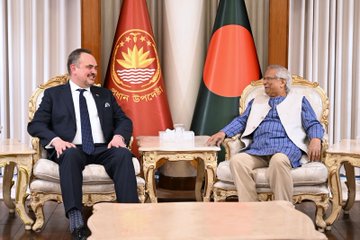
US ambassador in Bangladesh Brent T. Christensen with Chief Advisor Mohamed Yunus in Dhaka (Image Christensen on X)
The US envoy Bangladesh Army chief meeting and New Delhi’s outreach to BNP reveal a coordinated geopolitical recalibration.
By NIRENDRA DEV
Guwahati, January 30, 2026 — In another two weeks, Bangladesh will vote on February 12. Diplomatic signals from Washington and New Delhi suggest that Dhaka’s political chessboard is being quietly but decisively rearranged.
On January 29, the newly appointed United States Ambassador to Bangladesh, Brent T. Christensen, paid a courtesy call on Army Chief General Waker-Uz-Zaman at the Bangladesh Army headquarters. Officially, the meeting was framed as an exchange of greetings and a discussion on strengthening bilateral ties. Unofficially, its timing has raised eyebrows across South Asia.
The US envoy Bangladesh Army chief meeting comes at a moment of deep political uncertainty. Bangladesh is set to hold parliamentary elections and a national referendum simultaneously on February 12, 2026, amid widespread speculation that the political balance is tilting away from the Yunus-led dispensation, the National Citizen Party (NCP), and Jamaat-e-Islami, and increasingly in favour of the Bangladesh Nationalist Party (BNP).
Washington’s engagement with the military leadership—long seen as the ultimate stabilising force in Bangladeshi politics—signals that the United States is keen to safeguard institutional continuity and security during a potentially volatile transition. It also reflects a broader pattern in US diplomacy: engaging power centres that matter when electoral outcomes appear fluid.
India, meanwhile, has made its own moves. In a notable and politically loaded gesture, both Houses of the Indian Parliament paid tributes on January 28 to former Bangladesh Prime Minister Khaleda Zia, who passed away on December 30, 2025. Lok Sabha Speaker Om Birla described her contribution to India-Bangladesh relations as enduring, while Rajya Sabha Chairman and Vice President C P Radhakrishnan recalled her role as Bangladesh’s first woman prime minister and a three-time leader of the country.
These tributes were more than protocol. They were widely read as New Delhi’s signal of renewed engagement with the BNP, particularly its acting chairman Tarique Rahman, at a time when the party is seen as having an electoral edge. India’s “extraordinary keenness” to reach out to the BNP reflects a pragmatic recalibration—placing stability and continuity in bilateral ties above past political preferences.
The security backdrop, however, remains tense. Authorities in Bangladesh have warned of possible political violence or extremist attacks during the election period, potentially targeting rallies, polling stations, and religious sites. Transport restrictions will be imposed from February 10, with a near-total shutdown on polling days. The US Embassy in Dhaka has already announced limited services and issued advisories urging vigilance.
Taken together, these developments point to a subtle convergence of interests. Washington is hedging against instability by engaging the military. New Delhi is reopening channels with a likely future power centre. And Bangladesh’s election is no longer just a domestic event—it has become a regional inflection point.
As February 12 approaches, the question is no longer who will win, but how smoothly power can transition—and who will be best positioned when it does.
(This is an opinion piece. Views expressed are author’s own.)
Follow The Raisina Hills on WhatsApp, Instagram, YouTube, Facebook, and LinkedIn




About The Author