Bangladesh After Hasina: Pathology of Institutional Collapse Stays
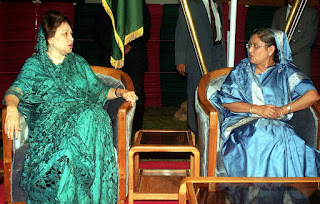
Khaleda Zia and Sheikh Hasina (Image X.com)
As Bangladesh approaches a post-Hasina transition, the central risk is not political change but the persistence of one-party dominance
By NIRENDRA DEV
New Delhi, January 12, 2026 — Bangladesh’s political transition is often framed as a binary—Awami League versus Bangladesh Nationalist Party (BNP). That framing is misleading and dangerous. The central challenge facing Bangladesh is not which party governs, but whether the state can escape the gravitational pull of one-party dominance that has hollowed out its democratic institutions.
Since the restoration of electoral politics in 1991, Bangladesh has struggled to institutionalise opposition. Under Sheikh Hasina’s Awami League (2008–2024), this failure became systemic. Parliamentary scrutiny collapsed; fewer than one percent of bills were substantively altered through opposition input. Parliament functioned procedurally, not deliberatively. Opposition politics migrated from legislative chambers to the streets, creating a cycle of boycotts, protests, and repression.
The media, constrained by legal pressure and informal coercion, failed to function as an effective watchdog. In combination, these trends produced a model of electoral authoritarianism: elections without accountability, governance without constraint.
The 2024 mass uprising reflected popular exhaustion with this model. However, the post-Hasina transition has revealed a deeper structural problem. The interim regime has retained the same bureaucratic architecture that sustained authoritarian governance. Bangladesh’s civil service—like those of India and Pakistan—remains a colonial inheritance designed for extraction and control rather than public accountability. Personnel continuity has ensured behavioural continuity.
This continuity matters. Authoritarianism in Bangladesh was not sustained by political leadership alone but by a compliant administrative ecosystem—bureaucracy, police, and regulatory bodies—that adapted to power rather than constrained it. Without reform, new rulers inherit old habits.
The emerging political trajectory suggests the BNP may gain decisive advantage after February. Yet a BNP landslide, absent institutional reform, risks reproducing the same pathologies that defined the Awami League era. Power concentration, weakened oversight, politicised bureaucracy, and marginalised opposition could persist—only under different political symbolism.
International experience suggests a solution: the constitutionalisation of opposition. This includes granting statutory authority and resources to the Leader of the Opposition, mandating opposition leadership of key oversight committees, and re-establishing parliament as the primary arena of political contestation. India’s parliamentary committee system, despite recent strains, demonstrates how opposition can meaningfully shape policy without destabilising governance.
Equally critical is the restoration of inclusive electoral competition. The banning of the Awami League, even if politically expedient, undermines the credibility of the transition and reinforces external concerns—particularly in New Delhi—about legitimacy and long-term stability.
Bangladesh’s crisis is not ideological. It is institutional. The choice before Dhaka is stark: reform the rules of power or merely rotate its beneficiaries. Without institutionalised opposition, an independent media, and bureaucratic reform, any incoming government—BNP or otherwise—will inherit not a democracy, but a machine calibrated for dominance.
(This is an opinion piece. Views expressed are author’s own)
Yunus Tilts to Pakistan, But Bangladesh Knows: India Still Matters
Follow The Raisina Hills on WhatsApp, Instagram, YouTube, Facebook, and LinkedIn




About The Author