India’s Audit Collapse: How Weak Oversight Erodes Accountability
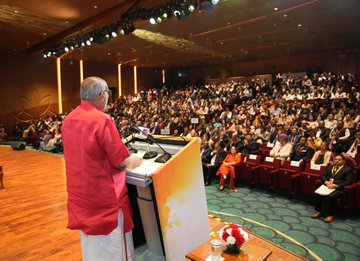
Vice President CP Radhakrishnan addresses Audit Diwas. (Image VPIndia on X)
Despite new IT tools, MoUs with elite institutions and a revamped audit framework, a decade of data exposes a crisis—massive pendency, missing replies and an accountability system on the brink.
By P. SESH KUMAR
New Delhi, December 8, 2025 — Yet another Accountant General’s conference (32nd) of CAG ended in November 2025. Efforts of application of IT audit tools such as audit of Tamil Nadu’s prison system and Kerala scholarship schemes were recognized and rewarded. MoUs were announced with IIT/IIM/ICAI/IPAI to improve audit quality and professionalising it. IT Audit strategic framework has been shared in a rare press briefing. But what is the state of effectiveness of actual delivery of audits? A look at decade of audit data across Union and State governments tells a troubling story: tens of thousands of Inspection Reports (IRs) and audit paragraphs lie unanswered, tens of thousands of Action Taken Notes (ATNs) remain unsubmitted, and even the first replies mandated under rules are absent in thousands of cases.
Audit has never been more prolific, but its afterlife has never been weaker. The accountability chain—IRs to draft paragraphs to CAG Reports to PAC recommendations to ATNs—has rusted at every link. Yet there is a second, quieter truth: the system’s resistance is not always born of malice.
At times, CAG’s own audit machinery (especially its IRs) may generate technically correct but context-blind comments, trivial observations, or unsustainable objections that dilute its credibility and trigger bureaucratic defensiveness.
The silent mountain of unanswered audit
If one were to spend a moment inside the enormous spreadsheets of pending IRs and ATNs, the constitutional promise of accountability begins to look like an elaborate theatre production-grand sets, stirring speeches, and nothing behind the curtains.
Across the Union government today, thousands of ATNs on CAG Reports are pending, almost 85 per cent without even the first reply. For example, 10,191 ATNs were pending while no ATN was received in 6785 paras in 2022-23 for state governments.
The position in Union Government was no better—10,998 ATNs pending and no ATN in 812 paras in the same year. In several major States, between 8,000 and 14,000 IRs remain outstanding at any given time; many have been ageing in dusty files for ten years or more.
Some departments treat IRs as if they were postcards from a distant cousin: occasionally acknowledged, rarely answered, never acted upon. PAC recommendations pile up like archaeological layers, each committee recording the sins of the past with no guarantee that the guilty departments will ever send back the mandatory ATNs.
Recoveries at the instance of CAG hovered between 5.5% and 6.55% in Union Government while State Governments showed 16.14% to 21% recoveries during 2021-23. This is not an isolated aberration; it is the normal rhythm of the accountability system today.
How did we get here? The anatomy of chronic pendency
The origins of the crisis lie deep in the structure of government responsiveness and the culture of compliance—both of which have been steadily eroded.
At the district and directorate level, IRs are treated not as warning signals but as administrative irritants. Officers are transferred frequently, internal audit units are understaffed, financial advisors are overwhelmed, and the incentives for replying to IRs are almost nonexistent. The result: a field formation quickly learns that ignoring audit carries no cost.
Meanwhile, audit itself has broadened its scope through data analytics, multi-dimensional risk assessments, and aggressive sampling. More audits have produced more paragraphs, but the Executive’s follow-up capacity has remained stagnant. Audit supply has grown; audit absorption has not. When departments cannot digest the flow of objections, pendency becomes the natural by-product.
CAG undertakes frequent and differently titled audits—you name it and we have it: performance audit, compliance audit, horizontal review, limited review, value for money, 3 Es audit (the last two thankfully subsumed into performance audit), test check, financial audit, accounts audit, certification audit, financial attestation audit and so on. This leads to regular and almost continuous audits without as much a break and no wonder- many audited entities complain of unplanned and frequent audits bordering on harassment.
Add to this a political ecosystem where PACs and COPUs are consumed by headline issues while millions of rupees leak away in the shadows of delayed ATNs, and the decay of follow-up becomes inevitable.
But there is another dimension seldom acknowledged in public discourse-one that requires the CAG institution to look inward with the same honesty it demands of others.
When audit becomes noise: the uncomfortable truth about unsustainable observations
For years, field offices have whispered what audit headquarters seldom hears: that not all IR observations are born equal. A significant fraction is sharp, insightful, and transformational. But interspersed among these are comments so technically narrow, so blind to ground realities, or so trivial in consequence that they produce cynicism instead of compliance.
When an engineer is faulted for a two-centimetre variance in a retaining wall that has zero structural or financial impact, or when a school headmaster is held responsible for not maintaining a register whose format changed thrice in a year, the IR becomes less a diagnostic instrument and more a bureaucratic burden. The message the Executive receives is simple: if audit chases trivialities with the same vigour as systemic failures, then everything can be ignored safely.
In revenue departments, audit often flags short levy of a few hundred rupees arising from clerical rounding differences—while simultaneously raising grave observations on evasion, misclassification and fraudulent refunds. When both types of comments arrive in the same IR with identical status, officers instinctively bracket them together. The tragedy is that genuine, high-impact findings lose their sharpness because the surrounding noise drowns them out.
This is not unique to India. Every advanced SAI has grappled with the “materiality–triviality conundrum.” The UK National Audit Office uses proportionality thresholds and rigorous significance filters; the US GAO rejects draft findings if they fail tests of materiality, fairness, sustainability and systemic relevance; the Auditor-General of New Zealand applies the principle of “no surprises,” ensuring departments understand the rationale before findings are finalised; Canada’s OAG uses extensive internal peer review to weed out weak observations.
India’s CAG has strong guidelines, but their application is inconsistent. Some audit teams are exemplary in their judgement; others are overzealous or too literal. The institution does not suffer from lack of integrity-never that-but sometimes from lack of calibration. There is also the ubiquitous system of fixing targets for field offices in terms of number of draft paragraphs (irregularities in audit reports) and money value of audit findings—which distorts and disincentivises what should be positive audits.
Instead of taking pride in assessing positive contributions in terms of loss prevented or loopholes or lacunae in law or rules and regulations removed or amendments made to improve effectiveness and delivery of benefits and programmes to beneficiaries—the emphasis continues to be on measuring money value of ‘defects’ or deficiencies highlighted in reports.
The Executive’s irresponsibility cannot be excused. But audit, too, must ensure that what it demands action upon is material, defensible, context-aware and proportional. It should come out of its closet—when it is tempted to either ignore replies or dismiss the replies with the now much ‘abused’ rebuttal ‘however, the fact remains that…’. This would discourage if not irritate any well-meaning audited entity which would hesitate to confide in audit as it has no real incentive to furnish reply.
Retendering Under Scrutiny: CAG Advisories and Global Lessons
Why acknowledging good work strengthens-not weakens-audit
Most top-tier Supreme Audit Institutions (SAIs) practise balanced reporting: they highlight strong internal controls, robust financial discipline, innovative schemes, and sincere corrective actions taken by departments. This has two magical effects.
First, it earns trust. When audit is seen as fair, departments stop viewing it as an adversary and start seeing it as a guardian.
Second, it sharpens criticism. When an audit office praises where praise is due, its censure becomes far more powerful when it is deserved.
Indian audit reports do occasionally mention good practices, but not with the frequency or visibility needed to shift perception. In some States, AG offices have begun publishing “Good Practices” annexures in sector audits, but this is not systematic.
If CAG expects departments to abandon defensiveness, audit must abandon the perception that it delights only in fault-finding. A system that recognises and rewards good financial governance will produce more of it.
The broken feedback loop: from ignored IRs to paralysed ATNs
When trivial and material observations are mixed, when departments reply selectively, when audit overloads the system, and when legislatures do not enforce consequences, the accountability supply chain collapses.
IRs are not replied to; draft paragraphs lose their sharpness; final CAG reports become repetitive; PAC recommendations lack teeth; ATNs never return; and the same systemic weaknesses reappear in subsequent audit cycles. Audit becomes a one-way conversation: loudly spoken, barely heard.
This is the real danger. India is not short of audit; it is short of audit that leads to action.
The practical way forward: obligations, not suggestions
Reform must occur on both sides-Executive and Audit-and must be rooted in enforceable obligations, not polite expectations.
First, replying to IRs and ATNs must become a statutory duty with measurable consequences. Ignoring audit should affect performance appraisal, vigilance status, promotions and financial autonomy of departments.
Second, a national IR/ATN dashboard should publish real-time pendency data, department-wise, value-wise and age-wise. Name and shame works where internal admonition fails.
Third, PACs should institutionalise quarterly hearings exclusively on pendency. Secretaries of chronic offender departments must be put on record-not selectively, but systematically.
Fourth, CAG must strengthen internal quality assurance: materiality filters, risk-weighted sampling, compulsory sustainability testing, and peer review of draft IRs. The aim is not to reduce audit enthusiasm but to increase audit precision.
Fifth, a Balanced Reporting Protocol should be mandated-every major audit must identify at least a few good practices or improvements. Fairness strengthens credibility; credibility strengthens compliance.
Sixth, legacy backlogs must be triaged. High-value, high-risk IRs should be taken up first; ancient, low-impact paras should be formally reviewed, categorised and, where appropriate, condoned in consultation with PACs.
Finally, audit and Executive must work on integrated digital platforms: e-IR, e-DP, e-ATN systems with mandatory timestamps, auto-escalations and analytics. CAG has introduced CAG-Connect and OIOS – One IAAD One System- at great cost and effort to streamline and modernize audit practices and products—these have be evaluated realistically and holistically so that value addition is objectively assessed.
The audit cycle must become a closed loop again-not a leaking pipeline.
Making audit matter again
The Indian audit system stands today at a paradoxical moment: more technologically advanced, more rigorous and more prolific than ever-but continuing to face a crisis of responsiveness, credibility and closure. The Executive has allowed pendency to metastasise into institutional decay. But audit, too, must confront the fact that trivial observations dilute serious findings, that proportionality must guide reporting, and that credibility is a function of fairness as much as rigour.
A reformed system-one where audit is precise, balanced and evidence-driven, and where departments are obligated, not merely encouraged, to respond-can restore the constitutional promise of financial accountability. Without such reform, audits will continue to be produced with great ceremony only to die quietly in unanswered IRs and missing ATNs.
India does not need more audit. India needs audit that leads to action.
(This is an opinion piece, and views expressed are those of the author only)
The Audit Watchdog Has Lost Its Bite — The CAG Must Reinvent
Follow The Raisina Hills on WhatsApp, Instagram, YouTube, Facebook, and LinkedIn




About The Author