Assam’s Linguistic Vote Struggle: Bhojpuri Becomes a Flashpoint
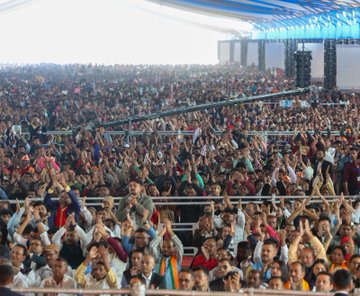
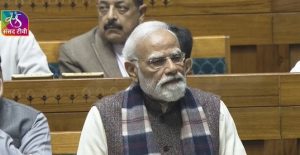
Prime Minister Narendra Modi's Assam rally (Modi on X)
From native–outsider narratives to ticket wars, language is reshaping Assam’s electoral chessboard
By NIRENDRA DEV
Guwahati, February 10, 2026 — In Assam’s politics, the native versus outsider narrative has always carried sharp electoral consequences. As the state heads into another round of crucial polls, linguistic identity—particularly the growing visibility of the Bhojpuri-speaking community—has moved from the margins to the centre of political contestation.
The Bhojpuri issue is not new. Memories still linger of 2003, when Bihari candidates appearing for railway recruitment exams were attacked in Assam during Nitish Kumar’s tenure as Railway Minister. That episode cemented Bhojpuri-speaking migrants in the public imagination as “outsiders,” a tag that continues to shape regional politics even today.
Yet Assam’s demographic reality is far more complex. The Bhojpuri community, long associated with tea gardens, small trade, and informal labour, is now increasingly asserting itself as part of Assam’s diverse—but politically contentious—social fabric.
Ticket Politics and the ‘Parachute Candidate’ Anxiety
In the run-up to the elections, internal churn within political parties reflects a growing conflict between non-Bengali local aspirants and Bhojpuri-speaking contenders. At the heart of this tension lies a familiar fear: parachuted candidates versus grassroots claimants.
Political parties have previously attempted to bridge this gap through cultural outreach. Campaign songs have been translated into Bhojpuri—alongside Nepali, Bodo, and Bengali—to tap into linguistic solidarity. The Akhil Assam Bhojpuri Parishad has also played a visible role, highlighting the community’s contribution while stressing its integration into the broader Assamese identity.
The BJP, in particular, has deployed Bhojpuri-speaking leaders in tea-garden-dominated constituencies such as Lakhipur, targeting an estimated 15,000-plus Hindi-speaking voters. This strategy has delivered electoral dividends—but it has also sharpened local resentment.
Udarbond–Silchar: A New Flashpoint
This election cycle, the Udarbond assembly segment—adjacent to Silchar, the Barak Valley’s commercial nerve centre—has emerged as a hotbed of linguistic contest between Bengali Hindus and Bhojpuri speakers.
Even within the BJP, three Bhojpuri leaders are said to be in the fray for the ticket. The Congress, meanwhile, is likely to nominate Ajit Singh. The plot thickened after former Lakhipur MLA Rajdeep Gawala surfaced as a strong aspirant in Silchar, triggering resistance from local groups.
To counter Gawala, a Nagorik Meeting is expected in Udarbond, where a resolution may be adopted opposing his candidature—on the grounds that he is not only Bhojpuri-speaking but also originally hails from Lakhipur, not Udarbond. The subtext is unmistakable: language and local origin are being fused into a single political argument.
Beyond Barak Valley: A Statewide Undercurrent
The Bhojpuri question is not confined to southern Assam. In Lumding, near the Nagaland border, language has also entered political discourse. Congress leader Ajay Pandey frames it cautiously: “Language is a delicate topic in India. Linguistic diversity led to the creation of multiple states after Independence. The local language is inseparable from regional pride.”
Assam has seen this before. In 2020, the state government’s proposal to make Assamese a compulsory subject across schools sparked widespread protests, particularly in Bengali-speaking Barak Valley. That episode underlined how quickly language can transform into political mobilisation.
Opposition parties—the Congress and the AIUDF—are now seen as capitalising on this sensitivity. Even some BJP supporters are uneasy. Guwahati-based Rana Das, a BJP voter, warns: “By excluding Assamese citizens or others who speak Bengali, you cannot create an Assam for Assamese.”
His comment is a veiled critique of Chief Minister Himanta Biswa Sarma’s push for “One Assam, One Identity.”
Language as Power, Not Just Words
For many observers, the stakes go beyond elections. Manoj Gogoi, an Assamese literature teacher, argues that in Northeast India, language is fundamentally about power and cultural control. “Look at our neighbourhood. Religion could not act as a unifying force; Bangladesh was created with language and culture as the trigger,” said Gogoi.
That historical lesson resonates deeply in Assam, where linguistic politics often act as an undercurrent shaping voter behaviour—sometimes more decisively than ideology or development promises.
As parties sharpen their strategies, one thing is clear: in Assam’s electoral arena, Bhojpuri is no longer just a language. It is a symbol—of migration, belonging, and the uneasy negotiation of identity in a multilingual state.
Follow The Raisina Hills on WhatsApp, Instagram, YouTube, Facebook, and LinkedIn




About The Author