Assam’s Infiltration Question Is Bigger Than Politics
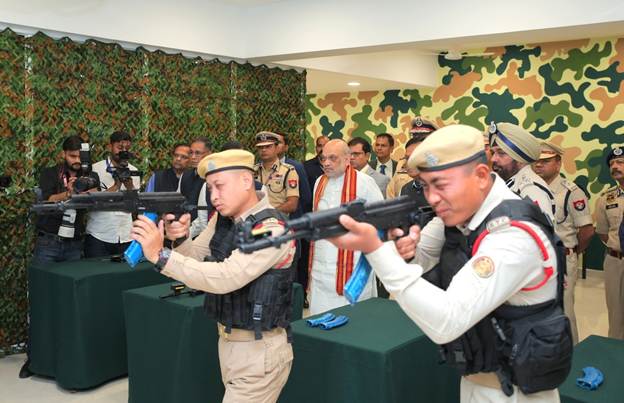
Union Minister for Home Affairs Amit Shah, today inaugurated the Lachit Barphukan Police Academy in Dergaon, Assam. (Image credit PIB)
As Assam enters elections, the Special Revision of electoral rolls exposes how demography, migration, and politics intersect
By NIRENDRA DEV
Guwahati, February 5, 2026 — Illegal Bangladeshi Muslim infiltration in Assam is far more complex than political slogans or television debates suggest. It is embedded in history, demography, labour economics, and electoral arithmetic—precisely why Assam remains the only state placed under a standalone Special Revision (SR) of electoral rolls.
The SR is distinct from the Special Intensive Revision (SIR) being conducted elsewhere. In Assam, Booth Level Officers are not collecting fresh enumeration forms linked to the 2003 database. Instead, they are cross-verifying existing entries against pre-filled registers while rationalising polling stations—reducing voters per booth from 1,500 to 1,200. House-to-house verification began on November 23, 2025, with January 1, 2026 as the qualifying date.
As Assam heads toward Assembly elections, analysts argue that the SR has already yielded visible results.
First, a significant number of allegedly ineligible names have been flagged, leading to objections against their inclusion in voter lists. Unlike earlier Congress regimes, when such objections were politically discouraged, the present exercise has created a deterrent effect against electoral legitimisation of suspected infiltrators.
Second, there is a growing realisation among sections of undocumented migrants that demographic manipulation through electoral enrolment is no longer effortless. This awareness itself alters behaviour—often more effectively than enforcement alone.
Third, those who allegedly shelter or facilitate such infiltration are beginning to confront the limits of long-term demographic engineering in Assam.
Infiltration, however, does not follow a single route. One under-examined pathway has been the movement of Bangladeshi Muslim women as low-wage domestic workers, often aided by informal religious or social networks. Over time, gradual assimilation blurs distinctions between legal residents, migrants, and infiltrators. Sociologists also note how personal law practices are sometimes exploited to accelerate demographic entrenchment.
The insider-outsider debate is not unique to Assam. Across the Northeast, identity markers are rigid. In Mizoram, outsiders are “Vai Naupang”; in Nagaland, “plain manu”; in Meghalaya, “Dkhars”. These labels rarely distinguish between Indian citizens and foreigners—revealing the region’s deeper anxiety about cultural survival.
Census data only sharpens this unease. Assam’s Muslim population rose to 34.22% in 2011, a jump of over four percentage points from 2001. District-level spikes in Darrang, Kamrup, Nalbari, and Barpeta raise uncomfortable questions—especially when similar growth is visible far from the international border.
Former Home Minister P. Chidambaram once acknowledged illegal immigration as a “major issue.” That admission, buried in political noise, captures Assam’s enduring paradox: statistics that explain little, and anxieties that refuse to fade.
(This is an opinion piece. Views expressed are author’s own.)
Follow The Raisina Hills on WhatsApp, Instagram, YouTube, Facebook, and LinkedIn




About The Author