


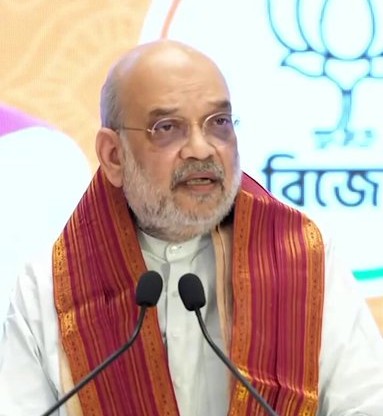
Home Minister Amit Shah visited Kolkata with a BJP chargesheet targeting 15 years of TMC “misgovernance,” a direct challenge to Mamata Banerjee on infiltration, Hindu majority politics, and a bold prophecy — BJP will govern Bihar, Bengal, and Odisha simultaneously.
By NIRENDRA DEV
KOLKATA, March 30, 2026 — Home Minister Amit Shah arrived in Kolkata with a mission statement, a chargesheet, and a prophecy. The mission: unseat Mamata Banerjee. The chargesheet: a formal catalogue of what BJP calls 15 years of TMC misgovernance — syndicate rule, corruption, political violence, appeasement, and administrative collapse. The prophecy: Bihar, Bengal, and Odisha under the same saffron government, simultaneously, for the first time.
The BJP had not issued a chargesheet against TMC in the 2021 assembly election. That it has done so now is, by itself, a signal of the party’s single-minded focus on 2026.
‘Anga, Banga, Kalinga’: The Three-State Vision
Shah did not come to Kolkata with a narrow electoral pitch. He came with a civilisational one. “After many years, Anga, Banga and Kalinga — that is Bihar, West Bengal and Odisha — will have governments of the same party,” Shah said.
With BJP already governing Bihar and Odisha, the claim frames Bengal not merely as an electoral contest but as the final piece of a regional political architecture. The message to West Bengal voters was clear: you will either be part of this alignment, or outside it.
The Chargesheet’s Core Purpose: Breaking the SIR Narrative
The TMC and sections of the Kolkata media had, by BJP’s own reading, successfully engineered a situation in which the Special Intensive Revision (SIR) of electoral rolls became the dominant issue of the pre-election season — effectively crowding out discussions of governance performance.
The chargesheet was BJP’s counter-move: a deliberate effort to return the conversation to what the party calls Mamata Banerjee’s “ku-sashan” — misgovernance — over 15 years. Syndicate raj, “tollabaj” (extortion networks), political violence, corruption, and the safety of women are the headline charges.
The strategy appears to have achieved its primary objective. The chargesheet is being discussed. The SIR controversy, while not forgotten, is no longer the only conversation.
On Infiltration: “We Will Remove Infiltrators”
The infiltration issue is where Shah was most explicit — and most combative. “Mamata Banerjee is trying to present the case of infiltrators from Bangladesh as the case of Bengali-speaking people — but none is buying these gimmicks and falsehood now,” Shah said.
“I want to make it clear on behalf of the BJP that we are resolved to identify and expel every single infiltrator from the country — not merely from the voter lists, but from across the entire nation. This is my party’s agenda,” he added.
Shah characterised West Bengal as India’s “principal corridor” for infiltration — a framing that positions the state not as a regional electoral contest but as a national security frontier. The Home Minister accused the TMC of deliberately conflating illegal immigrants with the Bengali-speaking community to generate sympathy and shield its vote bank.
BJP Bengal unit president Samik Bhattacharya reinforced the messaging in sharper language, declaring the season “jabar bela” — the time to go — for the Trinamool Congress, and attributing the party’s current aggression to the panic of incumbents who sense the ground shifting.
The Majority Community Signal
Shah’s language at the press conference contained a carefully layered message on community politics. He began with an inclusive formulation before narrowing it with precision: “Hum sab samuday ki logo ki chinta karenge — we will always be concerned about protecting the rights of people from all communities. Vishesh kar Bahumat samaj ki — especially, the majority community.”
“Kyon ki Trushti karan ke karan — because of appeasement, there has been a lot of injustice and discrimination against the majority community,” Shah added.
The formulation is deliberate. It allows BJP to present a universalist platform while signalling unmistakably to its Hindu base that their interests are the priority. Analysts note that religious polarisation is already a structural reality on the ground in West Bengal — and that TMC is simultaneously banking on its own core constituency, the Muslim vote.
The fear of a Muslim vote split — with AIMIM and two other smaller Muslim-based parties contesting the 2026 polls — has visibly unsettled the Trinamool leadership. A fragmented minority vote could, in a first-past-the-post system, prove decisive in a significant number of marginal seats.
The Wheelchair Line: Puncturing the Sympathy Vote
One of the most pointed moments of Shah’s appearance in Kolkata targeted something from the 2021 playbook directly. “At times, she gets her foot fractured; at other times, she has her head bandaged,” he added.
In 2021, images of Mamata Banerjee campaigning from a wheelchair after an injury generated significant public sympathy and became a defining visual of that campaign. Shah’s remark was a pre-emptive strike against any recurrence — signalling that the BJP intends to contest the sympathetic narrative aggressively this time.
Officer Transfers, Ram Navami, and the Murshidabad Violence
Shah defended the Election Commission’s transfer of IAS and IPS officers in West Bengal, arguing that many had functioned as de facto TMC operatives rather than neutral administrators.
“Across the country, the EC transfers officers ahead of polls. This is nothing new. But in West Bengal, most officers work for the government. That is why there have been more changes here. Because officers were changed, there was less violence during Ram Navami this year. But we do not want any form of violence,” he added.
The remarks came against the backdrop of violence in the Muslim-dominated Murshidabad district during Ram Navami celebrations. Shah also alleged that district magistrates in West Bengal had been unable to function without political fear, and hit back at Mamata Banerjee’s criticism of the SIR electoral roll revision — noting that West Bengal was the only state where the process had generated controversy of this magnitude.
At a Glance
| Factor | Detail |
| BJP chargesheet released | 2026 — first time; no chargesheet was issued in 2021 |
| Core charges against TMC | Misgovernance (ku-sashan), syndicate raj, tollabaj, corruption, political violence, women’s safety |
| Shah’s three-state prophecy | Anga (Bihar) + Banga (Bengal) + Kalinga (Odisha) = BJP govts simultaneously |
| Infiltration stance | West Bengal = India’s “principal corridor”; vows to remove all infiltrators nationally |
| Mamata’s counter-claim | Conflating infiltrators with Bengali-speaking community — rejected by Shah as “gimmick” |
| Community politics signal | Universal framing + explicit “majority community” priority |
| Muslim vote risk for TMC | AIMIM + 2 Muslim parties contesting; potential vote split causing TMC anxiety |
| “Jabar bela” quote | Samik Bhattacharya, BJP Bengal unit president |
| Wheelchair reference | Shah pre-empts 2021-style sympathy narrative |
| EC officer transfers | Defended as necessary; Shah credits transfers for reduced Ram Navami violence |
| Murshidabad violence | Violence in Muslim-dominated district during Ram Navami cited as context |
| SIR controversy | Bengal only state where electoral roll revision triggered major political dispute |
West Bengal is ₹7.35 lakh crore in debt. Mamata calls it welfare
Follow The Raisina Hills on WhatsApp, Instagram, YouTube, Facebook, and LinkedIn




