Airlines Pull Out as US War Signals Near Iran Rattle the World
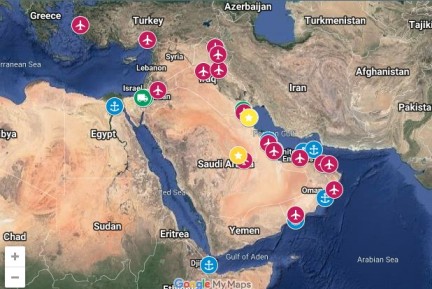
A representative image of flight positions in the Middle East (Image X.com)
From mass airline cancellations to unprecedented US force deployments, warning signals are flashing across the Middle East as tensions around Iran escalate.
By TRH World Desk
New Delhi, January 24, 2026 — Fears of a possible US strike on Iran have begun rippling through global aviation and security circles. Several major international airlines have abruptly cancelled flights to the Middle East amid rising military and geopolitical tension.
Israeli journalist Ariel Oseran wrote on X that airlines including Lufthansa, Air France, KLM and Swiss International Air Lines have cancelled Saturday flights to Israel, the UAE and Saudi Arabia. He added that United Airlines and Air Canada have also suspended services to Israel, citing mounting security concerns.
These developments coincided with growing intelligence chatter across the region. Former Swedish Prime Minister Carl Bildt noted on X that Turkey’s foreign minister sees signs indicating Israel may be preparing to strike Iran, a perception reinforced by the sudden wave of airline cancellations.
Military Signals Grow Louder
Adding to the unease, defence analyst Ian Ellis highlighted a dramatic US military posture in the region. Quoting the U.S. President, Ellis noted: “We’re watching Iran… We have a massive fleet heading in that direction.”
Ellis pointed out in his post on X that ahead of Operation Midnight Hammer in June 2025—the largest B-2 bomber strike ever conducted—the United States had positioned an even larger air and naval armada near Iran than what is currently visible. Comparative force-posture maps show dense concentrations of US carrier strike groups, guided-missile submarines and long-range strike aircraft across the EUCOM and CENTCOM theatres.
The operational blueprint of Midnight Hammer involved B-2 Spirit bombers, Tomahawk cruise missiles and extensive decoy and support packages—demonstrating the scale of capabilities Washington can rapidly marshal in the region.
Historically, commercial aviation reacts faster than diplomacy. The sudden suspension of flights is widely viewed as a leading indicator of serious escalation risk. Airlines, guided by intelligence advisories and insurance triggers, rarely ground routes without credible threat assessments.
While no official announcement of military action has been made, the convergence of airline shutdowns, public military signaling and regional intelligence warnings underscores a volatile moment. For markets, governments and ordinary travelers alike, the message is unmistakable: the Middle East is entering another phase of acute uncertainty, with Iran once again at the epicenter.
Consent Collapses: State Violence in Iran Tears Society Apart
Follow The Raisina Hills on WhatsApp, Instagram, YouTube, Facebook, and LinkedIn




About The Author