Afzal Guru’s Hanging: When India Chose Secrecy Over Closure
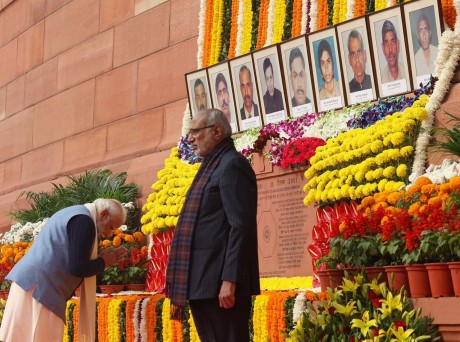
Prime Minister Narendra Modi pays homage to martyrs who sacrificed their lives when parliament was attacked. (Image Lok Sabha Press Team)
The Op-Ed revisits the 2001 Parliament terror attack, the 2013 execution of Afzal Guru under the UPA, and why the manner of the hanging still haunts India’s democracy and Kashmir’s conscience.
By NIRENDRA DEV
New Delhi, December 13, 2025 — FLASHBACK. On December 13, 2001, terrorists stormed the Indian Parliament, shaking the Republic at its core. The attack left security personnel dead and the nation outraged. Justice, the Supreme Court later ruled, demanded the ultimate penalty: “The collective conscience of society will only be satisfied if capital punishment is awarded.”
More than a decade later, in February 2013, that conscience was invoked again—this time amid deep political unease.
Afzal Guru was hanged in secrecy, during the tenure of Prime Minister Dr Manmohan Singh, with Sushil Kumar Shinde as Home Minister and Pranab Mukherjee as President. The execution came at a moment when the UPA government, often accused by critics of minority appeasement, was battling political vulnerability ahead of the 2014 general elections.
The speed, the silence, and the shadows surrounding the hanging turned a legal closure into a moral and political storm.
From Arrest to Gallows
Within days of the 2001 attack, Delhi Police arrested Professor SAR Geelani, later acquitted. Afzal Guru, his cousin Showkat Guru, and Afsan Guru were detained soon after. Headlines screamed guilt long before the courts spoke—“Varsity don guided fidayeen,” “Lecturer was terror hub.”
Afzal was sentenced to death in 2002 by a POTA court. The Delhi High Court upheld the verdict in 2003. The Supreme Court confirmed it in 2005. Yet the execution stalled for years—until February 2013, when his mercy petition was rejected and the noose tightened swiftly.
The Secrecy That Refused to Fade
Afzal Guru’s family in Kashmir said they were not informed of his imminent execution, a claim that drew sharp criticism from rights groups. His body was not returned for burial. The government later said a letter was sent by Speed Post—a justification that drew widespread condemnation.
The People’s Union of Civil Liberties (PUCL) called the execution politically motivated, arguing that established norms were flouted in “tearing hurry.” Kashmir’s then Chief Minister Omar Abdullah warned that the decision would echo across generations.
“You will have to prove that the death penalty is not used selectively,” he said, pointedly referring to other terror convicts whose sentences remained unresolved.
A Nation United—And Divided
In a rare moment, Congress, BJP, and the Left publicly backed the execution, calling it the culmination of due process. Television studios celebrated a “victory of democracy.” Sweets were distributed.
But writer Arundhati Roy, writing in The Guardian, called it “a stain on India’s democracy,” arguing that the real story lay beyond the courtroom—in Kashmir, one of the world’s most militarised regions and a perpetual fault line of the Indian state.
The Afterlife of Afzal Guru
The controversy did not end at the gallows. In 2016, student protests against the hanging erupted in Delhi, leading to the arrest of Kanhaiya Kumar—then a student leader, now a Congress politician. Afzal Guru’s name, far from disappearing, became a political and emotional symbol.
Justice or Optics?
The hanging of Afzal Guru closed a case—but opened a question India has yet to answer: can justice delivered in secrecy ever bring closure? Or does it merely trade legal finality for political convenience?
For Kashmir, Afzal Guru became less a convict and more a symbol. For Delhi, the execution was proof of resolve. Between the two lies an uncomfortable truth—that the Indian state, in 2013, chose decisiveness over dialogue, and secrecy over reconciliation.
(This is an opinion piece, and views expressed are those of the author only)
India and Japan Vow Fight Against Terrorism After Pahalgam Attack
Follow The Raisina Hills on WhatsApp, Instagram, YouTube, Facebook, and LinkedIn




About The Author