Africa Rising: India’s Partnerships Beyond Traditional Alliances
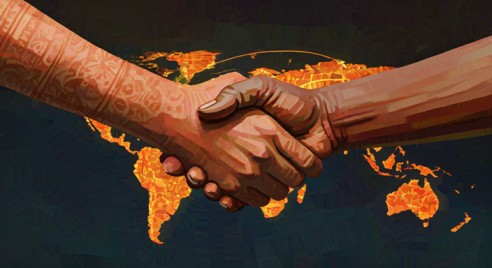
Africa Rising India's Strategic Partnerships (Image TRH)
The question is not whether India can beat China in Africa, but whether India can define a model of partnership that Africa itself prefers.
By TRH Foreign Affairs Desk
New Delhi, December 11, 2025 — Indian embassies in nations are enlisting social media influencers to onboard the India story. Ambassadors are holding meetings with influencers to encourage them to travel to India—to see Indian cities and partake India’s education ecosystem.
With an assertive Africa on the advent and an Indian hand in inviting the African Union to join the G20 when the summit was held in New Delhi, envoys are accelerating efforts to bring Africa closer to India. That is a sharp geostrategic play unfolding amid lens on China’s deep dollar entanglement of African nations.
Africa is no longer the “forgotten continent” of Indian foreign policy speeches—it is now a competitive, strategic, high-stakes theatre where India and China are openly testing influence, capacity, and political vision.
As Africa rises—with the African Union entering the G20, regional blocs reasserting autonomy, and major economies like Nigeria, Kenya, Ethiopia, and South Africa pushing new growth curves—New Delhi is recalibrating its engagement far beyond traditional development diplomacy.
In recent years, India has turned quiet consistency into visible strategic intent. Prime Minister Narendra Modi’s outreach—hosting the Voice of Global South Summit, expanding Defence Ministry exchanges with East African littoral states, and reopening diplomatic missions across Africa—has marked a deliberate transition from goodwill presence to geopolitical investment.
As External Affairs Minister S. Jaishankar said during his Nairobi visit: “India is Africa’s reliable and time-tested partner. Our development projects are not debt traps; they are demand-driven and locally owned.” This statement was a not-so-subtle contrast to China’s Belt and Road Initiative.
India’s Traditional Stakes: Soft Power With Hard Benefits
India enjoys a unique historic connection with Africa—one that predates contemporary geopolitics.
- Diaspora bridges in Kenya, Tanzania, South Africa, Mauritius, Zambia, and Uganda.
- Defence cooperation from naval patrols in the western Indian Ocean to training programmes for African militaries.
- Education networks through ITEC scholarships and Africa-focused centres in Indian universities.
- Pharmaceutical dominance, with Indian generic drug manufacturers supplying 50% of Africa’s medicines.
Unlike China’s resource-extraction-heavy model, India’s Africa engagement grew through people-centric partnerships—healthcare, capacity building, agriculture, and small business ecosystems.
The challenge now is whether that legacy can withstand Beijing’s aggressive economic statecraft.
China’s Expanding Footprint: Money, Metals, and Motorways
China’s approach in Africa is simple: scale, speed, and surplus financing. Through the BRI, Beijing has built:
- ports in Djibouti, Tanzania, and Cameroon,
- rail lines in Kenya, Nigeria, and Ethiopia,
- massive mining investments in the DRC, Zambia, and Guinea.
Chinese lending still dominates African infrastructure, despite renegotiations and rising debt distress.
New Delhi cannot match Beijing dollar-for-dollar. But it doesn’t need to.
Where India Gains an Edge
Three structural advantages give India strategic leverage over China in Africa:
Trust Capital
African leaders frequently praise India for “non-intrusive and respectful partnership”. During his Ethiopia visit this year, MoS External Affairs V. Muraleedharan noted: “India builds where Africa asks, not where India wants.” This is Africa’s sharpest critique of Beijing’s template.
Security in the Indian Ocean
With piracy resurgent near the Red Sea and Western navies overstretched, India’s role as a net security provider is accelerating. Joint patrols with Mozambique, food aid to Sudan and Somalia, and naval rescues have made New Delhi a stabilising force.
China, by contrast, operates from a single heavy military base in Djibouti—viewed with both suspicion and necessity.
Digital and Developmental Partnerships
India’s Pan-African e-Network, tele-medicine services, and UPI-linked digital infrastructure pilots in Mauritius and Kenya mark a new frontier where New Delhi holds natural competitive advantage. Beijing has hardware; India has interoperable digital public goods.
This is the space African leaders are most excited about.
The New Africa Policy: Beyond Non-Alignment
India’s engagements today are no longer framed as counter-China moves but as co-authored development journeys. The third India–Africa Forum Summit and rising ministerial visits underline that Africa is not peripheral—it is central to India’s ambitions as a leading power.
But the rivalry is real. China’s cheque book is deeper; India’s goodwill is stronger. China builds roads; India builds capacities. China extracts minerals; India grows markets.
Africa is choosing—but not between India and China. It is choosing partners who respect sovereignty, supply modern tools, and stay when the cameras leave.
What India Must Do Next
To consolidate gains, New Delhi must:
- Host IAFS-IV without further delay.
- Expand development financing in partnership with Japan, the UAE, and the EU.
- Secure critical mineral agreements in the DRC, Namibia, and Rwanda.
- Increase naval presence and training across the Western Indian Ocean.
- Build India–Africa digital corridors with UPI, Aadhaar-enabled tech, and tele-education networks.
Africa is rising—and choosing partners who treat it as an equal stakeholder.
Script Africa Model
New Delhi’s Africa moment is here. The question is not whether India can beat China in Africa, but whether India can define a model of partnership that Africa itself prefers. The early signs—from Nairobi to Addis Ababa to Maputo—suggest it can.
India’s Africa story is shifting from quiet diplomacy to strategic leadership. In a multipolar world, this may be New Delhi’s most underrated advantage.
Follow The Raisina Hills on WhatsApp, Instagram, YouTube, Facebook, and LinkedIn




About The Author