Afghanistan–Pakistan Conflict Deepens After Pakistani Airstrikes
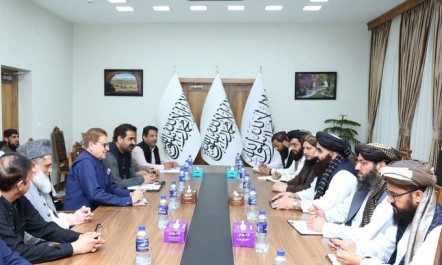
Afghan FM Meets Pakistan’s Special Envoy Amid Bilateral Concerns (Image credit X.com)
Afghanistan Pakistan conflict risks wider war as Taliban accuse Islamabad of killing civilians in cross-border strikes
By TRH Op-Ed Desk
New Delhi, February 23, 2026 — Tensions along the Afghanistan–Pakistan frontier is once again flaring after the Taliban administration claimed that Pakistani Air Force jets carried out airstrikes inside Afghan territory, allegedly killing dozens of civilians.
Islamabad has historically justified such operations as counterterror strikes against the Tehrik-i-Taliban Pakistan (TTP), which it accuses of launching attacks from Afghan soil. Kabul, however, denies harbouring anti-Pakistan militants and insists that villages — not militant camps — are being targeted.
“This is a pattern we have seen before,” said Manish Anand, Editor of The Raisina Hills. “Pakistan frames these strikes as counterterrorism. The Taliban frame them as sovereignty violations. The truth becomes secondary to escalation.”
A Dangerous Replay of 2025
Last year witnessed months of cross-border artillery fire and retaliatory operations. Military outposts were hit. Casualties mounted. Diplomatic channels froze.
“The current trajectory mirrors the early stages of last year’s escalation,” Anand observed. “What begins as a ‘limited strike’ can quickly spiral into sustained confrontation.”
At the heart of the friction lies the disputed Durand Line, a boundary Afghanistan’s Taliban rulers do not formally recognize as an international border.
“As long as the Durand Line remains politically contested, every tactical strike carries strategic consequences,” Anand noted.
Asim Munir’s Strategic Gamble
Pakistan’s military leadership under Army Chief Asim Munir argues that TTP militants operate with impunity across the border.
However, Anand cautioned that escalation carries risks beyond counterterror objectives. “General Asim Munir may calculate that limited force projects strength domestically,” he said. “But miscalculation against a battle-hardened Taliban regime could produce blowback inside Khyber Pakhtunkhwa.”
Pakistan is simultaneously navigating economic fragility and political unrest linked to former Prime Minister Imran Khan. “When domestic pressure rises, external confrontation sometimes becomes politically convenient,” Anand added. “But convenience is not strategy.”
Taliban’s Post-Withdrawal Capability
Unlike in the early 2000s, the Taliban now control substantial US-origin military equipment left behind after the American withdrawal in 2021. “The Taliban are no longer an insurgent force hiding in mountains,” Anand said. “They are a regime with battlefield experience and access to modern equipment. Pakistan cannot assume asymmetry in its favour.”
Former US envoy Zalmay Khalilzad has already expressed concern that repeated airstrikes risk widening the conflict.
Global Powers Watching Closely
The Afghanistan Pakistan conflict carries broader geopolitical implications. “Washington, Beijing and New Delhi are all watching,” Anand said.
Under Donald Trump, the United States has recalibrated its regional posture. China remains deeply invested in Pakistan’s stability. India views prolonged instability as a regional security threat.
“If escalation continues, this will not remain a bilateral issue,” Anand warned. “It becomes a regional security crisis with global actors forced into diplomatic positioning.”
The Larger Question
The immediate trigger may be alleged airstrikes. The deeper drivers include border disputes, militant safe-haven accusations, internal political pressures and unresolved historical grievances.
“The Afghanistan–Pakistan border is a geopolitical fault line,” Anand concluded. “If cross-border strikes become normalized, the frontier risks turning into a permanent war zone. And history tells us — wars in Afghanistan rarely remain contained.”
Deadly Border Clashes Erupt Between Pakistan and Afghanistan
Follow The Raisina Hills on WhatsApp, Instagram, YouTube, Facebook, and LinkedIn




About The Author