Parliament as a Narrative Battlefield: Politics vs Accountability
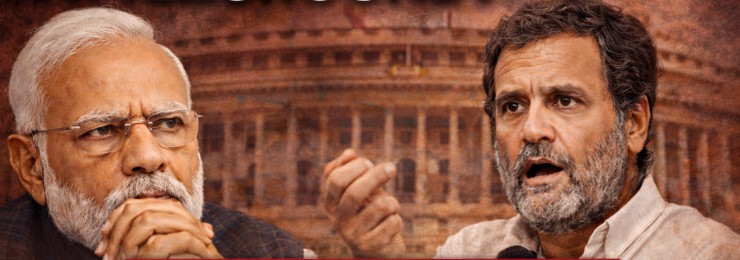
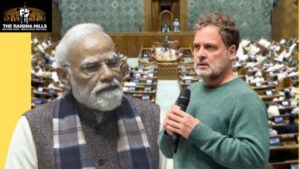
A creative representation of ongoing slugfest in India's parliament. (Image TRH)
As disruptions continue in Parliament, Manish Anand argues that India’s democracy risks losing substance to narrative warfare
By TRH News Desk
New Delhi, February 10, 2026 — India’s Parliament, once envisioned as the nation’s primary forum for deliberation and accountability, is increasingly resembling what political commentator Manish Anand describes as a “narrative battlefield”—a space where competing political stories overpower substantive debate.
Speaking on a special episode of The Raisina Hills, Anand reflects on the ongoing parliamentary logjam, opposition protests, and the controversy triggered by a letter written by Congress women MPs to Lok Sabha Speaker Om Birla. The letter sought clarification and redress over reports suggesting that Prime Minister Narendra Modi had been advised to avoid the House due to alleged security concerns linked to opposition women MPs.
“If such a perception was conveyed or reported,” Anand notes, “it raises unprecedented questions—both about parliamentary convention and about the reputational implications for elected representatives.”
He stresses that seeking clarification is a democratic right, particularly when public narratives risk damaging individual credibility without substantiated evidence.
Parliamentary Democracy and the Cost of Narrative Politics
According to Anand, Parliament today is no longer merely dysfunctional—it is ideologically polarised to the point where narrative dominance matters more than governance outcomes.
“When ruling parties and opposition alike treat Parliament as a messaging arena rather than a problem-solving institution,” he argues, “it is citizens who ultimately lose.”
Anand cautions against political actors internalising their own narratives as absolute truths. Narratives, he says, are tools of persuasion—not substitutes for facts.
“When politicians begin to believe their own political messaging unquestioningly, their connection with ground reality weakens—and that distance from truth eventually becomes distance from the people.”
Silencing Debate Weakens Institutions
The Raisina Hills commentator raises concern over repeated instances where opposition leaders are allegedly prevented from speaking or interrupted during proceedings. “In a parliamentary democracy, convention is clear,” Anand notes. “The government gets its way—but the opposition must get its voice.”
He argues that denying space to opposition speech, rather than rebutting it politically or factually, undermines democratic legitimacy and raises uncomfortable questions about how Parliament is being conducted.
Narratives vs Lived Realities
Anand also highlights the widening gap between official narratives and public experience, particularly on issues such as public health, air pollution, rising medical expenses, and out-of-pocket healthcare costs.
“Announcing schemes creates reassurance,” he says, “but believing that announcements alone resolve systemic problems is dangerous,” Anand warned.
He clarifies that welfare programmes are important—but they cannot replace structural reform if underlying conditions continue to worsen.
Questions Don’t Disappear When Parliament Falls Silent
Referring to controversy around excerpts attributed to an unpublished book by former Army Chief General Manoj Mukunda Naravane, Anand points out that suppressing discussion inside Parliament does not erase public curiosity outside it.
“If questions are not heard in Parliament,” he observes, “they travel to the streets, to social media, to public consciousness,” he added.
Even unpublished or withdrawn material, he adds cautiously, often continues to circulate informally—making transparency and open debate more effective than enforced silence.
Democracy’s Real Test
Anand concludes with a warning: democracy is not tested by how efficiently power is exercised, but by how confidently dissent is accommodated.
“Mandates are given to both sides,” he says. “One to govern. The other to question. If either role is weakened, democracy itself is diminished,” Anand stressed.
(This is an opinion piece. Views expressed in the article belong to Manish Anand.)
Epstein Files Raise Questions for India: Why Clarification Matters
Follow The Raisina Hills on WhatsApp, Instagram, YouTube, Facebook, and LinkedIn




About The Author