Why Europe Is Turning to India: Republic Day Diplomacy
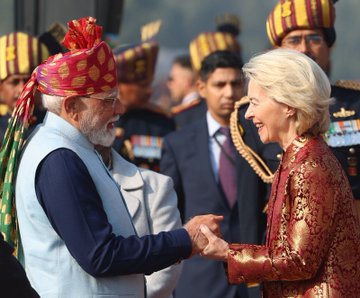
Prime Minister Narendra Modi with EU Commission President Ursula von der Leyen on R Day (Image Modi on X)
As the old rules of global diplomacy collapse under Trump-era shocks, India–EU ties signal a strategic realignment driven by trade diversification, security anxieties, and democratic convergence
By TRH World Desk
New Delhi, January 26, 2026 — India’s 77th Republic Day was not just ceremonial pageantry; it quietly reflected a deeper geopolitical shift. The presence of the European Commission President, the European Council leadership, and a large EU delegation was a signal moment in an era when global diplomacy is undergoing what even Western leaders describe as an “implosion.”
The old certainties of international order—anchored in American predictability—are fading. “In this moment of flux, Europe’s collective arrival in New Delhi matters. It coincides with India and the European Union nearing the conclusion of a long-stalled free trade agreement, negotiations that resumed seriously only after 2012 and are now close to signature,” said Manish Anand, senior geopolitics analyst in his monologue for the YouTube channel of The Raisina Hills.
For India, this agreement is strategic insulation. Coming amid renewed tariff shocks and trade unpredictability associated with a second Trump presidency, New Delhi is consciously diversifying its trade basket. “After agreements with the UK and New Zealand, an EU deal—covering a bloc worth roughly $35–37 trillion—offers India scale, stability, and market access unmatched by any single country except the US,” added Anand.
Europe’s motivations are equally compelling. First, India and the EU share a foundational similarity: democracy. “In a fractured world, two large democratic systems with policy continuity offer each other predictability. Second, Europe is increasingly uneasy about overdependence—on American security guarantees and on Chinese markets,” stressed Anand.
Washington’s inward turn and Beijing’s asymmetrical market access have sharpened European anxieties, he added.
India emerges here as a natural partner. “Defence cooperation with France, Germany, and Italy is already deepening, with joint ventures, production units, and strategic projects underway. As Europe reassesses its security architecture, India’s growing defence manufacturing capacity becomes strategically relevant,” said Anand.
China, too, looms large in Europe’s calculations. “European firms complain of restricted access to Chinese markets even as Chinese exports flood Europe,” added Anand. In India, Europe sees a competitive counterweight—large enough to matter, open enough to engage.
Demography completes the equation. “Europe faces ageing populations and skilled manpower shortages, while India’s median age of 27 offers a demographic dividend,” said Anand. Germany’s annual commitment of 90,000 work visas for Indians is not charity; it is strategic necessity.
Together, capital, technology, skills, and democratic norms make the India–EU partnership one of the most consequential geopolitical developments of this decade. Republic Day diplomacy merely made visible what is already underway: a quiet reordering of global power.
(Manish Anand hosts discussions on geopolitics for the YouTube channel of The Raisina Hills.)
Pakistani Analyst Reads Germany Signaling India Pivot for Europe
Follow The Raisina Hills on WhatsApp, Instagram, YouTube, Facebook, and LinkedIn




About The Author