Modi–Merz Moment: India–Germany Ties Signal a Strategic Reset
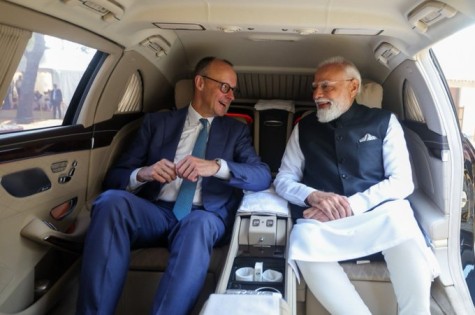
PM Modi hosts Chancellor Friedrich Merz (Image Modi on X)
India–Germany Strategic Partnership deepens as PM Modi hosts Chancellor Friedrich Merz, blending defence, technology, green energy and geopolitics
By TRH Foreign Affairs Desk
New Delhi, January 12, 2026 — When German Chancellor Friedrich Merz chose India for his first official visit to Asia, the signal was unmistakable: Berlin now sees New Delhi not merely as a market, but as a strategic pillar of the Indo-Pacific order. The optics mattered—from Sabarmati Ashram to the Kite Festival in Ahmedabad—but the substance was sharper, deeper, and unapologetically geopolitical.
The India–Germany Strategic Partnership, now 25 years old, has entered a phase where symbolism is being replaced by structure. Defence cooperation, once cautious, is now openly ambitious. Joint exercises, reciprocal logistics support, naval collaboration in the Indian Ocean, Germany’s participation in MILAN and TARANG SHAKTI, and coordination through the Information Fusion Centre–IOR indicate that Berlin is aligning more closely with India’s maritime security vision.
This is not accidental. Europe’s strategic innocence has ended. The Ukraine war, supply-chain shocks, and uncertainty around US leadership have pushed Germany to diversify its security and economic bets. India fits that recalibration—democratic, militarily credible, economically ascendant, and geographically central to global sea lanes.
Equally consequential is the defence industrial roadmap, which opens the door to co-development and co-production. Germany brings advanced technology and capital; India offers scale, skilled manpower, and cost competitiveness. This is not buyer–seller diplomacy—it is partnership by design.
On terrorism, the joint condemnation of attacks in Pahalgam and Delhi and alignment at the UN 1267 sanctions framework reinforce India’s long-held position on cross-border terror. Germany’s unequivocal language matters at a time when global attention often drifts from accountability to ambiguity.
Economically, the visit underscored a quiet truth: India–Germany trade crossing USD 50 billion is not the ceiling but the floor. With strong backing for the India–EU Free Trade Agreement, cooperation in semiconductors, AI, critical minerals, green hydrogen and battery storage positions the partnership at the heart of future industries, not legacy ones.
Climate cooperation under the Green and Sustainable Development Partnership—with nearly €5 billion already deployed—shows how strategic interests and climate responsibility can coexist without moral lectures or performative diplomacy.
Perhaps most telling is Germany’s embrace of India in shaping the Indo-Pacific, supporting IMEC, UN Security Council reforms, and rules-based order. This is Europe stepping out of the Atlantic shadow and acknowledging India as a co-architect, not a junior partner.
The Modi–Merz engagement marks a transition: from transactional engagement to strategic convergence. In a fractured world, India and Germany are quietly betting on each other—and that may be one of 2026’s most consequential geopolitical moves.
Follow The Raisina Hills on WhatsApp, Instagram, YouTube, Facebook, and LinkedIn




About The Author