India–China Relations in 2025: Why Reset Stopped Short of Peace
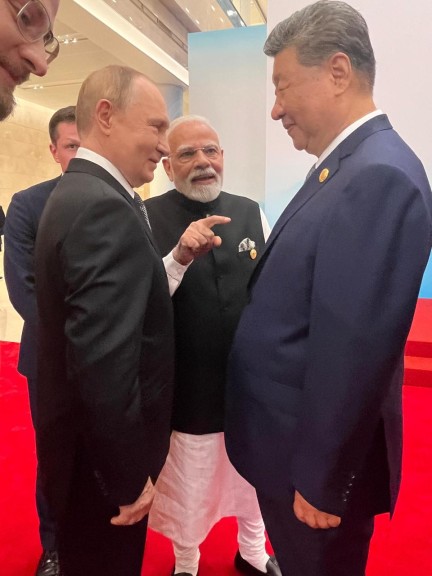
Prime Minister Narendra Modi with Chinese and Russian President Xi Jinping and Vladimir Putin at SCO Summit! (Image PMO)
Marking 75 years of diplomatic ties, India and China eased tensions through calibrated engagement—but unresolved border disputes and trade imbalances kept reconciliation out of reach
By NIRENDRA DEV
New Delhi, December 31, 2025 — The year 2025, which marked the 75th anniversary of diplomatic relations between India and China, did not deliver a grand reset. Instead, it offered something more limited but politically necessary: breathing room.
India–China relations in 2025 reflected a familiar duality—normal diplomatic engagement running parallel to latent confrontation. This coexistence is not accidental. It is rooted in history, geography, and the structural rivalry between two rising powers forced to share a contested border and an increasingly crowded Asian strategic space.
Throughout the year, both sides attempted to shift the tone—from outright hostility to calibrated engagement—recognising that coexistence, however uneasy, was unavoidable. The resumption of dialogue, commemorative events, and selective confidence-building measures underlined this pragmatic impulse.
At the multilateral level, the Russia–India–China (RIC) format showed modest revival. Prime Minister Narendra Modi and President Xi Jinping’s interactions alongside Russian President Vladimir Putin underscored a limited convergence—less a partnership of purpose than a shared resistance to a US-dominated global order. Beyond that opposition, strategic unity remained thin.
Crucially, Beijing moved slowly on troop de-escalation along the Line of Actual Control (LAC). While late 2024 agreements enabled disengagement at specific friction points such as Depsang and Demchok, multiple standoff locations persisted through 2025, remaining dormant flashpoints capable of undoing diplomatic gains overnight.
The Modi–Xi meeting on the sidelines of the SCO Summit in August reflected this cautious optimism. Both leaders acknowledged positive momentum, reiterated developmental priorities, and endorsed mechanisms such as the Working Mechanism for Consultation and Coordination (WMCC) to manage border tensions.
Economic engagement also saw partial normalization. Efforts to reduce the trade deficit, reopen border trade passes—Lipulekh, Shipki La, and Nathu La—and resume direct flights improved commercial flows and people-to-people contact. Plans to restart the Kailash Mansarovar Yatra and revive high-level cultural exchanges in 2026 further suggested tactical thaw.
For Indian businesses, the reset offered tangible benefits. Electronics, renewable energy, electric vehicles, and pharmaceuticals saw eased supply-chain pressures. Yet analysts rightly described this as a calculated re-entry, not a return to pre-2020 dependence. Trade volumes grew, but imbalances deepened—tempering optimism.
New Delhi’s strategic establishment remained clear-eyed. Economic interdependence could not override strategic vulnerability. The boundary dispute remained the core constraint, shaping every other dimension of engagement.
China’s broader diplomatic posture in 2025 reinforced this caution. As global instability grew—amplified by Donald Trump’s America-first policies—Beijing prioritised neighbourhood diplomacy, positioning itself as a stabiliser, from Southeast Asian border mediation to economic outreach.
For India, the lesson of 2025 was unmistakable: normalization is not reconciliation. Tactical adjustments may manage risk, but trust remains absent. The true measure of the India–China reset lies not in rhetoric, but in outcomes—and those, for now, remain incomplete.
(This is an opinion piece. Views are personal)
Follow The Raisina Hills on WhatsApp, Instagram, YouTube, Facebook, and LinkedIn




About The Author