$5 Trillion on the Line: Why the AI Race Is Turning Brutal
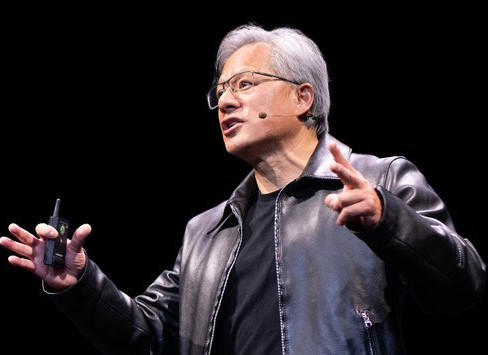
Nvidia CEO Jensen Huang. (Image credit X Nvidia)
From ChatGPT’s Gunshot Moment to a Full-Blown AI Death Match, the Party Is Ending
By S JHA
Mumbai, February 3, 2026— Djoomart Otorbaev, former Prime Minister of the Kyrgyz Republic, warns that the $5 trillion AI race is now turning violent.
“The AI race did not begin with a handshake, a white paper, or a government summit. It began with a gunshot,” claims Otorbaev in a LinkedIn post.
He stated that “OpenAI released ChatGPT to the public on November 30, 2022—and fired the opening round of what has now become the most expensive technological arms race in human history.”
“By 2026, artificial intelligence is no longer a productivity story or a Silicon Valley curiosity. It is a Darwinian death match. The entry ticket is measured not in millions, but in hundreds of billions of dollars,” he grimly noted. And the markets, he adds, drunk on AI euphoria, are only now beginning to feel the hangover.
“OpenAI was once the unquestioned king of large language models. That era is over. Google has re-entered the arena with force, and its Gemini 3 moment is not incremental—it is structural,” added Otorbaev. He stated that “scoring 37.2 per cent on Humanity’s Last Exam compared to GPT-5.1’s 26.5 per cent is not a rounding error. It is a regime shift.”
Meanwhile, OpenAI’s financial trajectory is increasingly unforgiving. “With annual recurring revenue near $20 billion and reported ambitions of a trillion dollars in cumulative spend over eight years, the arithmetic stops being visionary and starts becoming lethal,” warned Otorbaev.
Then there is Palantir Technologies—the perfect emblem of this cycle. “Revenues have roughly doubled since 2022, while the stock has surged about 2,500 per cent. Trading at over 20 times projected 2030 revenue is no longer growth investing. It is narrative investing,” added Otorbaev.
Palantir may not break the system, he states, but it reveals a market that has lost the ability to distinguish operational reality from stock-market fantasy.
“Nvidia, for now, remains the house that always wins. At over $5 trillion in valuation, it is the most expensive company on Earth,” added Otorbaev. Yet even this fortress, he states, shows cracks.
“Google’s Ironwood TPUs are competing directly with Nvidia’s B200s. The real moat is no longer silicon—it is CUDA. Software lock-in, not hardware, is what keeps margins in the stratosphere,” added Otorbaev.
By the second half of 2026, as AMD and hyperscaler-designed silicon offer smoother migration paths, Nvidia will face a brutal choice: cut prices or surrender ground, he warned. “Beneath all this lies a quieter but more dangerous issue—accounting. Microsoft, Amazon, Meta, and Alphabet are amortizing GPUs over six years,” added Otorbaev.
In an industry where effective compute doubles every 18 months, he adds, a six-year-old accelerator is close to scrap metal. “The buy everything AI strategy is dead. 2026 demands a scalpel, not a sledgehammer,” asserted Otorbaev.
Alphabet now stands out as a value play after reclaiming technical leadership, he states further. “Nebius offers a more aggressive bet, grounded in the real lifecycle of AI hardware rather than financial optics. And xAI remains the wildcard—Grok 4 is closing the gap fast, and for those with private-market access, asymmetry still exists,” added Otorbaev.
The bubble will not pop, he said, adding: “It will migrate. Capital will flee vaporware and stories and concentrate around real models, real silicon, and real economics.”
“The only remaining question is brutally simple: Are you holding the bag—or are you holding the future,” asked Otorbaev.
A Three Mile Island Moment for AI? Stark Warning to the World
Follow The Raisina Hills on WhatsApp, Instagram, YouTube, Facebook, and LinkedIn




About The Author